
Zero-emission zones (ZE zones): a guide for businesses
Direct answer
A zero-emission zone is an area, usually a city centre, where in time only zero-emission vans and trucks may transport goods. Since 1 January 2025, Dutch municipalities have been introducing these zones for urban logistics; the start date differs per municipality. Transition rules give existing vehicles a few more years of access based on their emission class, until 1 January 2030 at the latest.
- Clear definition
- Data-driven assessment
- Risks and opportunities visible
- Practical next steps
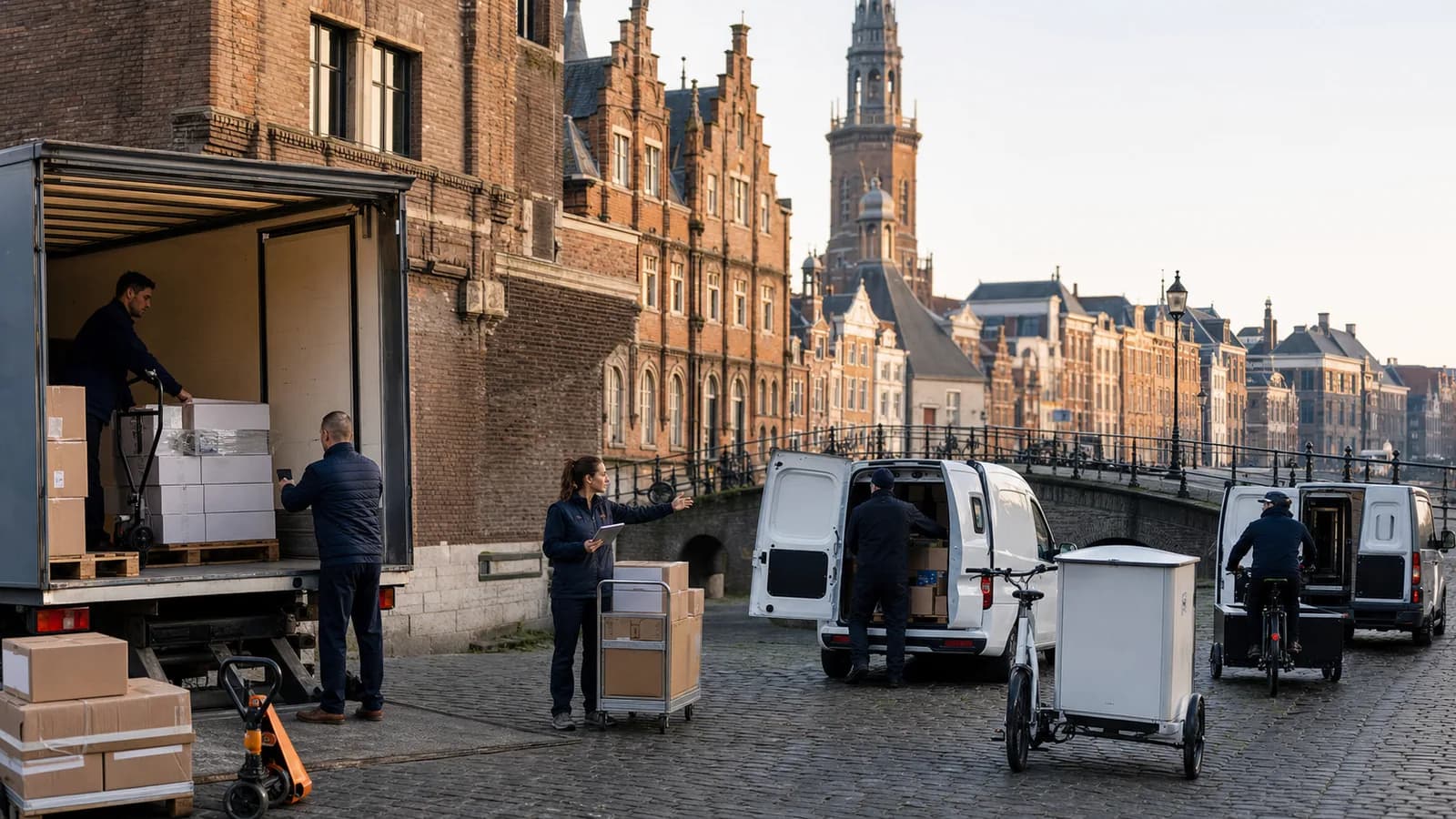
Zero-emission zones (ZE zones): scattered information versus Energy Intelligence
Dutch city centres want cleaner air and less exhaust from the delivery and construction traffic that drives through them every day. That is why municipalities have been introducing zero-emission zones for urban logistics since 1 January 2025. Think of the courier delivering parcels in the centre every morning, or the installer driving a diesel van to a job downtown: for them, these zones determine which vehicle may still enter in the coming years. This affects carriers, construction firms, installers and shops with their own delivery service.
- The first municipalities started on 1 January 2025; around twenty municipalities and Schiphol now have a zone and more have decided to introduce one, each with its own start date.
- The rules only apply to vans and trucks, including those running on petrol or gas; passenger cars, taxis and buses may enter the zones freely.
- Transition arrangements per emission class run until 1 January 2030 at the latest; businesses that cannot switch in time can apply for an exemption via the official RDW desk.
Insight
Traditional approach
Information is scattered across portals, documents, invoices or separate spreadsheets.
Modern approach
Data, context and interpretation are brought together into a clear decision picture.
Decision-making
Traditional approach
Choices are made based on averages, assumptions or occasional analyses.
Modern approach
Scenarios, KPIs and current measurement data make the trade-off more concrete and repeatable.
Follow-up
Traditional approach
Actions often stay non-committal or disappear into separate reports.
Modern approach
Follow-up actions, monitoring and reporting are linked to the same energy data.
How does a zero-emission zone work?
A municipality designates the zone, usually the centre and surrounding districts, and marks the boundaries with road signs. Inside the zone, access rules apply to vans and trucks, so to urban logistics such as parcel delivery, construction traffic and the supply of shops and hospitality venues. Passenger cars, taxis and buses are not covered. The rules do apply to vehicles running on petrol or gas and to private individuals who own a van or truck. New vans and trucks first registered from 1 January 2025 must be zero-emission to enter: battery-electric or hydrogen-electric. Each municipality sets its own start date and exact boundaries, but the national access rules are the same everywhere.
- Applies to vans and trucks; passenger cars, taxis and buses are exempt.
- Around twenty municipalities and Schiphol currently have a zone, including Amsterdam, Rotterdam, The Hague and Utrecht.
- New vans and trucks first registered from 1 January 2025 must be zero-emission.
- Boundaries and start dates differ per municipality; the access rules are set nationally.
Which transition rules apply?
The transition rules look at your vehicle's emission class and first registration date. Vans with emission class 4 or lower have no access. Emission class 5 may enter the zones until 1 January 2027. For emission class 6, the current arrangement runs until 1 January 2028; the Dutch government has announced its intention to extend that period to 1 January 2029. For trucks, the end date depends on the type and registration date: Euro 6 rigid trucks and tractor units keep access until 1 January 2028 or 1 January 2030. By 1 January 2030 at the latest, all transition arrangements end and every van and truck inside a zone must be zero-emission. The licence plate check on opwegnaarzes.nl shows exactly how long your vehicle keeps access.
- Van with emission class 5: access until 1 January 2027.
- Van with emission class 6: access until 1 January 2028, with an announced extension to 1 January 2029.
- Truck with a Euro 6 engine: access until 1 January 2028 or 2030, depending on type and registration date.
- By 1 January 2030 at the latest, everything inside the zone must be zero-emission.
What can you do now?
First map which routes and customers lie inside a zero-emission zone. The overview on opwegnaarzes.nl shows the zone and start date per municipality; not every business is affected. Then run the licence plate check for every vehicle in your fleet, so you know per vehicle how long it may still enter the zones. Plan replacements around those end dates: delivery times for electric vehicles and arranging charging infrastructure take lead time. If switching is not yet possible, for example because no zero-emission alternative exists for your vehicle type, you can apply for an exemption. There are national exemptions, including one based on a hardship clause, and exemptions that apply per municipality. Applications run through the official desk of the RDW, the Netherlands Vehicle Authority.
- Check on opwegnaarzes.nl which municipalities on your routes have a zone and from when.
- Run the licence plate check per vehicle and plan your fleet replacement around those end dates.
- Allow lead time for electric vehicles and charging infrastructure.
- Apply for an exemption where needed via the official RDW desk; sites charging fees for this are not official.
Curious what this looks like with your own data?
In a no-obligation call, a specialist looks at your meters, sites and energy questions with you. Response within one business day.
Search the knowledge base
Find the answer to your question.
Search using your own words. Abbreviations and spelling variants are recognised, so EMS also finds the articles on energy management systems.
Topic