
Load balancing for charging points: a guide for businesses
Direct answer
Load balancing for charging stations is the automatic distribution of the available capacity of an electricity connection across multiple charging points. A charging management system matches the charging to what the connection can handle and to the other consumption in the building. This lets more cars charge at the same time on the same connection, without overloading the main fuse or requiring a heavier connection.
- Clear definition
- Data-driven assessment
- Risks and opportunities visible
- Practical next steps
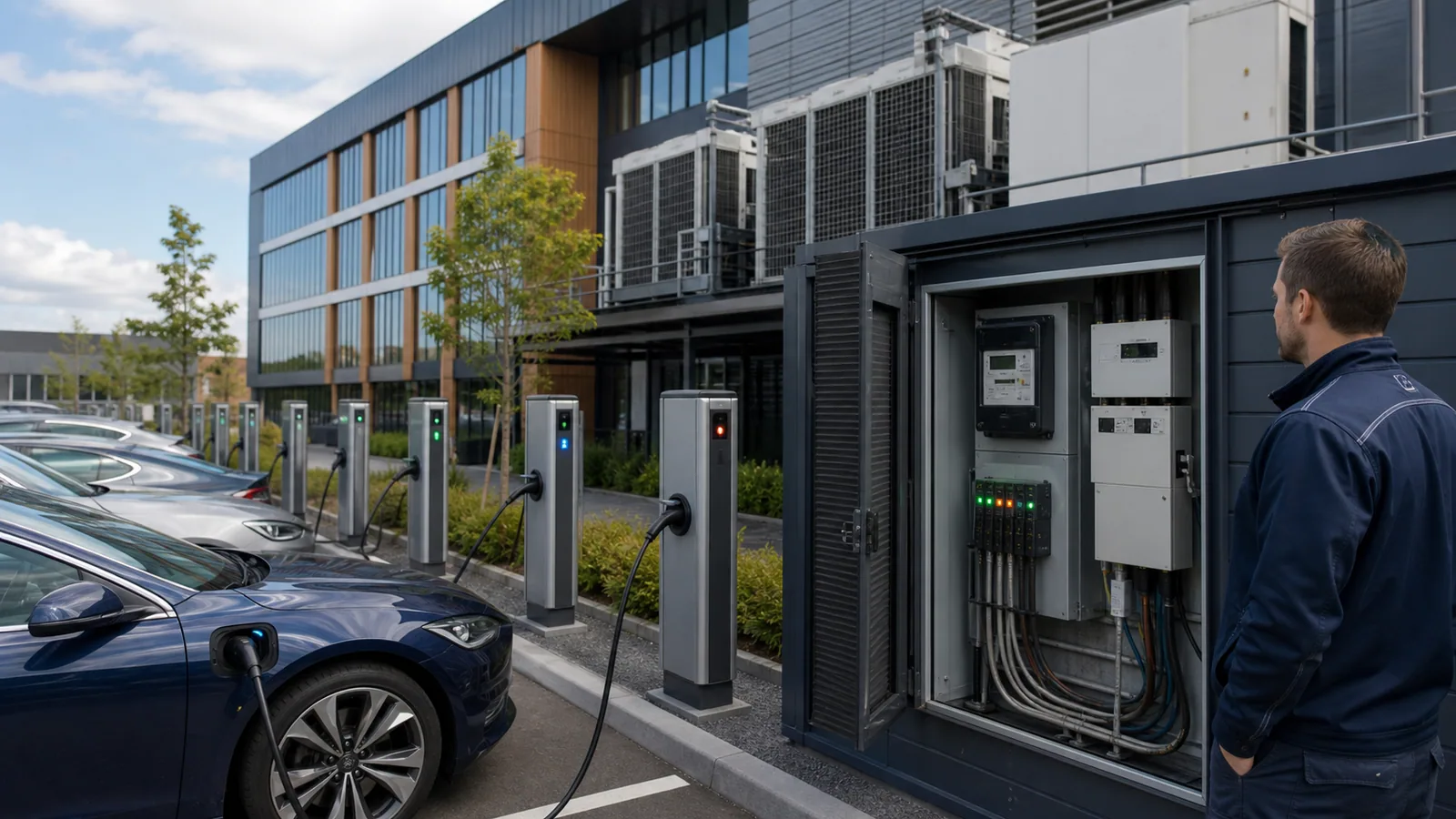
Load balancing for charging points: scattered information versus Energy Intelligence
More and more businesses install charging stations for staff, visitors or their own fleet. The recognisable moment is late afternoon: everyone plugs in while the kitchen, the climate system and the machines are still running. Four or five cars charging at full power at the same time push many connections to their limit. Requesting a heavier connection takes time and, in areas with grid congestion, is sometimes unavailable for years. That is why smart control of charging points is the practical route for many organisations.
- Static load balancing gives the charging points a fixed power ceiling; dynamic load balancing follows the building's actual consumption in real time via a meter.
- With load balancing you can often install more charging points on the existing connection, without immediately requesting an upgrade from the grid operator.
- The system protects the main fuse: if total demand threatens to become too high, the cars temporarily charge more slowly.
Insight
Traditional approach
Information is scattered across portals, documents, invoices or separate spreadsheets.
Modern approach
Data, context and interpretation are brought together into a clear decision picture.
Decision-making
Traditional approach
Choices are made based on averages, assumptions or occasional analyses.
Modern approach
Scenarios, KPIs and current measurement data make the trade-off more concrete and repeatable.
Follow-up
Traditional approach
Actions often stay non-committal or disappear into separate reports.
Modern approach
Follow-up actions, monitoring and reporting are linked to the same energy data.
How does load balancing work?
A charging management system monitors how much power is available and distributes it across the charging points in use at that moment. There are two variants. With static load balancing, the group of charging points gets a fixed ceiling, a share of the connection capacity that is always reserved for charging. That ceiling does not change, even when the building consumes little. With dynamic load balancing, a meter in the main distribution board continuously measures the building's actual consumption. The system passes the remaining headroom to the charging points. In the evening or at the weekend cars then charge faster, during a consumption peak in the building more slowly. Charging points and management system communicate with each other for this, often via the open protocol OCPP.
- Static: a fixed power ceiling for the charging points, simple and predictable.
- Dynamic: building consumption is measured in real time and the remaining headroom goes to the charging points.
- The system distributes the available power across the cars charging at that moment.
- Communication runs through a charging management system, often using the open protocol OCPP.
Why is load balancing needed?
A common charging point can demand 11 or 22 kilowatts at full power. When several cars charge at once, total demand quickly exceeds the capacity of the connection and the main fuse can trip. Without control, two options remain: install fewer charging points or request a heavier connection. That upgrade takes time and, in congestion areas in the Netherlands, is sometimes unavailable for a long period. Load balancing offers a third way: more charging points on the existing connection, with the certainty that total demand stays within the limit. It also relieves the electricity grid, because the charging peak is not stacked on top of the building peak. Cars are usually parked for hours anyway, so charging slightly slower is rarely a problem.
- More charging points on the existing connection, without immediately needing an upgrade.
- The main fuse stays protected, even when all cars plug in at the same time.
- The charging peak does not coincide with the building peak; that helps on a congested grid.
- Cars are parked for hours; spreading the charging rarely costs driving range in practice.
What should you pay attention to?
Dynamic load balancing stands or falls with accurate measurement. The meter must be placed where it sees the actual consumption of the entire building; a wrongly placed meter gives the system a distorted picture. Also agree on priority rules: which vehicles come first when headroom is scarce, for example company cars that need to leave again soon. Check as well whether charging points and management system can work together; not every brand supports every integration. Finally, know the limits. Load balancing distributes the capacity that exists, but does not make the connection larger. If the building's base consumption is already close to the connection capacity, little charging headroom remains and a heavier connection is still worth discussing.
- Measure building consumption at the right point, otherwise the system steers on wrong numbers.
- Set priority rules for moments with little available power.
- Choose charging points and a management system that support the same standards.
- Load balancing distributes capacity, it does not enlarge the connection.
Curious what this looks like with your own data?
In a no-obligation call, a specialist looks at your meters, sites and energy questions with you. Response within one business day.
Search the knowledge base
Find the answer to your question.
Search using your own words. Abbreviations and spelling variants are recognised, so EMS also finds the articles on energy management systems.
Topic