
Bidirectional charging: a guide for businesses
Direct answer
Bidirectional charging means electricity can flow both ways: the battery of an electric car is not only charged, but can also feed power back through an inverter. The car then acts as a buffer for a home, a building or the electricity grid. It requires a car that supports this and a bidirectional charger that can communicate with it.
- Clear definition
- Data-driven assessment
- Risks and opportunities visible
- Practical next steps
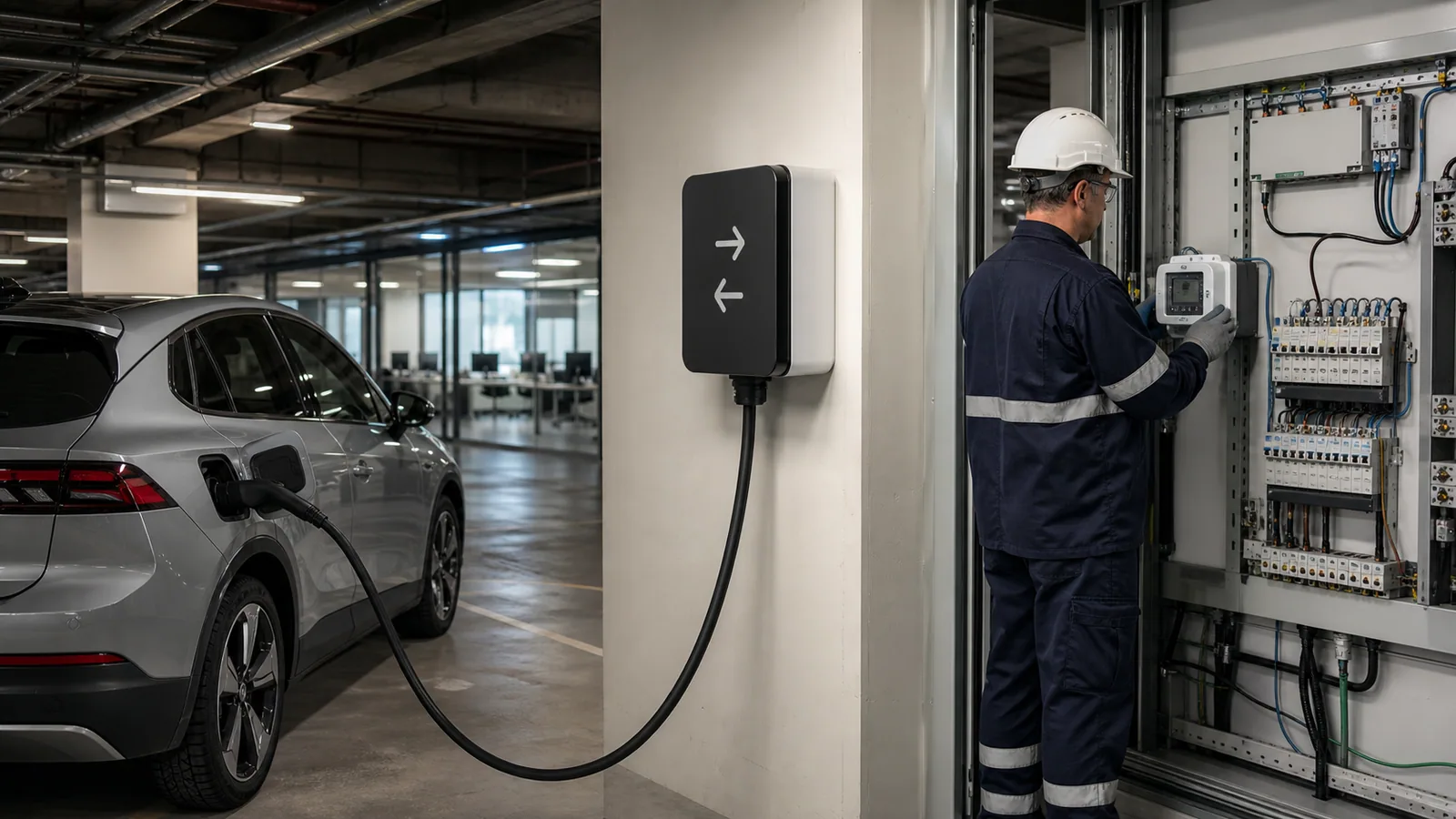
Bidirectional charging: scattered information versus Energy Intelligence
An electric car carries a battery that is often many times larger than a home battery, and that car sits parked for most of the day. Bidirectional charging exists to put that idle capacity to use. Picture a company car in the car park storing the midday surplus of solar power from the roof and feeding the building at the end of the afternoon. It matters to fleet managers, building owners with solar panels and households with a suitable car.
- Discharging requires an inverter that converts direct current from the battery into alternating current; that inverter sits either in a bidirectional DC charger or in the car itself.
- The variants are named after where the power goes: V2G feeds the grid, V2H and V2B feed a home or building, V2L powers individual appliances through a socket on the car.
- Both the car and the charger must support bidirectional charging and speak the same communication standard, such as ISO 15118-20; the range of suitable combinations is still limited.
Insight
Traditional approach
Information is scattered across portals, documents, invoices or separate spreadsheets.
Modern approach
Data, context and interpretation are brought together into a clear decision picture.
Decision-making
Traditional approach
Choices are made based on averages, assumptions or occasional analyses.
Modern approach
Scenarios, KPIs and current measurement data make the trade-off more concrete and repeatable.
Follow-up
Traditional approach
Actions often stay non-committal or disappear into separate reports.
Modern approach
Follow-up actions, monitoring and reporting are linked to the same energy data.
How does bidirectional charging work technically?
The battery of an electric car stores energy as direct current, while the electricity grid supplies alternating current. During normal charging, an inverter converts alternating current into direct current. Bidirectional charging adds the reverse route: an inverter converts battery power back into alternating current for the building or the grid. That inverter can sit in two places. With a bidirectional DC charger it sits in the charging station, and the car delivers direct current. With the AC variant, the bidirectional inverter sits in the car and alternating current runs through the charging cable. In addition, the car and the charger must communicate about when to charge or discharge and at what power. Standards exist for this, such as ISO 15118-20 and the older CHAdeMO protocol.
- Charging converts alternating current into direct current; discharging is the same conversion in reverse.
- With a bidirectional DC charger, the inverter sits in the charging station.
- With the AC variant, the bidirectional inverter sits in the car itself.
- Communication standards such as ISO 15118-20 and CHAdeMO manage the control between car and charger.
Which variants of bidirectional charging exist?
The variants are named after where the power goes. With vehicle-to-grid (V2G), the car feeds back into the electricity grid, for example to help balance supply and demand. With vehicle-to-home (V2H), the car powers its own home, mainly to use self-generated solar power later in the day. Vehicle-to-building (V2B) is the same principle for an office or commercial building, where the battery can flatten consumption peaks behind the connection. Vehicle-to-load (V2L) is the simplest form: a socket on the car powers individual appliances, without any fixed installation. The umbrella term for all these applications is V2X. Technically, the core is always the same: the battery discharges through an inverter to a consumer.
- V2G: feeding back into the electricity grid, usable for balancing and flexibility.
- V2H and V2B: the battery powers a home or building and increases self-consumption of solar power.
- V2L: a socket on the car powers appliances, without a fixed charging installation.
- V2X is the umbrella term for all forms of bidirectional charging.
What does it require and where are the limits?
Bidirectional charging places demands on the whole chain. The car must support it; that currently applies to a limited number of models. The charger must be bidirectional and demonstrably work with that car model, because not every combination works. An energy management system decides when the battery charges or discharges, based on generation, consumption or price signals. Anyone feeding back into the grid also needs suitable metering and arrangements with the energy supplier. Allow for losses: every conversion between alternating and direct current loses part of the energy, and a full charge and discharge cycle involves two conversions. Extra cycles also put load on the battery, so check the manufacturer's warranty conditions. Backup power during an outage only works if the installation is built to run disconnected from the grid.
- Car, charger and energy management system must all be suitable and work together.
- The range of cars and chargers supporting bidirectional charging is still limited.
- Every charge and discharge cycle involves conversion losses; less energy comes out than went in.
- Feeding back into the grid requires suitable metering and arrangements with the energy supplier.
- Backup power only works with an installation that can run disconnected from the grid.
Curious what this looks like with your own data?
In a no-obligation call, a specialist looks at your meters, sites and energy questions with you. Response within one business day.
Search the knowledge base
Find the answer to your question.
Search using your own words. Abbreviations and spelling variants are recognised, so EMS also finds the articles on energy management systems.
Topic