
Electrifying a logistics fleet: a guide for businesses
Direct answer
Electrifying a logistics fleet means replacing diesel vans and trucks with electric vehicles step by step, together with charging infrastructure at the company's own depot. Most Dutch businesses start with vans and grow towards electric trucks. The energy side is often the biggest challenge: the depot needs far more power, while the electricity grid is congested in many regions.
- Clear definition
- Data-driven assessment
- Risks and opportunities visible
- Practical next steps
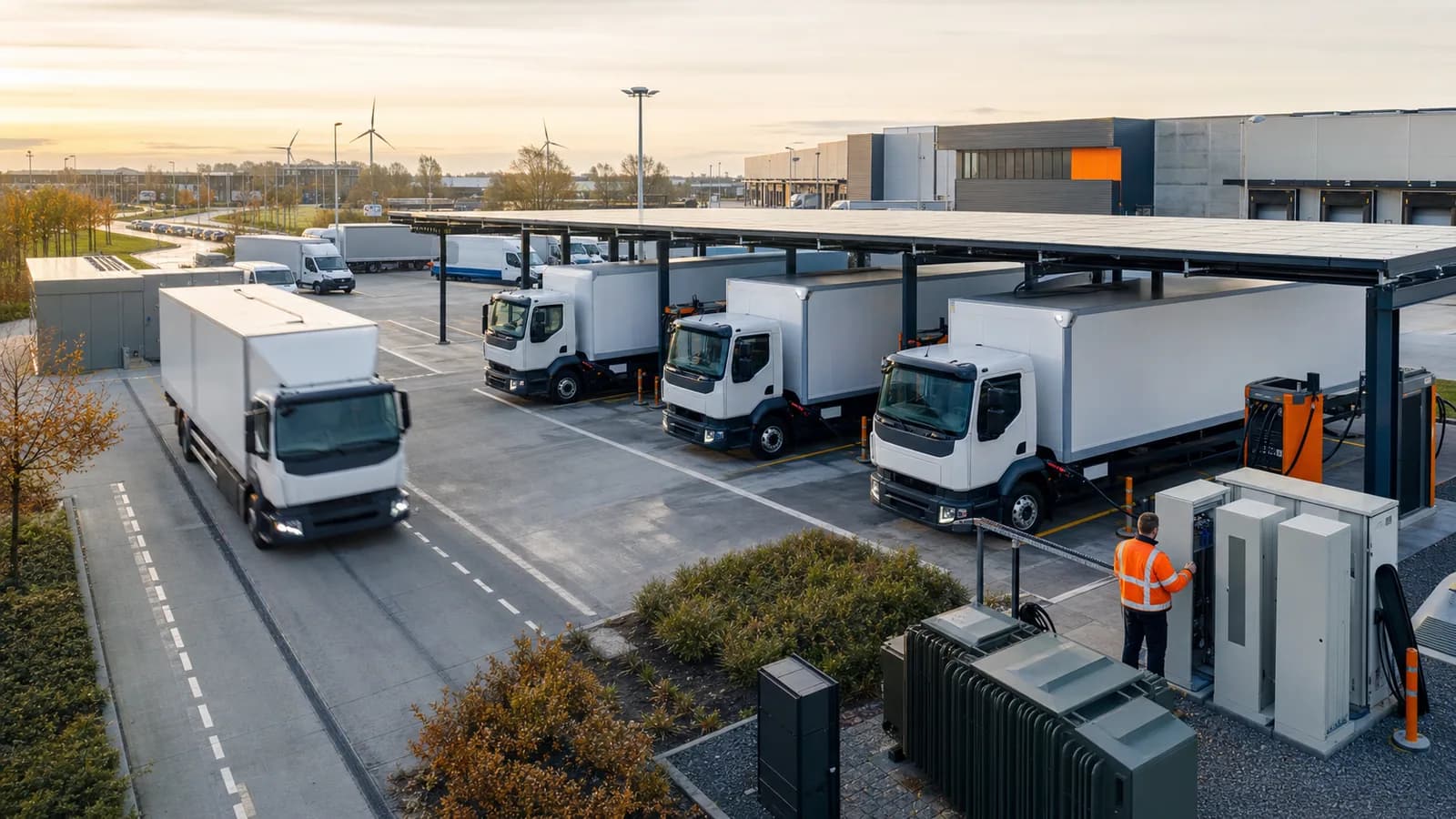
Electrifying a logistics fleet: scattered information versus Energy Intelligence
Carriers and companies with their own fleet face pressure to decarbonise from several sides: Dutch municipalities are introducing zero-emission zones for urban logistics, clients ask for clean transport and European rules push manufacturers towards zero-emission trucks. At the same time, a planner cannot simply swap out diesel. An electric truck must complete its trip and be charged on time. Electrification is therefore not a purchasing decision, but an operation that affects vehicles, routes and the depot at once.
- Start with the vans: the range of electric models is mature and zero-emission zones in Dutch city centres make the switch urgent.
- Plan electric trucks per trip: range and charging time determine which routes fit; overnight depot charging is the base, fast charging on the road the supplement.
- Talk to your grid operator early: upgrading the depot connection often involves long waiting times due to grid congestion; smart charging or a battery can limit the demand.
Insight
Traditional approach
Information is scattered across portals, documents, invoices or separate spreadsheets.
Modern approach
Data, context and interpretation are brought together into a clear decision picture.
Decision-making
Traditional approach
Choices are made based on averages, assumptions or occasional analyses.
Modern approach
Scenarios, KPIs and current measurement data make the trade-off more concrete and repeatable.
Follow-up
Traditional approach
Actions often stay non-committal or disappear into separate reports.
Modern approach
Follow-up actions, monitoring and reporting are linked to the same energy data.
Where do you start? Vans first
The transition almost always starts with the vans. The range of electric models is mature: nearly every manufacturer offers an electric variant, with a driving range that comfortably covers city and regional work. Dutch municipalities add urgency with zero-emission zones: in designated parts of city centres, only zero-emission vans and trucks will eventually be allowed, with transitional rules for existing vehicles. Anyone delivering in cities therefore needs a plan. Vans are also a safe learning ground. Charging can often be done with regular charge points at the depot or at the driver's home, and daily operations closely resemble those with diesel. The lessons on charging, planning and energy use then carry over to the heavier vehicles.
- Nearly every manufacturer now offers an electric van; the range covers city and regional work.
- Zero-emission zones in Dutch city centres will eventually only admit zero-emission vans and trucks, with transitional rules for existing vehicles.
- Charging can often be done with regular charge points at the depot or at the driver's home.
- The experience with vans is the learning ground for the step towards electric trucks.
Electric trucks: planning per trip and per charging window
Electric trucks are on the rise, but demand more planning than vans. Range differs per model and per load: many day trips in distribution are feasible, long trips require charging along the way. So plan per trip: how many kilometres, how much weight, and where the schedule leaves room to charge. The base is depot charging: the trucks are parked overnight anyway and charge steadily at a pre-planned power level. Fast charging on the road supplements this for longer trips; the public network of fast chargers for trucks is growing, including along major corridors. The Dutch knowledge organisation ElaadNL publishes forecasts on where that charging demand will land. Treat charging time as part of trip planning, not as an afterthought.
- Check every route against range, load and available charging windows.
- Overnight depot charging is the base: the vehicles are parked anyway.
- Fast charging on the road supplements longer trips; the public network for trucks is growing.
- Include charging time in trip planning, just like driving and rest times.
The energy side: often the real bottleneck
Charging several electric trucks at once quickly requires more power than the entire building used before. The depot's grid connection often needs a substantial upgrade. And that is exactly where it pinches: in many parts of the Netherlands the electricity grid is full and requests for extra transport capacity join a waiting list. So talk to your grid operator early, preferably as soon as the first electrification plans are on the table. There is often more possible within the existing connection than expected. With smart charging, a charging management system spreads sessions across the night, keeping the peak low. A battery at the depot can absorb charging peaks. And in congested areas, grid operators sometimes offer contract forms for off-peak use.
- Map early how much charging power the depot needs, now and in five years.
- Apply for a connection upgrade in time; waiting times are common due to grid congestion.
- Smart charging spreads sessions across the night and keeps the peak within the existing connection.
- A battery at the depot can absorb charging peaks when the grid offers no room.
Curious what this looks like with your own data?
In a no-obligation call, a specialist looks at your meters, sites and energy questions with you. Response within one business day.
Search the knowledge base
Find the answer to your question.
Search using your own words. Abbreviations and spelling variants are recognised, so EMS also finds the articles on energy management systems.
Topic