
Charging hub on a business park: a guide for businesses
Direct answer
A charging plaza, in Dutch a laadplein, is a cluster of multiple charging points at one location, such as a business park, often behind one shared grid connection. Companies, visitors and logistics operators charge electric cars, vans and trucks there. By bundling charging points and managing them smartly, businesses share the installation costs and the scarce grid capacity, instead of each requesting a separate connection.
- Clear definition
- Data-driven assessment
- Risks and opportunities visible
- Practical next steps
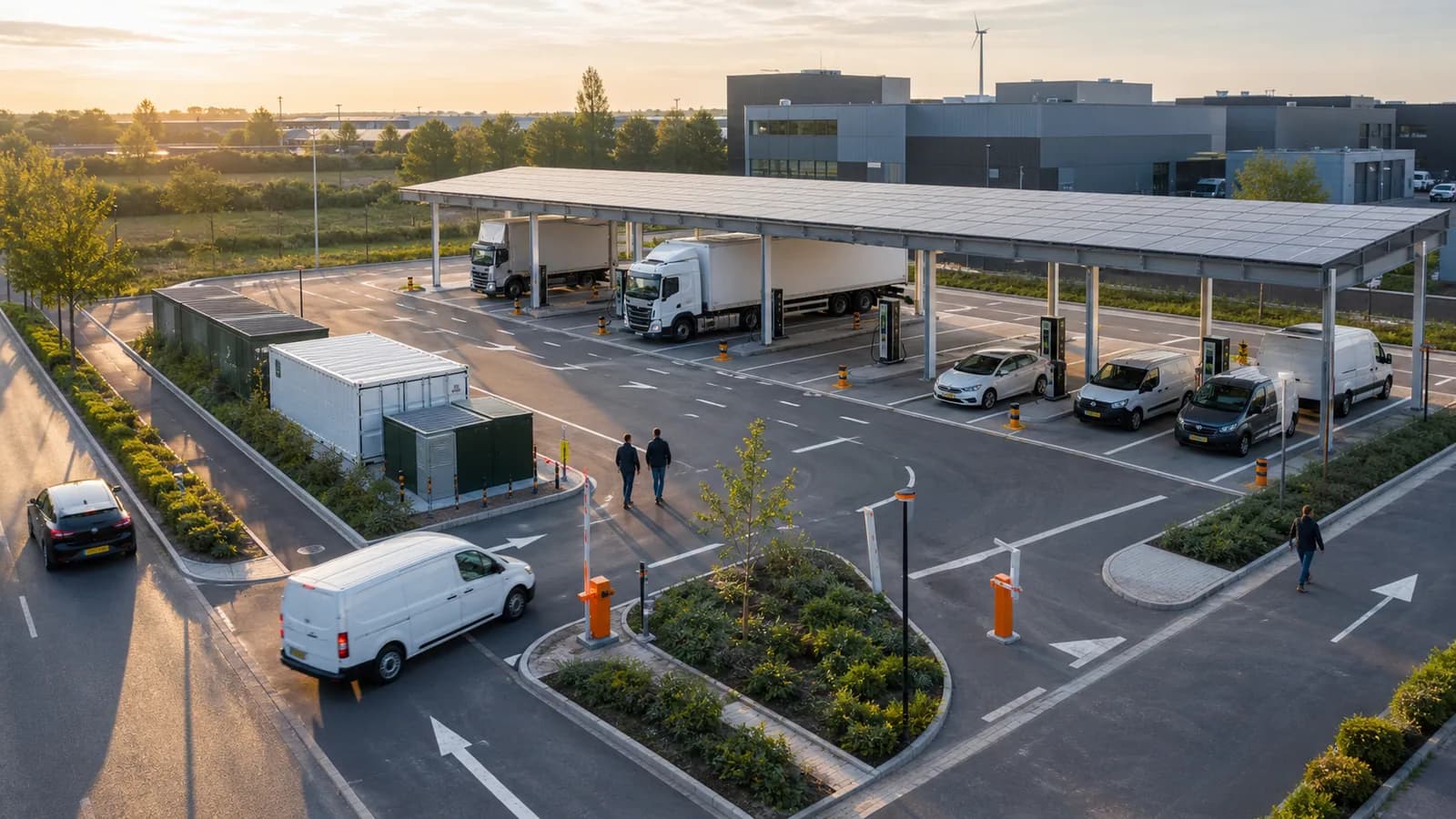
Charging hub on a business park: scattered information versus Energy Intelligence
More and more businesses are switching to electric vans and trucks, partly driven by zero-emission zones in Dutch city centres. These vehicles charge mainly on their own premises, often at night. Look around any business park and the same question appears everywhere: where will our vehicles charge tomorrow? Meanwhile, large parts of the Dutch electricity grid are full. A shared charging plaza is a logical answer: one well-equipped charging location for multiple companies, instead of dozens of separate initiatives each competing for grid capacity.
- A charging plaza bundles charging points for multiple users behind one grid connection or shared infrastructure; smart charging divides the available power.
- On business parks with grid congestion, a collective charging plaza is often more feasible than separate connections per company, for example as part of an energy hub or by sharing a connection.
- Check grid capacity with the grid operator early and settle ownership, management, access and cost allocation before you build.
Insight
Traditional approach
Information is scattered across portals, documents, invoices or separate spreadsheets.
Modern approach
Data, context and interpretation are brought together into a clear decision picture.
Decision-making
Traditional approach
Choices are made based on averages, assumptions or occasional analyses.
Modern approach
Scenarios, KPIs and current measurement data make the trade-off more concrete and repeatable.
Follow-up
Traditional approach
Actions often stay non-committal or disappear into separate reports.
Modern approach
Follow-up actions, monitoring and reporting are linked to the same energy data.
How does a charging plaza on a business park work?
A charging plaza bundles multiple charging points in one place, for example on a central car park. The charging points are connected to one grid connection or to shared electrical infrastructure. A smart charging system divides the available power among the vehicles charging at that moment. A van parked all night can charge more slowly than a truck that has to leave within the hour. This way more vehicles charge without increasing the peak load. A battery can act as a buffer: it charges when there is room on the grid and delivers power during charging peaks. An operator often takes care of the technology, the payment system and fault response, so the participating companies do not have to.
- Multiple charging points share one grid connection or shared infrastructure.
- Smart charging divides power based on departure time and need.
- A battery can absorb peaks and use spare room on the grid.
- An operator often handles technology, payment and fault response.
Why develop a charging plaza together?
Separate charging stations per company seem simple, but on a congested grid every company runs into the same wall on its own: no additional transport capacity. Collectively you are stronger. Companies can develop one charging location together and share the costs of the connection, construction and management. On business parks with grid congestion, a charging plaza can be part of an energy hub: companies coordinate generation, consumption, storage and charging within the capacity that is already there. Sharing a grid connection, known as cable pooling, can also create room. Company profiles complement each other too: offices charge during the day, logistics mainly in the evening and at night. The same charging points are used far better.
- Costs of the connection, construction and management are shared.
- Within an energy hub, companies coordinate charging, generation and storage.
- Sharing a grid connection, cable pooling, can create extra room.
- Different charging moments across companies improve utilisation.
How do you organise it and what should you watch?
Start with grid capacity: ask the grid operator early what is possible at the intended location, because that determines the design. Then organise the collective. Park management or a group of cooperating companies often takes the lead; an external operator can take over construction and management. Put agreements in writing: who owns the plaza, who may charge, how costs and revenues are settled, and what happens when a participant grows or leaves. Design for the future: electric trucks require considerably more power and space than passenger cars. Also consider the physical side: space, traffic safety, fire safety and any permits or consent needed from the municipality and the landowner. A charging plaza is no miracle cure: without solid agreements and grid capacity it will not get off the ground.
- Check grid capacity with the grid operator before you design.
- Choose an organisational model: park management, cooperating companies or an operator.
- Record ownership, access, cost allocation and growth agreements contractually.
- Account for heavier vehicles, space, safety and permits.
Curious what this looks like with your own data?
In a no-obligation call, a specialist looks at your meters, sites and energy questions with you. Response within one business day.
Search the knowledge base
Find the answer to your question.
Search using your own words. Abbreviations and spelling variants are recognised, so EMS also finds the articles on energy management systems.
Topic