
Business charging explained for businesses
Direct answer
Business charging covers charging electric cars in a company context: at charging points on the company's own site, at employees' homes with reimbursement by the employer, and on the road with a business charge card. A back-office system records every charging session and handles the settlement. This gives an organisation control over the charging costs of its fleet, employees and visitors.
- Clear definition
- Data-driven assessment
- Risks and opportunities visible
- Practical next steps
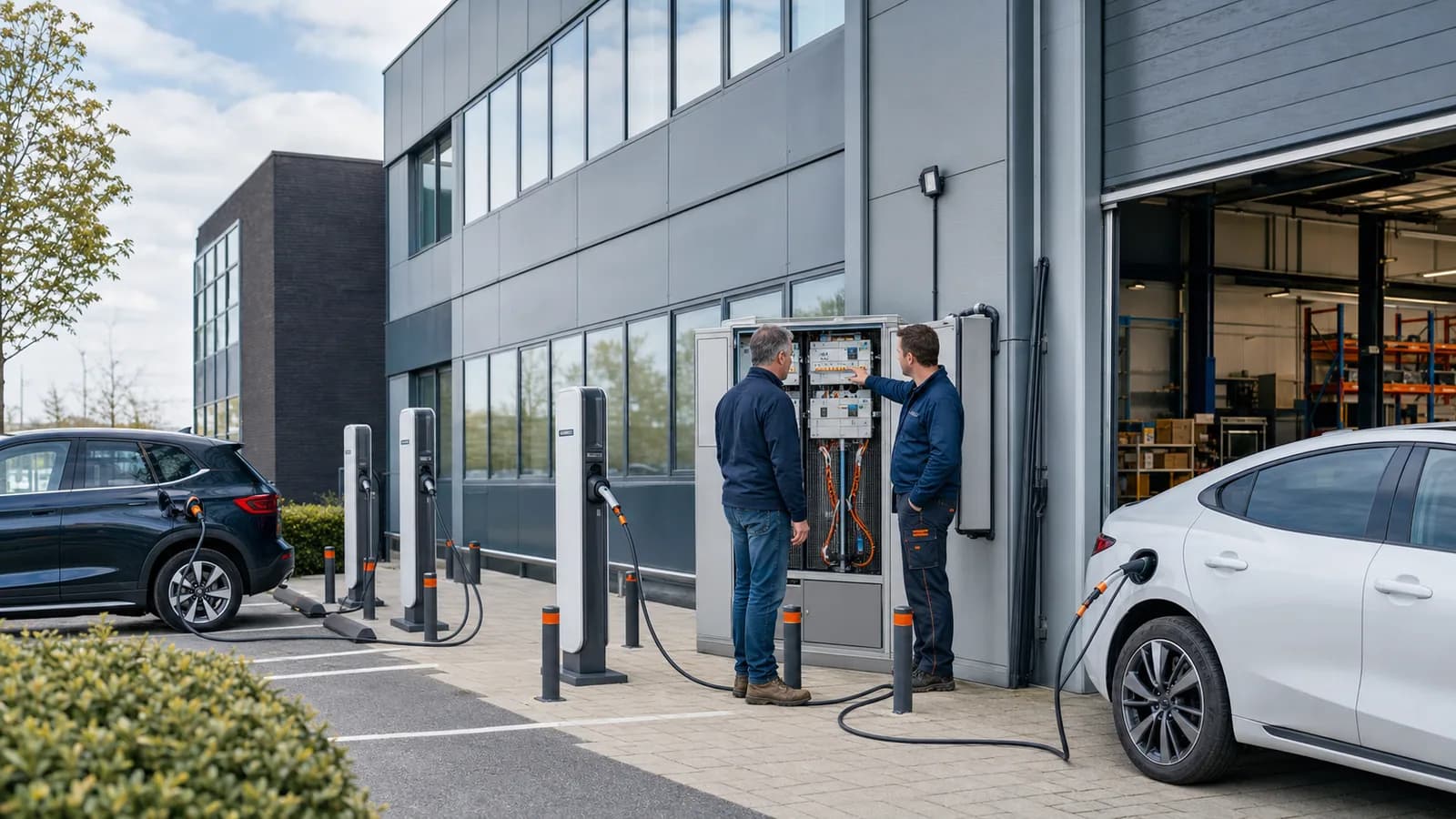
Business charging explained: scattered information versus Energy Intelligence
The share of electric cars in Dutch company fleets is growing fast, and with it the question of how charging is organised. A lease driver charges at home and wants to expense that electricity. The facility manager wants charging points in the car park for visitors and company cars. And on the road, everyone needs access to public charging points. Business charging bundles those three situations into one whole of technology, administration and agreements. It applies to any company with electric cars, from a single van to a complete fleet.
- Business charging happens in three places: on the company site, at the employee's home and at public charging points using a charge card.
- A charge card linked to a back office records every session per car or employee, so costs can be settled automatically.
- The building's grid connection determines how many cars can charge at once; load balancing distributes the available power across the charging points.
Insight
Traditional approach
Information is scattered across portals, documents, invoices or separate spreadsheets.
Modern approach
Data, context and interpretation are brought together into a clear decision picture.
Decision-making
Traditional approach
Choices are made based on averages, assumptions or occasional analyses.
Modern approach
Scenarios, KPIs and current measurement data make the trade-off more concrete and repeatable.
Follow-up
Traditional approach
Actions often stay non-committal or disappear into separate reports.
Modern approach
Follow-up actions, monitoring and reporting are linked to the same energy data.
What are the building blocks of business charging?
The basis is the charging point itself. Regular charging points use alternating current (AC): the car converts it on board, and a full battery takes several hours. That suits locations where cars are parked for a long time, such as an office site or a home driveway. Fast chargers use direct current (DC) and deliver much higher power; they are meant for short stops and for logistics with little idle time. The second building block is the charge card with its back office: it identifies who is charging, records the electricity used and enables settlement, including at public charging points. The third building block is the building's grid connection: it determines how much power is available for charging.
- AC charging points suit cars that are parked for hours, such as at the office or at home.
- DC fast chargers deliver high power for short stops and logistics.
- The charge card and back office record who charges, where and how much.
- The building's grid connection limits the total charging power.
How does the settlement work?
The money flow differs per charging situation. If an employee charges at the office, the charging point records the session by name or licence plate; the employer can offer this for free or charge it on. If an employee charges at home, a charging point with its own kWh metering measures exactly how much electricity went to the car. The employer reimburses those costs, usually automatically through the back office of the charge card provider. With public charging, the employee pays with the business charge card and the invoice goes directly to the employer. Record the agreements on tariffs and reimbursement in writing beforehand. The Dutch private-use addition for a company car is separate from this: it concerns the car, not who pays for the electricity.
- At the office: the charging point records sessions per employee or licence plate.
- At home: a charging point with its own kWh metering enables reimbursement of the actual charging costs.
- Public: the business charge card sends the costs directly to the employer.
- The company-car tax addition is separate from the settlement of charging costs.
What should you consider during installation?
Start with the grid connection: how much power is available on top of the building's existing consumption? Several charging points at once quickly demand a lot of power. Load balancing partly solves this: a smart system distributes the available power across the charging cars and takes the rest of the building's consumption into account. That way, more charging points fit on the same connection. If a heavier connection is still needed, take grid congestion into account: in parts of the Netherlands there is a waiting time for new or heavier large-consumer connections. So build future-proof: install cabling or empty conduits for extra charging points, choose charging points that can be controlled through open communication protocols, and reserve space in the meter cupboard.
- First check the available power on the existing grid connection.
- Load balancing distributes the power intelligently and prevents overload.
- A heavier connection can take a long time due to grid congestion; apply early.
- Install cabling and smart control future-proof from the start, ready for expansion and smart charging.
Curious what this looks like with your own data?
In a no-obligation call, a specialist looks at your meters, sites and energy questions with you. Response within one business day.
Search the knowledge base
Find the answer to your question.
Search using your own words. Abbreviations and spelling variants are recognised, so EMS also finds the articles on energy management systems.
Topic