
Hydrogen vs. electric trucks: a guide for businesses
Direct answer
Hydrogen trucks and electric trucks are two routes to zero-emission freight transport. A battery-electric truck stores electricity in a battery; a hydrogen truck generates electricity on board from hydrogen in a fuel cell. Battery-electric uses the generated electricity most efficiently and dominates the current rollout. Hydrogen refuels quickly, but the supply of trucks, refuelling stations and green hydrogen is still limited.
- Clear definition
- Data-driven assessment
- Risks and opportunities visible
- Practical next steps
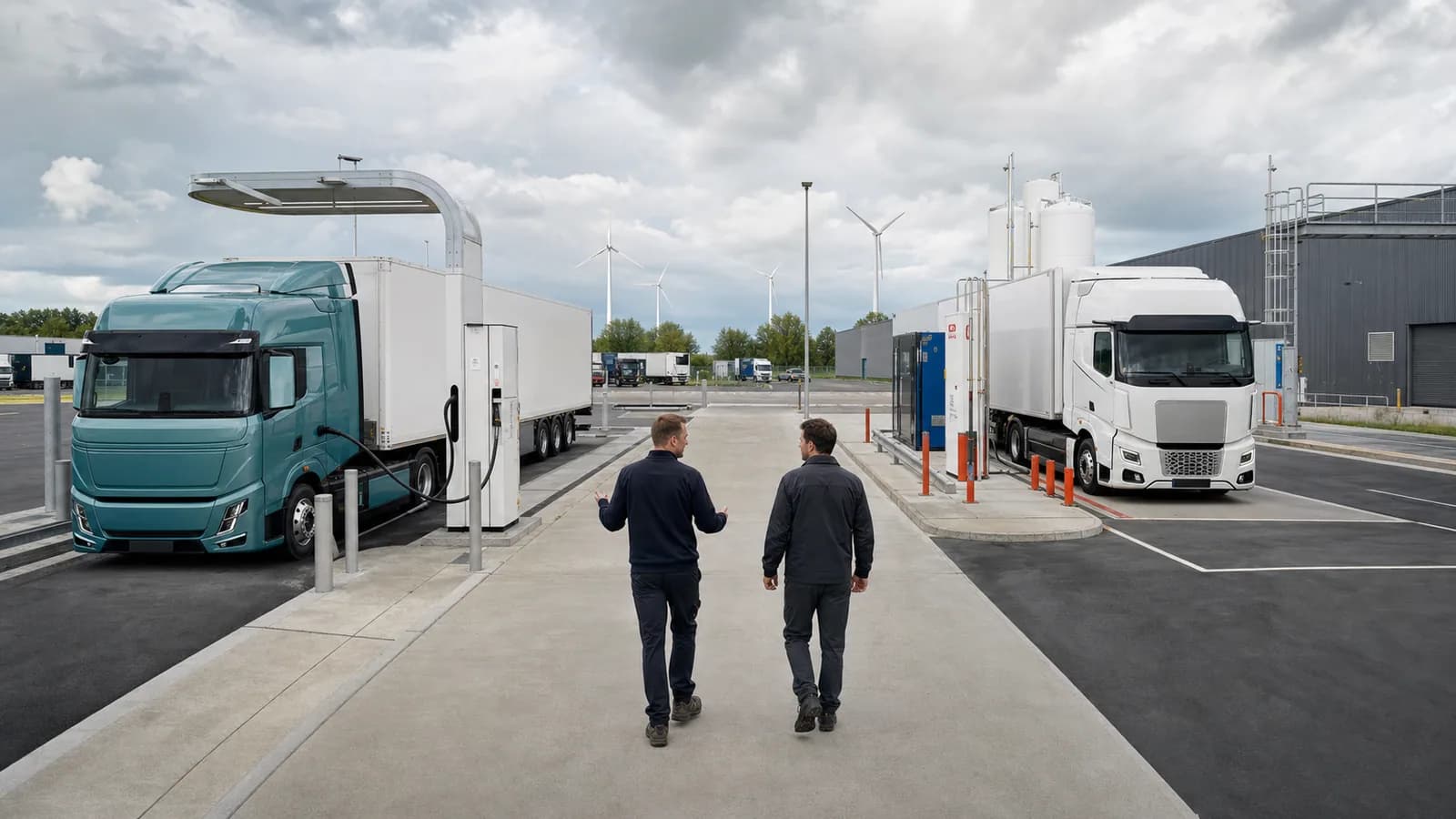
Hydrogen vs. electric trucks: scattered information versus Energy Intelligence
More and more Dutch inner cities are introducing zero-emission zones, and European CO2 standards require manufacturers to deliver more zero-emission trucks. Anyone replacing a truck now faces a technology choice that will shape planning, staffing and energy procurement for years. The difference becomes concrete on your own premises: a distributor whose trucks are parked at the depot every night can charge there. A carrier driving across Europe depends on public charging or refuelling infrastructure along the way.
- A battery-electric truck uses electricity far more efficiently than a hydrogen truck, because hydrogen loses energy during production, compression and conversion in the fuel cell.
- The supply of battery-electric trucks and charging infrastructure is more mature; in the Netherlands hydrogen trucks mainly run in pilots and the number of refuelling stations for heavy transport is small.
- The choice starts with your route profiles: daily distance, payload, idle times and whether you can charge on your own premises determine which technology fits.
Insight
Traditional approach
Information is scattered across portals, documents, invoices or separate spreadsheets.
Modern approach
Data, context and interpretation are brought together into a clear decision picture.
Decision-making
Traditional approach
Choices are made based on averages, assumptions or occasional analyses.
Modern approach
Scenarios, KPIs and current measurement data make the trade-off more concrete and repeatable.
Follow-up
Traditional approach
Actions often stay non-committal or disappear into separate reports.
Modern approach
Follow-up actions, monitoring and reporting are linked to the same energy data.
What is the difference between an electric and a hydrogen truck?
Both trucks run on an electric motor; the difference lies in the energy carrier. The battery-electric truck charges electricity from the grid and stores it in a battery. The hydrogen truck carries hydrogen in tanks and converts it into electricity on board, usually with a fuel cell. A variant with a hydrogen combustion engine also exists. The biggest technical difference is chain efficiency: from generated electricity to wheel, hydrogen loses considerably more energy, through electrolysis, compression, transport and conversion in the fuel cell. A hydrogen truck therefore needs a multiple of the generated electricity per kilometre. In return, refuelling hydrogen takes minutes and hydrogen carries a lot of energy per kilo, which offers potential range for heavy long-haul work.
- Both have an electric drivetrain; the energy carrier differs: battery, or hydrogen tank with fuel cell.
- With hydrogen, considerably more energy is lost from electricity to wheel than with direct charging.
- Refuelling hydrogen takes minutes; charging a large truck battery takes longer, although fast chargers with ever higher power are arriving.
- The weight of a large battery can reduce payload in the heaviest long-haul work.
Where does the market stand now?
Battery-electric dominates the rollout of zero-emission freight transport. Almost all major truck manufacturers deliver battery-electric models in series production, and the number of electric trucks on Dutch roads is growing. Charging currently happens mainly at company depots; public truck charging hubs along the main corridors are under construction. Researchers at knowledge organisations such as TNO and ElaadNL expect battery-electric to become the standard for the large majority of freight transport. Hydrogen trucks in the Netherlands mainly run in pilots and small series. The number of hydrogen refuelling stations suitable for heavy transport is limited; the Dutch government currently stimulates the buildout with subsidy for hydrogen in mobility. Green hydrogen is also still scarce: much hydrogen is currently made from natural gas and is then not emission-free across the chain.
- Almost all major truck manufacturers deliver battery-electric models; hydrogen trucks come in small series or pilots.
- Charging currently happens mainly at company depots; public truck chargers along corridors are under construction.
- The number of hydrogen refuelling stations for heavy transport in the Netherlands is small; the government currently stimulates the buildout through subsidy.
- Green hydrogen is scarce; hydrogen made from natural gas is not emission-free across the chain.
How do you choose between hydrogen and electric?
Do not start with the technology, but with your route profiles. Map per vehicle how many kilometres it drives per day, how heavy the payload is, where it is parked at night and how predictable the planning is. For most urban, regional and national profiles, a battery-electric truck charging at its own depot fits. Do check early whether your grid connection can handle charging several trucks at once: in areas with grid congestion, extra transport capacity takes time, and smartly scheduled charging outside peak hours eases that. Hydrogen comes into view when the profile structurally does not fit batteries: very long daily distances, maximum payload and no opportunity to charge. In that case, first check whether refuelling infrastructure is within reach, and start with a pilot before committing the fleet.
- Map the route profile per vehicle: daily distance, payload, idle times and route.
- Check early whether your grid connection can handle charging several trucks; in congestion areas extra capacity takes time.
- Consider hydrogen only if the profile does not fit batteries and refuelling infrastructure is within reach.
- Start with a pilot per route profile and revisit the choice periodically; both technologies are developing fast.
Curious what this looks like with your own data?
In a no-obligation call, a specialist looks at your meters, sites and energy questions with you. Response within one business day.
Search the knowledge base
Find the answer to your question.
Search using your own words. Abbreviations and spelling variants are recognised, so EMS also finds the articles on energy management systems.
Topic