
Planning charging infrastructure: a guide for businesses
Direct answer
Planning charging infrastructure means determining in advance how many charging points a business needs, where they go and how much power they require. The foundation is a fleet forecast: which vehicles go electric and when. This is followed by the charging profile, an early grid connection check with the grid operator and the choice between AC and DC charging points.
- Clear definition
- Data-driven assessment
- Risks and opportunities visible
- Practical next steps
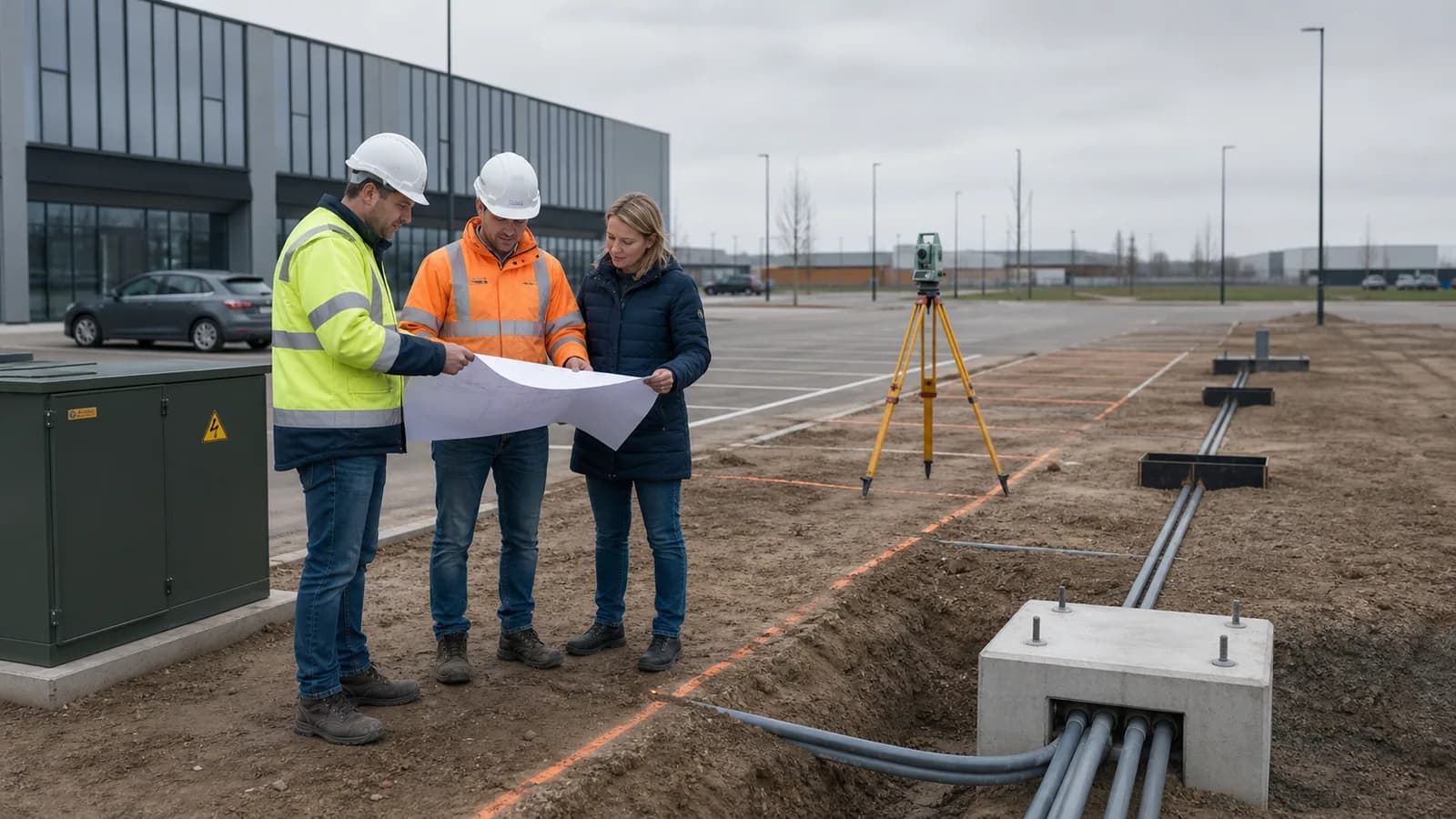
Planning charging infrastructure: scattered information versus Energy Intelligence
More and more businesses are electrifying their fleets: passenger cars, vans and sometimes trucks. Those who only think about charging points once the vehicles arrive get stuck. A distribution company ordering ten electric vans sometimes discovers too late that the grid connection cannot handle simultaneous charging. Good planning prevents this: first map the fleet and its charging behaviour, then the connection and the technology, and only then build. That way the charging infrastructure grows with the fleet instead of trailing behind it.
- A multi-year fleet forecast determines the number of charging points: how many vehicles electrify when, and how many kilowatt-hours they need per day.
- Ask the grid operator early whether the connection has sufficient capacity; in areas with grid congestion, extra transport capacity can involve long waiting times.
- With load balancing, a system distributes the available power intelligently across the charging points, so more vehicles can charge within the same connection.
Insight
Traditional approach
Information is scattered across portals, documents, invoices or separate spreadsheets.
Modern approach
Data, context and interpretation are brought together into a clear decision picture.
Decision-making
Traditional approach
Choices are made based on averages, assumptions or occasional analyses.
Modern approach
Scenarios, KPIs and current measurement data make the trade-off more concrete and repeatable.
Follow-up
Traditional approach
Actions often stay non-committal or disappear into separate reports.
Modern approach
Follow-up actions, monitoring and reporting are linked to the same energy data.
Where do you start: fleet forecast and charging profile
Do not start with the charging station, but with the vehicles. Make a fleet forecast covering several years: which vehicles will you replace with electric ones and when, and how many kilometres do they drive per day. Translate that into a charging profile: at which moments are the vehicles on your premises, how long do they stand still and how many kilowatt-hours must they charge in that time. A van parked at the site every night can charge slowly for hours. A vehicle that briefly returns during the day needs a lot of power in a short time. Also consider simultaneity: vehicles rarely all charge at full power at the same time. That profile determines how many charging points you need and the total power that goes with them.
- Map per vehicle type when it goes electric and how much it drives.
- Determine per vehicle the dwell times on your premises and the kilowatt-hours required.
- Account for simultaneity: not every vehicle charges at full power at the same moment.
- Plan several years ahead, so the end state drives the design.
How do you arrange the grid connection and the technology?
Check early with your grid operator whether the existing connection can handle the charging load. If more transport capacity is needed, submit the application as early as possible: in areas with grid congestion, applicants for extra capacity often join a waiting list. Then choose the charging technology. AC charging points charge through the converter in the vehicle, at more limited power; they suit vehicles that stand still for long periods, such as overnight. DC fast chargers deliver direct current straight to the battery and charge quickly, but demand far more power from the connection. Load balancing automatically distributes the available power across the active charging points. Install cabling and conduits future-proof from the start, sized for the end state of the fleet.
- Contact the grid operator early; extra transport capacity involves waiting times under congestion.
- AC suits long dwell times, DC suits fast charging at high power.
- Load balancing lets more charging points operate within the same connection capacity.
- Size cables and conduits for the future fleet, not the current one.
How do you build in phases and manage the charging points?
Build the charging infrastructure in phases, at the pace of the fleet. Do the civil works, such as excavation, foundations and cabling, in one go for the end state: this avoids repeatedly opening up the site. Install the charging points themselves per phase, each time new electric vehicles arrive. Also arrange the management. A back-office system registers charging sessions per vehicle or card, controls who may charge and flags faults. Agree who resolves faults and within what timeframe, because a charging point out of order quickly means a vehicle out of service. Evaluate usage periodically: actual charging profiles often deviate from the forecast and are the best basis for the next phase.
- Civil works and cabling sized for the end state in one go, charging points added per phase.
- A back office registers charging sessions, manages access and flags faults.
- Agree on maintenance and fault response before the fleet depends on it.
- Use actual charging data to size the next expansion phase.
Curious what this looks like with your own data?
In a no-obligation call, a specialist looks at your meters, sites and energy questions with you. Response within one business day.
Search the knowledge base
Find the answer to your question.
Search using your own words. Abbreviations and spelling variants are recognised, so EMS also finds the articles on energy management systems.
Topic