
V2G in practice: a guide for businesses
Direct answer
In practice, V2G only works with a complete chain: a bidirectional charger, an electric car that supports feeding power back, and a contract that settles the returned electricity. In the Netherlands that chain is available today, but supply is limited. V2G therefore mainly runs in pilots and first commercial projects, with shared cars and charging plazas leading the way.
- Clear definition
- Data-driven assessment
- Risks and opportunities visible
- Practical next steps
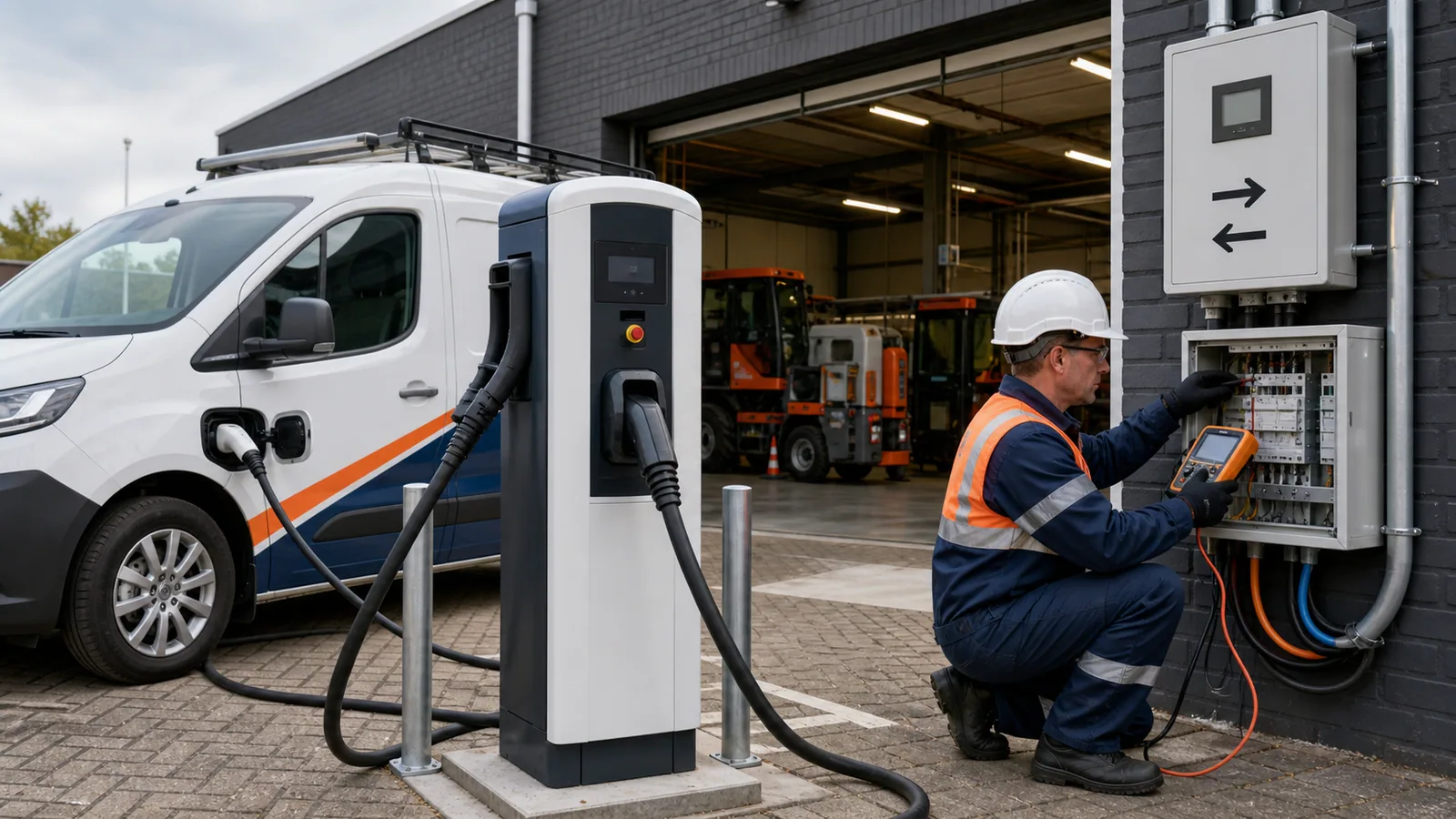
V2G in practice: scattered information versus Energy Intelligence
An electric car is parked for most of the day, often with a well filled battery. A business site with ten charging points quickly holds more storage capacity than many home battery systems. The idea of letting those batteries feed a building or the grid is therefore attractive, especially on a congested electricity grid. Between that idea and daily practice, however, sits a series of practical conditions. This page describes what is genuinely possible today in the Netherlands.
- Feeding power back from the car is possible today with a small number of models; the first cars and chargers that fully support the European CCS standard are arriving gradually.
- Besides a charger and a car, a market party is needed, such as a supplier or aggregator, that meters and settles the returned electricity.
- Businesses can prepare today without V2G hardware: reserve heavier cabling and space in new charging infrastructure and choose contracts that allow feeding back later.
Insight
Traditional approach
Information is scattered across portals, documents, invoices or separate spreadsheets.
Modern approach
Data, context and interpretation are brought together into a clear decision picture.
Decision-making
Traditional approach
Choices are made based on averages, assumptions or occasional analyses.
Modern approach
Scenarios, KPIs and current measurement data make the trade-off more concrete and repeatable.
Follow-up
Traditional approach
Actions often stay non-committal or disappear into separate reports.
Modern approach
Follow-up actions, monitoring and reporting are linked to the same energy data.
What do you need to make V2G work?
V2G requires three things at once. First, a bidirectional charger: a charging point that can send power not only into the car but also out of it. The supply of these is still limited and much smaller than the supply of regular charging points. Second, a car that supports feeding power back. Today that is possible with a small number of models, partly via the older CHAdeMO connector. For the CCS connector that has become the European standard, the communication standard ISO 15118-20 has been established, but manufacturers are introducing it step by step. Third, a contract: an energy supplier or aggregator that meters and settles the returned electricity and may trade it on the market. If one link is missing, the installation feeds nothing back.
- A bidirectional charger, with an energy management system that controls charging and discharging.
- A car that supports feeding back: a small number of models today, with CCS models becoming available gradually.
- A contract with a supplier or aggregator that settles the electricity.
- Metering that registers charging and feeding back separately.
Where is V2G already running in the Netherlands?
The Netherlands is an international frontrunner in practical projects. In Utrecht, bidirectionally charging shared cars work together as a neighbourhood battery: they charge when solar power is abundant and feed back at busy moments. First results from a fleet of fifty bidirectional shared cars there show feed-in peaks of almost 200 kilowatts. Knowledge organisation ElaadNL, founded by the joint Dutch grid operators, tests bidirectional chargers and cars in its own test lab, publishes research on grid impact and expects the missing standards to be resolved towards 2030. The Dutch government has also sent a national roadmap for bidirectional charging to parliament, with the goal that everyone buying a new electric car from 2035 can use the technology. The picture is consistent: technically it works, and scaling up awaits more suitable cars, chargers and finished standards.
- Utrecht leads the way: a fleet of fifty bidirectional shared cars fed back peaks of almost 200 kilowatts.
- ElaadNL tests bidirectional chargers and cars in its own test lab and studies the grid impact.
- A national roadmap for bidirectional charging exists, with 2035 as the target year for broad availability in new cars.
- Large-scale rollout mainly awaits a broader supply of suitable cars, chargers and finished standards.
What is realistic for your business right now?
For most businesses, full V2G is not yet a standard choice. The supply of bidirectional chargers and suitable cars is limited and the revenue side is still developing. There are also open issues. Not every car manufacturer covers intensive feeding back under the battery warranty; check the conditions. Policy discussions also address how returned electricity is treated fiscally, so that the same electricity is not taxed twice. What you can do today: when building new charging infrastructure, choose cabling, space and energy management so that bidirectional chargers can be added later, and pick contracts that do not block control and feeding back. Smart charging without feeding back, also known as V1G, already delivers a large share of the flexibility in the meantime.
- Expect limited supply: few bidirectional chargers and few suitable car models.
- Check with the manufacturer whether feeding back is covered by the battery warranty.
- Prepare with cabling, space and an energy management system that can handle discharging.
- Choose energy contracts that keep control and feeding back possible later.
- Start with smart charging without feeding back; that works with almost any car and charger.
Curious what this looks like with your own data?
In a no-obligation call, a specialist looks at your meters, sites and energy questions with you. Response within one business day.
Search the knowledge base
Find the answer to your question.
Search using your own words. Abbreviations and spelling variants are recognised, so EMS also finds the articles on energy management systems.
Topic