
Smart charging for fleets: a guide for businesses
Direct answer
Smart charging for a fleet is the intelligent control of your vehicles' charging sessions, within the limits of the grid connection and at the most favourable moments. A charging management system divides the available power across the charge points, prioritises vehicles that leave first and can respond to dynamic electricity prices or on-site solar generation. Everyone keeps driving, often without upgrading the connection.
- Clear definition
- Data-driven assessment
- Risks and opportunities visible
- Practical next steps
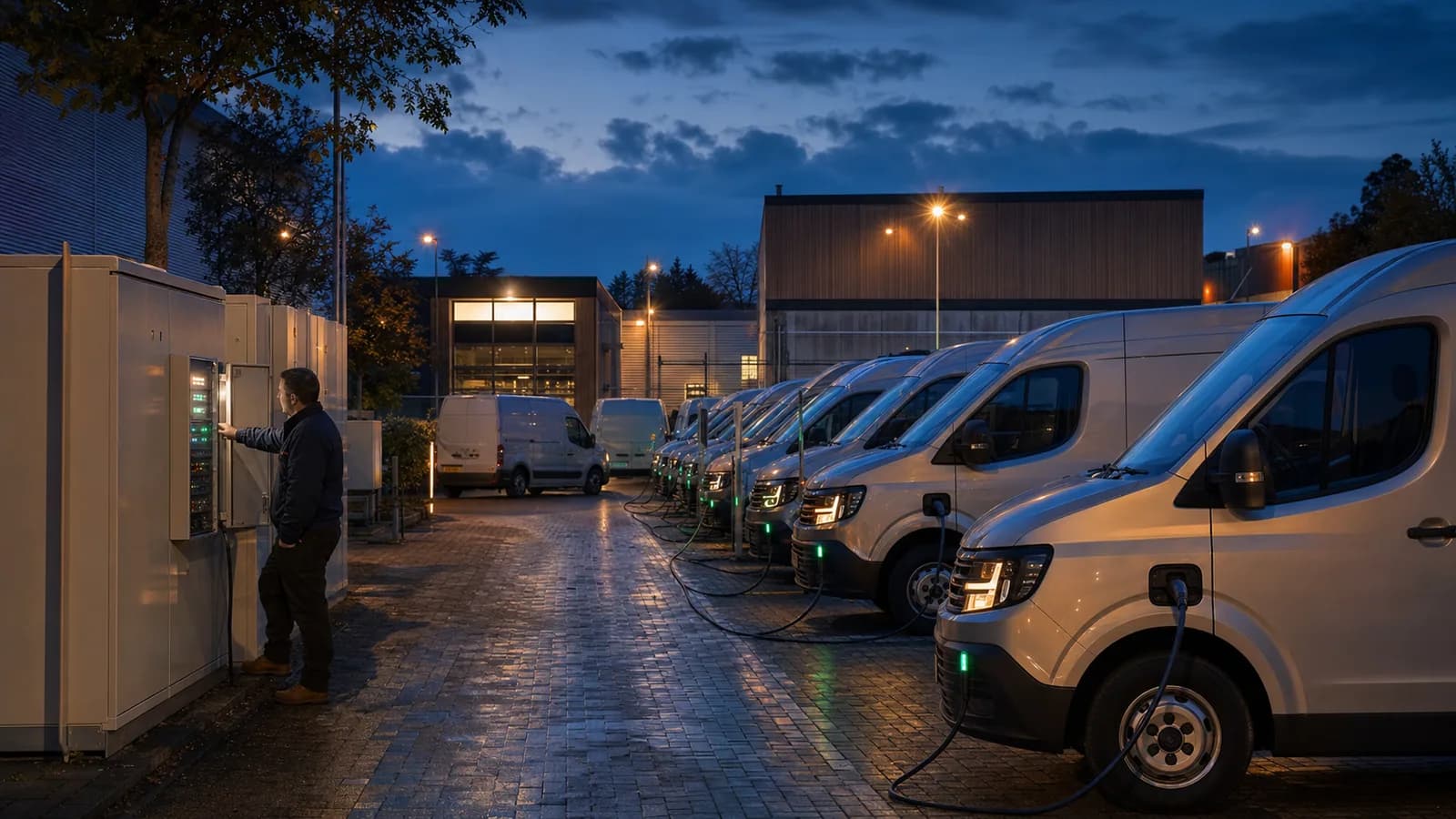
Smart charging for fleets: scattered information versus Energy Intelligence
Businesses electrifying a fleet often run into the limits of their grid connection. Ten electric vans plugging in at five in the afternoon together demand more power than many business connections can handle. Upgrading is expensive and, in Dutch areas with grid congestion, can take years. Smart charging takes a different approach: vehicles are usually parked far longer than the charging time they actually need. That idle time is the room you have to shift with.
- A charging management system spreads charging sessions within the existing connection: vehicles do not all charge at full power at once, but across the available hours.
- Prioritising by departure time ensures every vehicle is sufficiently charged when it is needed; vehicles that stay longer charge at quiet or cheap moments.
- Responding to dynamic prices or on-site solar panels can lower charging costs and peak load, without compromising vehicle availability.
Insight
Traditional approach
Information is scattered across portals, documents, invoices or separate spreadsheets.
Modern approach
Data, context and interpretation are brought together into a clear decision picture.
Decision-making
Traditional approach
Choices are made based on averages, assumptions or occasional analyses.
Modern approach
Scenarios, KPIs and current measurement data make the trade-off more concrete and repeatable.
Follow-up
Traditional approach
Actions often stay non-committal or disappear into separate reports.
Modern approach
Follow-up actions, monitoring and reporting are linked to the same energy data.
How does smart charging work for a fleet?
At the core is a charging management system that controls all charge points via an open standard such as OCPP. The system knows the limit of your connection and divides the available power across the connected vehicles. When many vehicles are plugged in at once, each charges somewhat slower or in turn, as long as everyone is charged in time. Departure time is leading: a vehicle that must leave at seven gets priority over one that only drives in the afternoon. On top of that, the system can steer towards hours with low dynamic electricity prices or towards the output of your own solar panels. A link with your back office or planning system provides the departure times and trip data that make this possible.
- The charging management system guards the connection limit and divides the power.
- Departure times set the order: whoever drives first, charges first or faster.
- Charging shifts to hours with low dynamic prices or high on-site solar output.
- Open standards such as OCPP connect charge points, management system and back office.
What does smart charging deliver for your fleet?
The first result is a lower peak load. By spreading charging sessions, total power stays below the limit of your connection. As a result, the existing connection often suffices for longer, even as the fleet grows. That avoids a connection upgrade, which is a major advantage in Dutch congestion areas: requests for extra transport capacity regularly end up in a queue there. The second result is in energy costs. Charging during hours with low dynamic prices, or when your own solar panels are producing, can make every charged kilowatt hour cheaper. Finally, the system provides insight: you see per charge point and per vehicle what has been charged, and can adjust accordingly.
- Lower peaks: total charging power stays within the existing connection.
- The connection suffices for longer, even as the fleet grows.
- Potentially cheaper charging by shifting to favourable price hours or on-site solar generation.
- Insight per charge point and vehicle enables adjustment and cost allocation.
What should you watch when setting it up?
Vehicle availability always comes first. A saving on charging costs is worthless if a van leaves half charged in the morning. Configure the system so departure time and required range are hard constraints, with price steering only after that. Also build in a margin for unexpected trips. Second point: data and integrations. The system is only as smart as the departure times it knows, so the link with your planning or back office must be correct and stay up to date. Choose charge points and software that work with open standards, so you are not locked into one supplier. Third point: involve your employees. Explain why a vehicle does not immediately charge at full power and how they can report an early trip.
- Availability first: departure time and range are hard constraints, price comes after.
- Keep departure times current through a link with planning or back office.
- Choose charging infrastructure with open standards to avoid supplier lock-in.
- Inform drivers: slower charging is normal and urgent trips can be reported.
Curious what this looks like with your own data?
In a no-obligation call, a specialist looks at your meters, sites and energy questions with you. Response within one business day.
Search the knowledge base
Find the answer to your question.
Search using your own words. Abbreviations and spelling variants are recognised, so EMS also finds the articles on energy management systems.
Topic