
Redispatch in the Netherlands: a guide for businesses
Direct answer
Redispatch is a market-based form of congestion management in the Netherlands: the grid operator pays companies to temporarily adjust their electricity consumption or generation at locations where the grid risks overload. Dutch redispatch runs through GOPACS, the joint platform of the Dutch grid operators. Companies offer their flexible capacity through a Congestion Service Provider and receive compensation when their bid is called.
- Clear definition
- Data-driven assessment
- Risks and opportunities visible
- Practical next steps
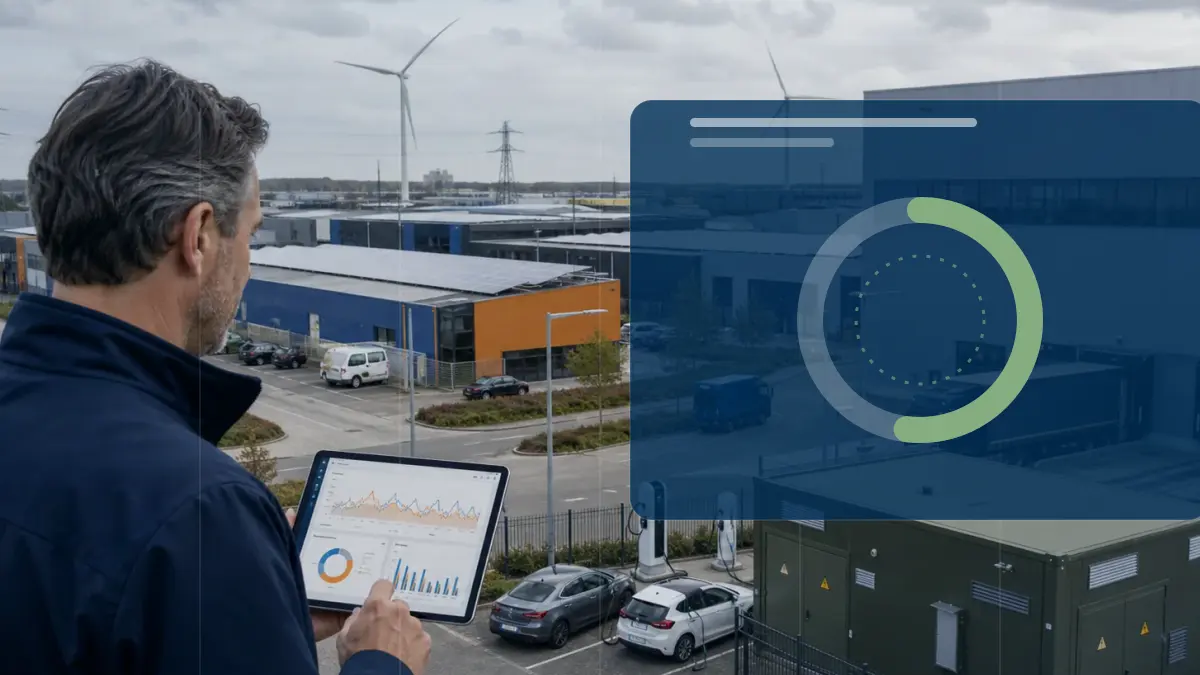
Redispatch in the Netherlands: scattered information versus Energy Intelligence
The Dutch electricity grid is at its limit in many regions. Grid reinforcement takes years, so grid operators look for ways to resolve bottlenecks in the short term. Redispatch is a key instrument: flexibility from companies is deployed exactly where the grid is constrained. A practical example from TenneT: a wind farm reduces its output, a greenhouse grower lowers consumption, and a solar park elsewhere makes up the difference. All three are paid for this.
- Bids run through the GOPACS platform and are placed by a Congestion Service Provider (CSP) on a connected trading platform such as EPEX SPOT or ETPA.
- Participation with free bids is currently possible from 100 kilowatts of flexible transport capacity; you decide when, how much and at what price you offer.
- From 1 megawatt of contracted transport capacity, the grid operator can make participation in congestion management mandatory, for example through a bidding obligation contract.
Insight
Traditional approach
Information is scattered across portals, documents, invoices or separate spreadsheets.
Modern approach
Data, context and interpretation are brought together into a clear decision picture.
Decision-making
Traditional approach
Choices are made based on averages, assumptions or occasional analyses.
Modern approach
Scenarios, KPIs and current measurement data make the trade-off more concrete and repeatable.
Follow-up
Traditional approach
Actions often stay non-committal or disappear into separate reports.
Modern approach
Follow-up actions, monitoring and reporting are linked to the same energy data.
How does redispatch work?
Redispatch starts with an expected overload in part of the grid, often visible a day in advance. Companies with flexible capacity place buy or sell orders through their Congestion Service Provider on a trading platform connected to GOPACS. GOPACS then combines orders inside and outside the congestion area: capacity is scaled down at the bottleneck and scaled up elsewhere, so the national energy balance remains intact. The grid operator pays the price difference between the matched orders, giving both parties a workable deal. Bids can be placed from 3 pm on the day before delivery until 45 minutes before the moment of delivery.
- GOPACS is the joint congestion management platform of the Dutch grid operators, from TenneT to the regional operators.
- A Congestion Service Provider (CSP) represents your company and places the bids on your behalf.
- Scaling down inside the congestion area is compensated by scaling up outside it; the grid is relieved without disturbing the balance.
- The grid operator pays the price difference between the matched buy and sell orders.
When will you encounter redispatch?
You will encounter redispatch if your company is located in a congestion area or investigation area and can adjust capacity at short notice. There are two forms of participation. With free bids you decide when, how much and at what price you offer flexibility; a threshold of 100 kilowatts currently applies. With a bidding obligation contract you make capacity structurally available and receive a fixed monthly fee plus a fee per megawatt hour called. If voluntary participation yields too little, the grid operator can oblige companies with contracted transport capacity of 1 megawatt or more to submit bids.
- Free bids: entirely at your own discretion, placed daily through your CSP.
- Bidding obligation contract: structural availability in exchange for a fixed monthly fee plus a fee per megawatt hour.
- The participation obligation currently applies from 1 megawatt of contracted transport capacity when voluntary supply falls short.
- Regional grid operators such as Enexis can also deploy redispatch on the day itself, until shortly before the congestion occurs.
What can your company do?
First map out which capacity you can shift without harming your operations. Think of cooling installations, combined heat and power, battery storage, or a production process that can pause for an hour. Then check whether your connection lies in a congestion area; your grid operator publishes this. To participate, you join a registered Congestion Service Provider, because only a CSP may place bids. Then weigh free bids against a bidding obligation contract. Under a contract, the fee per megawatt hour can be fixed or linked to the EPEX spot price, and compensation for missed SDE subsidy or guarantees of origin is sometimes part of the agreement.
- Take stock of flexible capacity: consumption you can reduce or generation you can adjust.
- Check with your grid operator whether your location lies in a congestion area or investigation area.
- Choose a registered Congestion Service Provider; participation is not possible without a CSP.
- Compare the compensation models: setting your own prices through free bids or fixed terms in a bidding obligation contract.
Curious what this looks like with your own data?
In a no-obligation call, a specialist looks at your meters, sites and energy questions with you. Response within one business day.
Search the knowledge base
Find the answer to your question.
Search using your own words. Abbreviations and spelling variants are recognised, so EMS also finds the articles on energy management systems.
Topic