
Cable pooling explained for businesses
Direct answer
Cable pooling is the sharing of a single electricity grid connection by up to four parties, who act towards the grid operator as one connected party. In short: installations located close together, such as a solar farm and a wind farm, jointly use the capacity of one cable. In the Netherlands this is possible from a connection capacity of 100 kilovolt-amperes and offers a way forward on congested grids.
- Clear definition
- Data-driven assessment
- Risks and opportunities visible
- Practical next steps
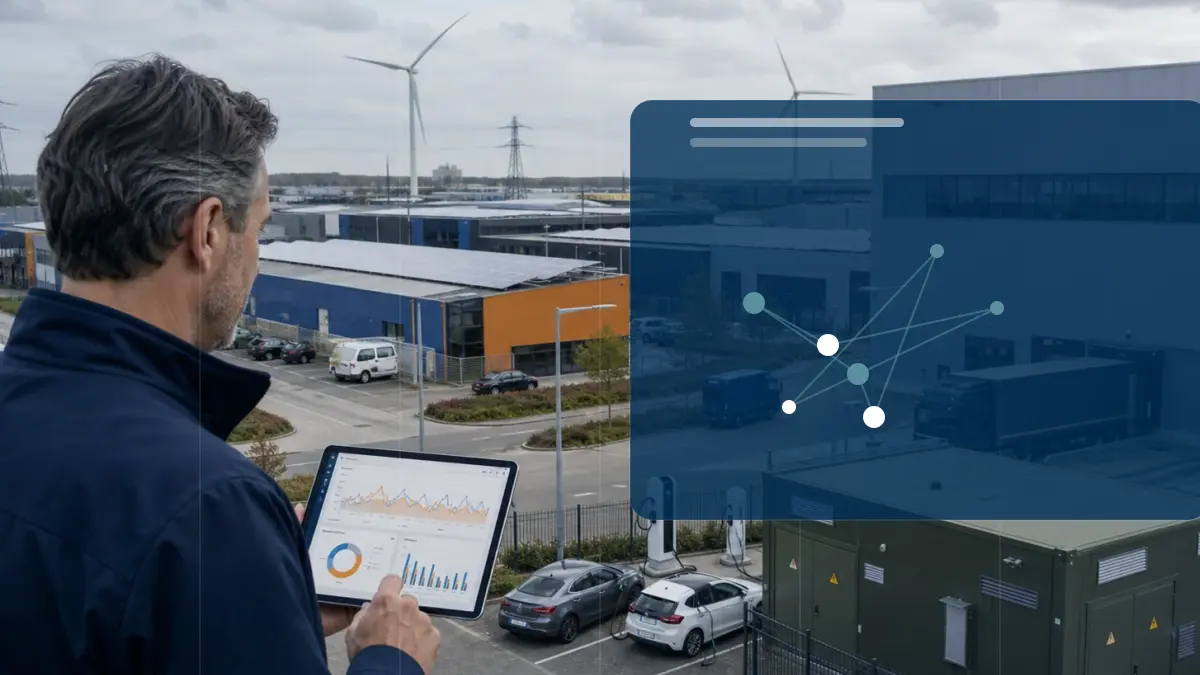
Cable pooling explained: scattered information versus Energy Intelligence
Large parts of the Dutch electricity grid are full. Businesses applying for a new large consumer connection, or wanting to expand one, often end up on a waiting list. Meanwhile, the neighbour's cable regularly sits half empty: a solar farm delivers during the day, but little happens at night. Cable pooling was created to use that idle capacity. It matters to developers of solar and wind farms, and since the rules were widened also to companies with batteries, electrolysers or high consumption.
- A connection can be shared from 100 kilovolt-amperes and with a maximum of four parties; the installations are on the same or an adjacent plot.
- After the Dutch regulator ACM widened the rules, ahead of the new Energy Act, batteries, electrolysers and consuming businesses may now share a connection alongside solar and wind farms.
- The participants sign one joint connection and transport agreement with the grid operator and register the arrangement with the ACM.
Insight
Traditional approach
Information is scattered across portals, documents, invoices or separate spreadsheets.
Modern approach
Data, context and interpretation are brought together into a clear decision picture.
Decision-making
Traditional approach
Choices are made based on averages, assumptions or occasional analyses.
Modern approach
Scenarios, KPIs and current measurement data make the trade-off more concrete and repeatable.
Follow-up
Traditional approach
Actions often stay non-committal or disappear into separate reports.
Modern approach
Follow-up actions, monitoring and reporting are linked to the same energy data.
How does cable pooling work?
With cable pooling, up to four parties connect their installations behind a single grid connection. Towards the grid operator they act as one connected party: there is one joint connection and transport agreement and one contracted transport capacity. The participants divide that capacity among themselves and coordinate their use. It works best with profiles that complement each other. A solar farm delivers during the day, a wind farm often at other moments. This keeps the cable in use more of the time without increasing the peak. Everything behind the transfer point, such as cables and installations, is built and managed by the participants themselves.
- A minimum connection capacity of 100 kilovolt-amperes, with a maximum of four parties.
- The installations are close together, on the same or an adjacent plot.
- One joint connection and transport agreement with the grid operator.
- The arrangement is registered with the Dutch regulator ACM.
When will you encounter it?
Cable pooling is mainly relevant in areas with grid congestion. If you apply there for a new connection or extra transport capacity, you often join a waiting list. Sharing an existing connection can be faster, because the grid operator does not have to build a new connection. Originally, Dutch law only allowed cable pooling for wind and solar farms in each other's immediate vicinity. The regulator ACM has widened the possibilities, ahead of the new Energy Act: storage, conversion and consumption may now also share a connection, and the threshold was lowered from 2 megavolt-amperes to 100 kilovolt-amperes. In a congestion area one hard limit applies: the combined demand may not increase the existing transport capacity.
- Often faster than waiting for a new connection in a congestion area.
- Widened from solar and wind only to batteries, electrolysers and consumers.
- The threshold was lowered from 2 megavolt-amperes to 100 kilovolt-amperes.
- The existing contracted transport capacity remains the ceiling in congestion areas.
How do you get started with cable pooling?
Start with your own energy profile: when do you consume or deliver power, and how much. Then find a partner in the immediate area with a profile that complements yours, for example generation next to consumption, or solar next to wind. Next, make clear agreements on cost sharing, capacity sharing and liability, because together you act as one connected party. Then submit the application to your regional grid operator, who checks whether you meet the conditions. All parties sign a joint connection and transport agreement or an addendum to it. Finally, you register the arrangement with the ACM. Allow for lead time: in practice, reaching solid agreements between the parties takes the most time.
- Map your energy profile and find a neighbour with a complementary profile.
- Record cost sharing, capacity sharing and liability in writing.
- Apply for the shared connection with your regional grid operator.
- Sign the joint connection and transport agreement together and register with the ACM.
Curious what this looks like with your own data?
In a no-obligation call, a specialist looks at your meters, sites and energy questions with you. Response within one business day.
Search the knowledge base
Find the answer to your question.
Search using your own words. Abbreviations and spelling variants are recognised, so EMS also finds the articles on energy management systems.
Topic