
Energy hubs explained for businesses
Direct answer
An energy hub is a local partnership in which Dutch businesses with a large consumer grid connection coordinate their electricity generation, consumption and storage within the available grid capacity. The core idea: by sharing capacity as a group, room is created on a congested electricity grid. This allows participants to expand or electrify even in areas affected by grid congestion.
- Clear definition
- Data-driven assessment
- Risks and opportunities visible
- Practical next steps
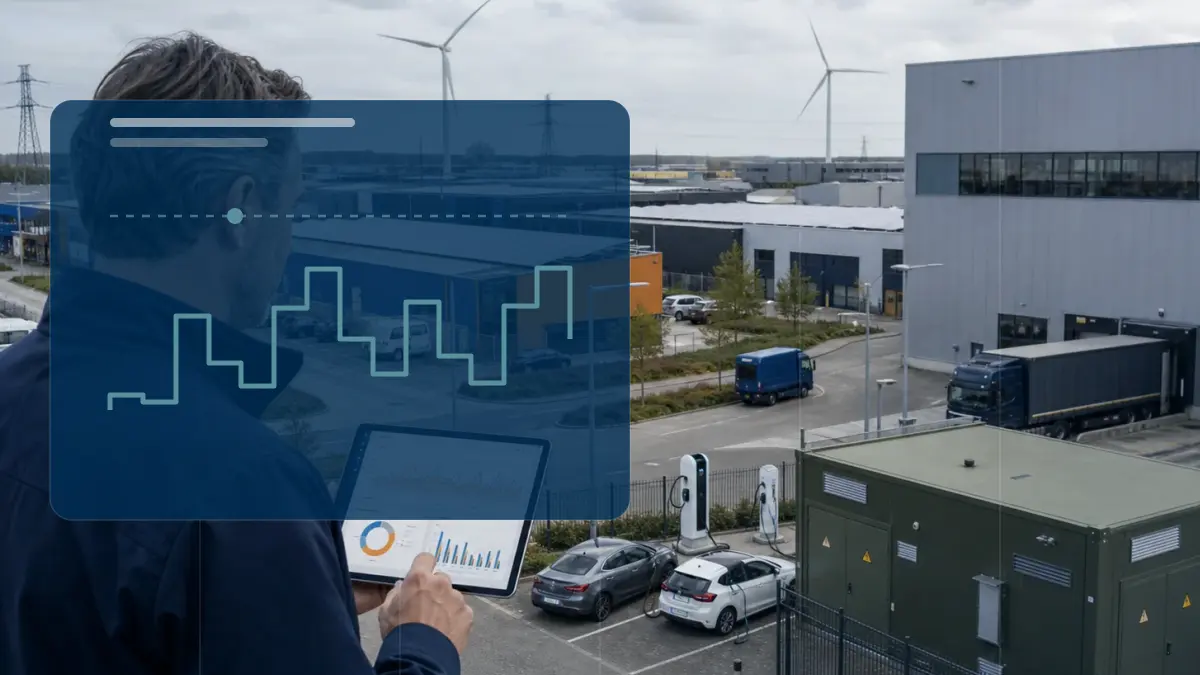
Energy hubs explained: scattered information versus Energy Intelligence
On many Dutch business parks the electricity grid is full. A business that wants to connect charging stations, a heat pump or an extra production line is told by the grid operator that no transport capacity is available. Meanwhile, neighbouring companies rarely use all their contracted capacity at the same moment. An energy hub exploits that difference. Businesses organise themselves, examine their actual consumption patterns together and agree with the grid operator on joint use of the grid.
- Participants are usually grid neighbours: businesses connected to the same part of the electricity grid, often on one business park.
- Through a group transport agreement, the hub signs one joint transport contract with the grid operator and distributes the capacity internally.
- Grid operators can already offer this group transport agreement; from 1 January 2027 they are required to do so.
Insight
Traditional approach
Information is scattered across portals, documents, invoices or separate spreadsheets.
Modern approach
Data, context and interpretation are brought together into a clear decision picture.
Decision-making
Traditional approach
Choices are made based on averages, assumptions or occasional analyses.
Modern approach
Scenarios, KPIs and current measurement data make the trade-off more concrete and repeatable.
Follow-up
Traditional approach
Actions often stay non-committal or disappear into separate reports.
Modern approach
Follow-up actions, monitoring and reporting are linked to the same energy data.
How does an energy hub work?
An energy hub revolves around three activities that participants combine as needed. First, capacity sharing: the group uses the available capacity of the local grid jointly, instead of each business staying strictly within its own contract. Second, joint generation and storage, for example solar panels or a battery serving the whole group. Third, smart steering: local demand and local supply are matched, so electricity does not have to travel unnecessarily across the congested grid. The grid operator facilitates this. It provides data on which businesses share the same cable and determines the capacity the group may use together. Participants typically set up a legal entity, such as a private limited company or a cooperative, to represent the hub.
- Capacity sharing: the group uses the local grid capacity jointly.
- Joint investment in generation and storage, such as solar panels or a battery.
- Smart steering: shifting consumption to moments with local supply.
- The grid operator provides data on grid neighbours and sets the group capacity.
- A legal entity, such as a company or cooperative, represents the hub.
What is the group transport agreement?
The group transport agreement (groepstransportovereenkomst) is the contract form that makes energy hubs legally possible in the Netherlands. Several large consumers jointly sign one transport agreement with the grid operator and receive contracted transport capacity as a group. The participants distribute that capacity among themselves through their own arrangements on consumption and feed-in. Each participant keeps its own connection and connection agreement. The grid operator then enforces the limit of the group rather than individual limits. This gives the operator more certainty about actual grid use and makes better use of the local grid. The Dutch regulator ACM has amended the energy codes accordingly: grid operators may already offer this agreement to large consumers and will be required to do so from 1 January 2027. The group capacity is based on historical usage and is typically lower than the sum of the individual contracts.
- One joint transport contract for the whole group of large consumers.
- The group distributes the capacity itself through internal arrangements.
- Each participant keeps its own connection and connection agreement.
- The ACM has amended the energy codes; offering becomes mandatory from 1 January 2027.
- The group capacity is based on the participants' historical consumption.
When will you encounter this and what can you do?
An energy hub becomes relevant once grid congestion affects your plans: you want to expand, electrify or feed in electricity, but the grid operator cannot provide additional transport capacity. In that case it pays to investigate whether neighbours on the same grid face the same problem. The first step is insight: which businesses are grid neighbours and what do the combined consumption patterns look like? Regional grid operators such as Liander and Stedin support this with data and regional coordinators. The Netherlands Enterprise Agency (RVO) offers a step-by-step plan and a legal toolkit with model contracts for the cooperation. Allow for a serious project: according to Liander, going from first idea to a working hub takes two years on average. Start early, even if the need is not yet acute.
- The trigger is usually refused or limited transport capacity.
- Start with insight into grid neighbours and combined consumption patterns.
- Grid operators provide data and regional guidance.
- RVO offers a step-by-step plan and a legal toolkit.
- Expect an average lead time of two years from idea to realisation.
Curious what this looks like with your own data?
In a no-obligation call, a specialist looks at your meters, sites and energy questions with you. Response within one business day.
Search the knowledge base
Find the answer to your question.
Search using your own words. Abbreviations and spelling variants are recognised, so EMS also finds the articles on energy management systems.
Topic