
Congestion management: how does it work: a guide for businesses
Direct answer
Congestion management is the approach Dutch grid operators use to prevent overloading of the electricity grid by paying companies to shift their consumption or feed-in. How does it work in essence: the grid operator first investigates where and when the grid is congested, then contracts flexible capacity from companies in that area. It is a temporary measure until the grid has been reinforced.
- Clear definition
- Data-driven assessment
- Risks and opportunities visible
- Practical next steps
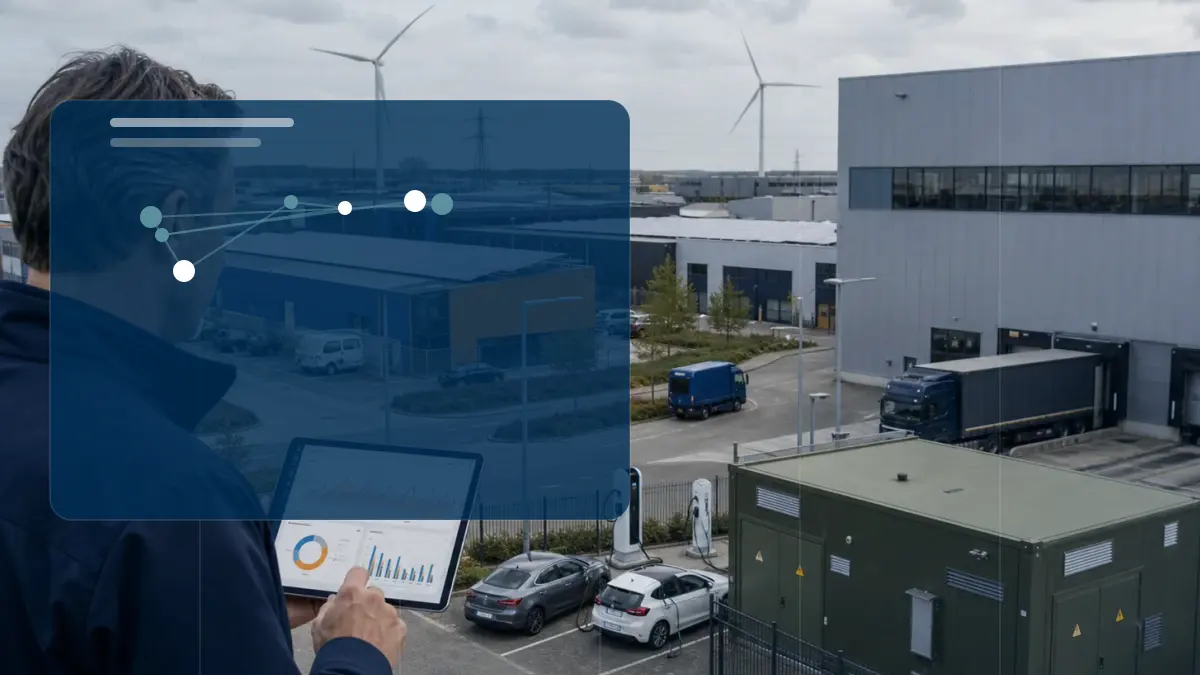
Congestion management: how does it work: scattered information versus Energy Intelligence
In large parts of the Netherlands the electricity grid is full: demand for transport capacity is growing faster than grid operators can build cables and substations. Grid reinforcement takes years. Congestion management bridges that period by distributing the existing capacity more intelligently. Picture a cold store that briefly turns down its freezer installations during the evening peak, paid by the grid operator. For companies with a large consumer connection in a congestion area, this has become a real part of managing energy.
- The grid operator starts with a congestion study that establishes where, when and how much flexible capacity is needed.
- Companies participate through a capacity limitation contract with fixed agreements or through redispatch bids, for example on the GOPACS platform.
- Participation starts voluntarily; if too little capacity is offered, the grid operator can oblige companies with a connection of one megawatt or larger to submit an offer.
Insight
Traditional approach
Information is scattered across portals, documents, invoices or separate spreadsheets.
Modern approach
Data, context and interpretation are brought together into a clear decision picture.
Decision-making
Traditional approach
Choices are made based on averages, assumptions or occasional analyses.
Modern approach
Scenarios, KPIs and current measurement data make the trade-off more concrete and repeatable.
Follow-up
Traditional approach
Actions often stay non-committal or disappear into separate reports.
Modern approach
Follow-up actions, monitoring and reporting are linked to the same energy data.
How does congestion management work step by step?
The process starts with the grid operator. As soon as it expects structural strain on part of the grid, it launches a congestion study. That study maps out at which moments the grid risks becoming overloaded and how much flexible capacity is needed to prevent this. The grid operator publishes the outcome and approaches large consumers in the area, asking whether they can shift consumption or feed-in. Companies that participate sign a contract with the grid operator or offer their flexibility via GOPACS, the platform on which companies offer flexible capacity for congestion management. At moments of expected strain, the grid operator activates the agreed flexibility. The company then temporarily reduces its power and receives the agreed compensation.
- The grid operator announces congestion and starts a congestion study in the area concerned.
- The study determines when the grid risks overloading and how much flexible capacity is needed.
- Large consumers in the area are actively approached to offer flexibility.
- Activation varies per situation: from a day ahead to shortly before the moment itself.
Which contracts and compensations exist?
There are two main forms. The first is the capacity limitation contract: you agree with the grid operator to use or feed in less power at certain moments, in exchange for compensation. The second form is redispatch: you offer flexible capacity per situation at a price you set yourself, for example via GOPACS. The grid operator assesses those bids and accepts or rejects them. The compensation can consist of a fixed availability fee, an amount per actual activation, or a combination of both. Many companies engage a congestion service provider: a specialised service company that handles the technology, the administration and the bidding. In some cases engaging such a party is even a condition for participation.
- Capacity limitation contract: fixed agreements on lower consumption or feed-in at peak moments.
- Redispatch: you offer flexible capacity at a price you set yourself.
- Compensation consists of an availability component, an activation component or both.
- A congestion service provider can handle bids and control on your behalf.
When will you encounter it and what can you do?
Congestion management applies to companies with a large consumer connection, meaning larger than three times eighty amperes, in areas the grid operator has designated as congestion areas. Participation starts voluntarily: the grid operator asks companies to offer flexible capacity. If that yields too little, it can oblige companies with a connection of one megawatt or larger to submit an offer. These rules are laid down in the grid codes supervised by the regulator ACM. You can prepare by mapping which processes can temporarily use less power, such as cooling, charging infrastructure or production you can reschedule. Companies that offer flexibility receive compensation, help keep the grid reliable and can thereby help create room for new connections in the region.
- Applies to a large consumer connection in a designated congestion area.
- Voluntary at first; from a connection of one megawatt the grid operator can make an offer mandatory.
- Map in advance which capacity you can shift and at which moments.
- The grid operator only activates flexibility at moments of expected strain.
Curious what this looks like with your own data?
In a no-obligation call, a specialist looks at your meters, sites and energy questions with you. Response within one business day.
Search the knowledge base
Find the answer to your question.
Search using your own words. Abbreviations and spelling variants are recognised, so EMS also finds the articles on energy management systems.
Topic