
Generation
Article 7 of 20 · Generation and storageGreen, blue and grey hydrogen: a guide for businesses
Direct answer
Green, blue and grey hydrogen are not different gases, but the same hydrogen made through a different production route. Grey hydrogen comes from natural gas, releasing CO2 into the air; blue hydrogen uses that same route, but captures and stores the CO2. Green hydrogen is made through electrolysis with renewable electricity, with no CO2 released during production.
- Clear definition
- Data-driven assessment
- Risks and opportunities visible
- Practical next steps
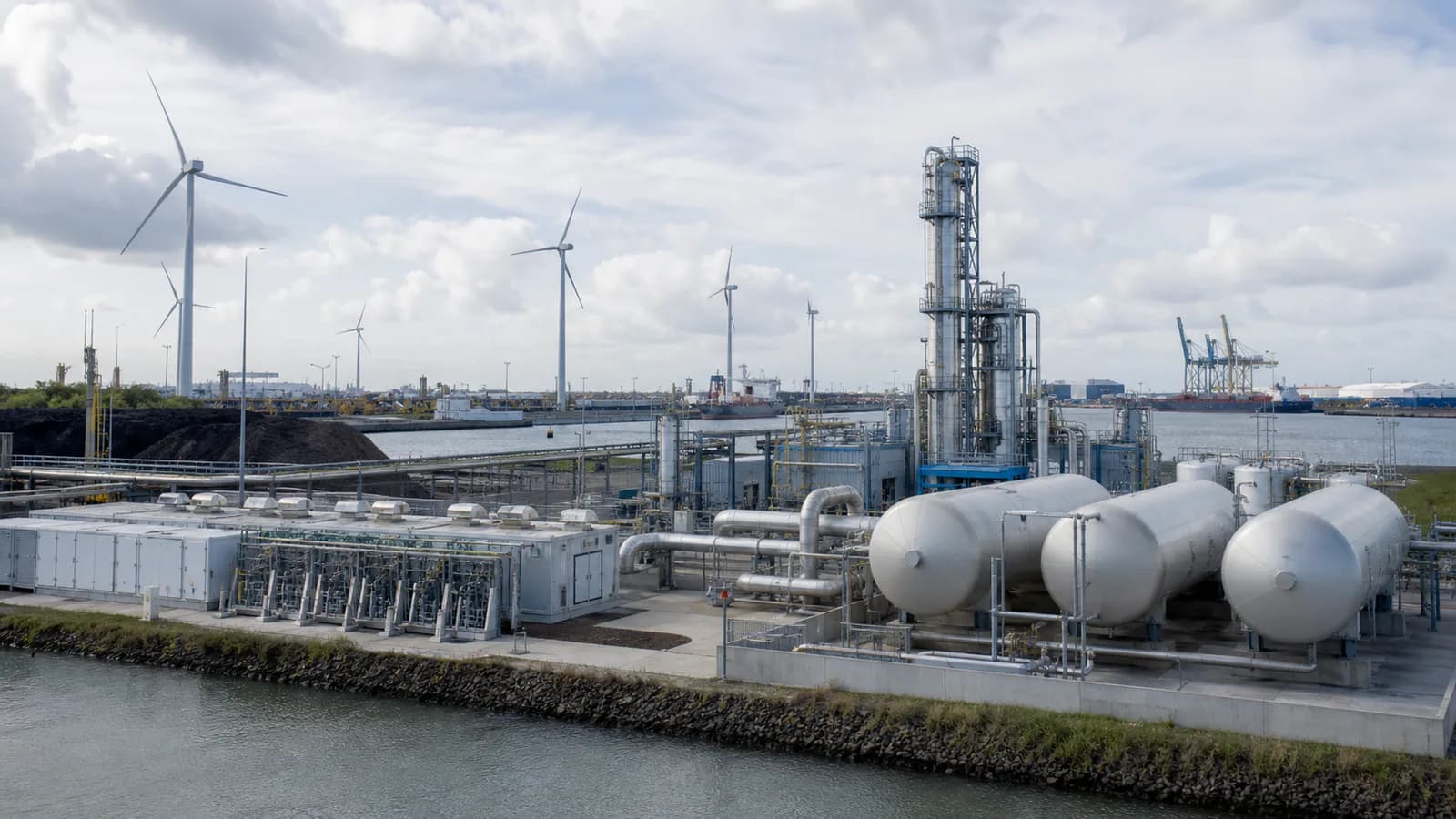
Green, blue and grey hydrogen: scattered information versus Energy Intelligence
Hydrogen itself is colourless. Even so, you will hear people speak of grey, blue and green hydrogen. Those colours are a convention to indicate how the gas was produced and how much CO2 was released. For a business buying or considering hydrogen, that route determines the climate impact and the price. A refinery using hydrogen today almost certainly works with grey hydrogen. Anyone weighing up sustainability runs into the question: which colour, and what does it cost.
- The colour says nothing about the gas itself, but about how it is made and how much CO2 is released.
- Grey comes from natural gas via steam reforming; blue is the same route with CO2 capture and storage; green comes from electrolysis with renewable electricity.
- In the Netherlands almost all hydrogen is currently grey; green hydrogen is produced on a very small scale.
Insight
Traditional approach
Information is scattered across portals, documents, invoices or separate spreadsheets.
Modern approach
Data, context and interpretation are brought together into a clear decision picture.
Decision-making
Traditional approach
Choices are made based on averages, assumptions or occasional analyses.
Modern approach
Scenarios, KPIs and current measurement data make the trade-off more concrete and repeatable.
Follow-up
Traditional approach
Actions often stay non-committal or disappear into separate reports.
Modern approach
Follow-up actions, monitoring and reporting are linked to the same energy data.
Grey, blue and green: what is the difference?
The three main colours follow the production route. Grey hydrogen is made from natural gas via steam reforming: natural gas reacts with steam, producing hydrogen while CO2 is released into the air. Blue hydrogen uses exactly the same route from natural gas, but the released CO2 is captured and stored, for example in an empty gas field. That way the CO2 does not reach the atmosphere, although in practice not all CO2 is captured. Green hydrogen follows a very different path: with renewable electricity from wind or sun, water is split through electrolysis into hydrogen and oxygen. That process releases no CO2.
- Grey: from natural gas via steam reforming, CO2 goes into the air.
- Blue: the same natural gas route, but with capture and storage of the CO2.
- Green: through electrolysis with renewable electricity, no CO2 during production.
- The colour describes the origin and the emissions, not the gas.
And the other colours?
Besides grey, blue and green, more colours circulate, all following the same principle: the colour refers to the energy source or the production process. They are less clear-cut and are not used the same way everywhere. Hydrogen from electrolysis with ordinary grid electricity is sometimes called yellow, because that electricity is a mix of sources and therefore partly fossil. Hydrogen from electrolysis with nuclear power is sometimes called pink or purple. At heart it all comes down to one question: how much CO2 is released during production. For your assessment, that distinction matters most, not the exact palette of colours.
- Yellow is sometimes used for electrolysis with ordinary grid electricity, partly fossil.
- Pink or purple sometimes stands for electrolysis with nuclear power.
- The colours are not a strict standard and are not used the same everywhere.
- The core question remains: how much CO2 is released during production?
Why green is the goal and grey still the practice
Green hydrogen is the goal, because no CO2 is released during production. Yet green is still expensive and scarce: making it costs more than grey hydrogen, and it needs a lot of renewable electricity that is also in demand elsewhere. Blue hydrogen is seen as a possible interim step, though it draws criticism, because it still requires natural gas. The hydrogen that industry uses today, mainly as a raw material for products such as ammonia and for refining, is therefore still almost always grey. For your assessment this means: the colour determines the climate gain, and the switch from grey to blue or green mainly comes down to cost and availability.
- Green releases no CO2 during production, but is currently more expensive than grey and scarce.
- Blue counts as a possible interim step, but stays dependent on natural gas.
- Industry today uses almost exclusively grey hydrogen, mainly as a raw material.
- The colour determines the climate gain; the switch comes down to cost and availability.
Curious what this looks like with your own data?
In a no-obligation call, a specialist looks at your meters, sites and energy questions with you. Response within one business day.
Search the knowledge base
Find the answer to your question.
Search using your own words. Abbreviations and spelling variants are recognised, so EMS also finds the articles on energy management systems.
Topic