
Aquathermy TEO TEA: a guide for businesses
Direct answer
Aquathermal energy is the extraction of heat and cold from water to sustainably heat and cool buildings and neighbourhoods. It has three Dutch forms: TEO from surface water such as rivers and lakes, TEA from waste water in the sewer system, and TED from drinking water. The recovered heat is often stored underground and upgraded with a heat pump for a heat network.
- Clear definition
- Data-driven assessment
- Risks and opportunities visible
- Practical next steps
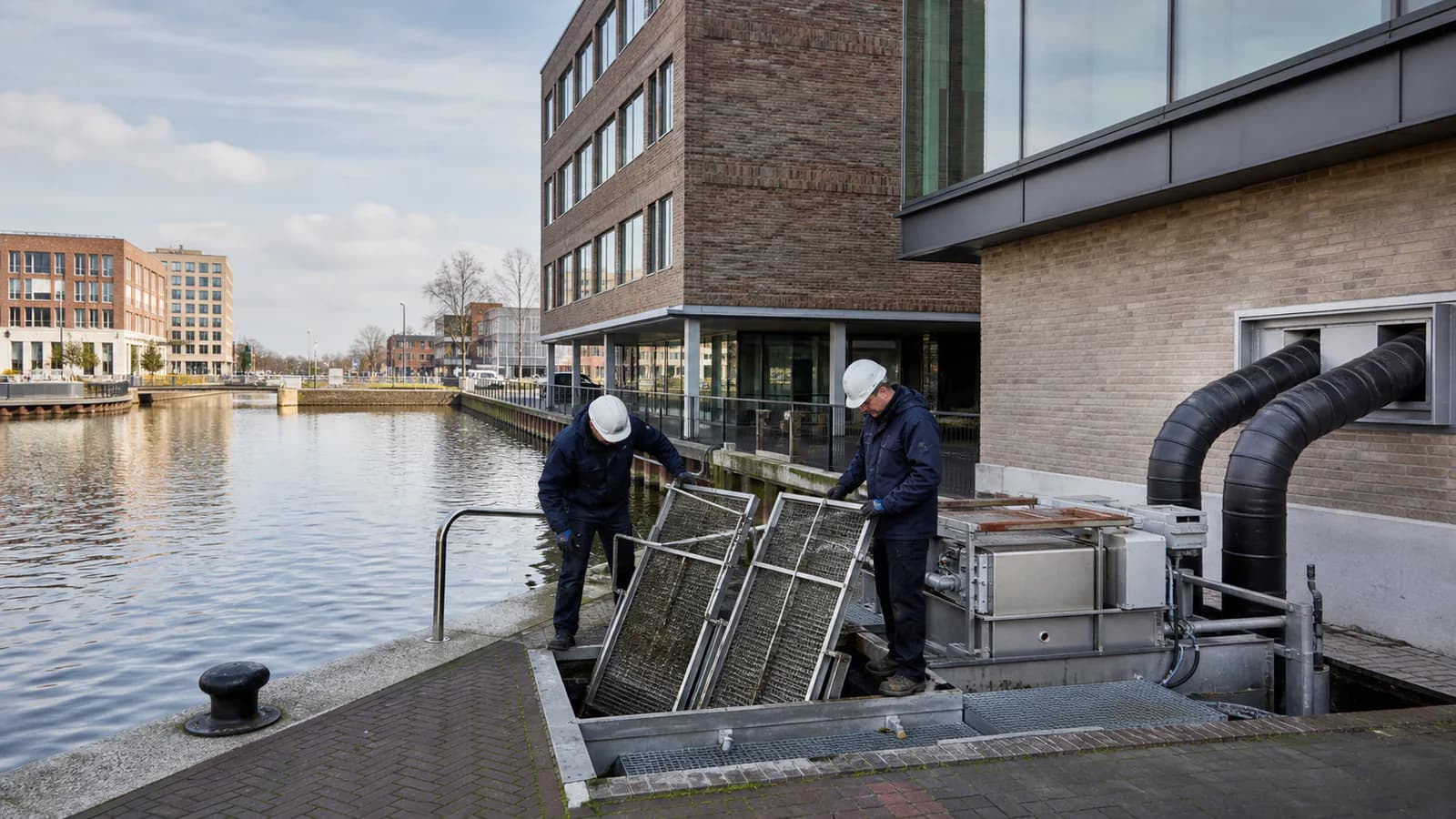
Aquathermy TEO TEA: scattered information versus Energy Intelligence
The water around us holds a lot of heat, even at a low temperature. A river, a canal, the sewer or the drinking water pipe acts as a large, free heat source. Aquathermal energy uses that heat to move homes and businesses away from natural gas. For a municipality wanting to make a neighbourhood gas-free, or a building owner next to open water, it is a serious alternative to a gas boiler. The Netherlands, a country of water, has a large, underused potential for it.
- TEO extracts heat from surface water, TEA from waste water in the sewer or treatment plant, and TED from the drinking water network.
- A heat exchanger extracts the heat, an underground store (ATES) keeps it until the heating season, and a heat pump raises the temperature for a heat network.
- Aquathermal energy delivers both heat in winter and cooling in summer, and works best for buildings close to a water source.
Insight
Traditional approach
Information is scattered across portals, documents, invoices or separate spreadsheets.
Modern approach
Data, context and interpretation are brought together into a clear decision picture.
Decision-making
Traditional approach
Choices are made based on averages, assumptions or occasional analyses.
Modern approach
Scenarios, KPIs and current measurement data make the trade-off more concrete and repeatable.
Follow-up
Traditional approach
Actions often stay non-committal or disappear into separate reports.
Modern approach
Follow-up actions, monitoring and reporting are linked to the same energy data.
What is aquathermal energy and what are its three forms?
Aquathermal energy is the collective name for extracting heat and cold from water. There are three forms, classified by source. TEO stands for thermal energy from surface water: heat from rivers, canals, lakes and ditches. TEA stands for thermal energy from waste water: heat from the sewer or from treated water at a sewage treatment plant. TED stands for thermal energy from drinking water: heat from the drinking water network. Surface water is the source with the greatest potential, because there is so much of it. Waste water is warmer and flows all year round, which makes it suitable for a constant supply.
- TEO: heat from surface water such as rivers, lakes and canals.
- TEA: heat from waste water in the sewer or the treatment plant.
- TED: heat from the drinking water network.
- Surface water has the greatest potential; waste water is warmer and more constant.
How does aquathermal energy work in outline?
The water itself never enters your building. A heat exchanger removes the heat from the water, after which the cooled water flows back to the source. Surface water is warmest in summer, exactly when you do not yet need that heat. The heat is therefore often stored temporarily underground, in an aquifer thermal energy store (ATES). In winter that stored heat is brought back up. The temperature from water and ground is too low to heat directly. A heat pump raises it to a usable level, after which a heat network delivers the heat to the connected buildings. In summer the same system delivers cooling.
- A heat exchanger extracts heat; the water returns cooled to the source.
- Heat from summer is often stored underground (ATES) until winter.
- A heat pump raises the temperature to a usable level.
- A heat network distributes the heat, and cooling in summer, across the buildings.
What should you watch out for?
Aquathermal energy stands or falls with the proximity of a suitable water source. The further the water lies from the buildings to be supplied, the more expensive and lossy the transport. Seasonal storage is usually indispensable, because heat demand and supply do not coincide; an underground store bridges that gap. That also makes it a matter of permits. Extracting from and discharging to surface water requires permission from the water authority or Rijkswaterstaat, and an underground store falls under the rules for ground energy. Aquathermal energy also works best in well-insulated buildings, because the source temperature is low.
- The water source must be close to the buildings to limit losses.
- Seasonal storage in an underground store bridges demand and supply.
- You need permits from the water authority or Rijkswaterstaat and for ground energy.
- Good insulation matters, because the source temperature is low.
Curious what this looks like with your own data?
In a no-obligation call, a specialist looks at your meters, sites and energy questions with you. Response within one business day.
Search the knowledge base
Find the answer to your question.
Search using your own words. Abbreviations and spelling variants are recognised, so EMS also finds the articles on energy management systems.
Topic