
ATES aquifer thermal energy storage: a guide for businesses
Direct answer
WKO, the Dutch term for aquifer thermal energy storage (warmte-koudeopslag), is a system that stores heat and cold seasonally in the shallow subsurface. In summer you cool the building and store the released heat. In winter you use that stored heat again, usually through a heat pump. This heats and cools a building with far less energy than a conventional installation.
- Clear definition
- Data-driven assessment
- Risks and opportunities visible
- Practical next steps
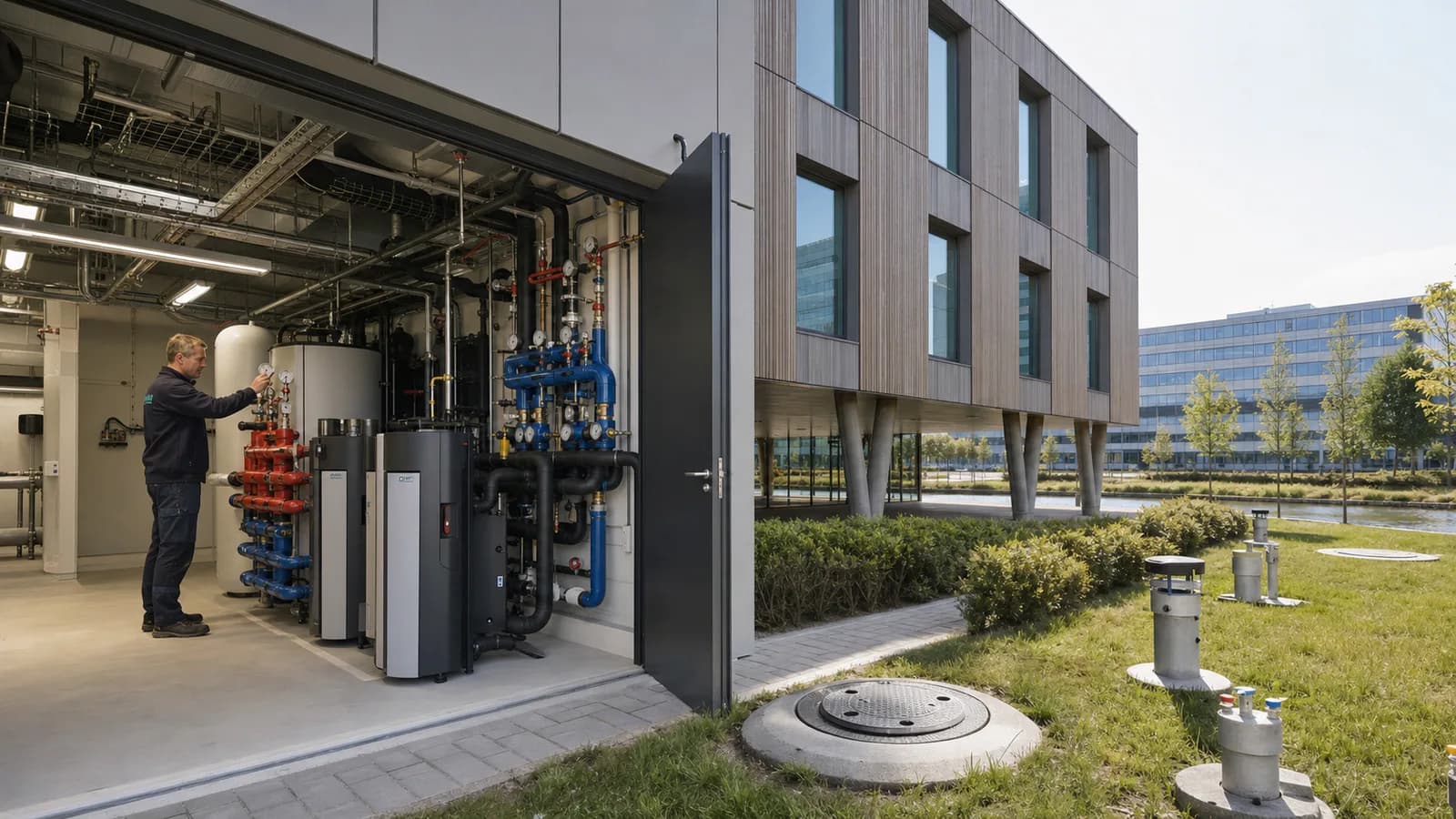
ATES aquifer thermal energy storage: scattered information versus Energy Intelligence
Larger buildings need energy all year round: heat in winter, cooling in summer. Producing both separately is costly and energy-intensive. WKO uses the subsurface as a buffer that bridges the seasons. You keep winter's cold for summer, and summer's heat for winter. In the Netherlands this mainly applies to offices, hospitals, data centres and other utility buildings with a substantial heating and cooling demand. The soil, the permit and the ongoing management determine which system fits.
- WKO follows the seasons: cooling produces stored heat for winter, heating produces stored cold for summer.
- There are open systems that pump groundwater and closed systems with fluid loops in the ground; for open systems the province is the competent authority, for closed systems the municipality.
- A sound energy balance is essential: if you structurally extract more heat than cold, the subsurface cools down and the system performs worse over time.
Insight
Traditional approach
Information is scattered across portals, documents, invoices or separate spreadsheets.
Modern approach
Data, context and interpretation are brought together into a clear decision picture.
Decision-making
Traditional approach
Choices are made based on averages, assumptions or occasional analyses.
Modern approach
Scenarios, KPIs and current measurement data make the trade-off more concrete and repeatable.
Follow-up
Traditional approach
Actions often stay non-committal or disappear into separate reports.
Modern approach
Follow-up actions, monitoring and reporting are linked to the same energy data.
How does WKO work?
WKO exploits the fact that the shallow subsurface has an almost constant temperature. In summer you extract cold from the ground to cool the building. The heat that is released is returned to the ground and stored there. In winter it reverses: you retrieve that stored heat, raise its temperature with a heat pump to a usable level and heat the building. The cold created in the process is stored again for the next summer. Energy shuttles back and forth between the seasons, instead of you having to generate heat and cold separately.
- The shallow subsurface serves as a seasonal buffer with a stable temperature.
- Summer: cooling with ground cold, the released heat goes into the ground.
- Winter: retrieving the stored heat and upgrading it with a heat pump.
- A heat pump bridges the gap between ground temperature and the desired temperature.
Open or closed system?
WKO exists in two main forms. An open system pumps groundwater between a warm and a cold source in a water-bearing layer. Its underground footprint can be larger than the plot itself, so in densely built areas systems can interfere with each other. For an open system the province is the competent authority and a permit is required under the water rules. A closed system uses no groundwater, but loops in the ground with a circulation fluid that exchanges heat and cold with the soil. For these the municipality is the competent authority. Open systems often suit larger buildings, while closed systems also fit smaller projects and homes.
- Open system: pumping groundwater between a warm and a cold source.
- Closed system: fluid loops in the ground, without pumping up groundwater.
- Competent authority: the province for open systems, the municipality for closed systems.
- Open systems have a larger underground footprint and can interfere with each other.
What should you watch out for?
WKO is not suitable everywhere and requires careful preparation. First the soil: there must be a suitable water-bearing layer or enough room for ground loops, and the area must not be crowded with other systems or protected groundwater. Then the permit: an open system goes through the province, a closed system through the municipality. The energy balance is crucial. If year after year you extract more heat than cold from the ground, the subsurface cools structurally and efficiency falls. That is why WKO comes with monitoring and periodic reporting on pumped volumes, temperatures and balance. The upfront investment is high; the payback lies in the lower energy consumption.
- Suitable soil is a precondition, not every location lends itself to it.
- A permit is needed: the province for open, the municipality for closed systems.
- Guard the energy balance, or the subsurface cools and efficiency drops.
- Expect monitoring, periodic reporting and a high upfront investment.
Curious what this looks like with your own data?
In a no-obligation call, a specialist looks at your meters, sites and energy questions with you. Response within one business day.
Search the knowledge base
Find the answer to your question.
Search using your own words. Abbreviations and spelling variants are recognised, so EMS also finds the articles on energy management systems.
Topic