
Biogas and green gas: a guide for businesses
Direct answer
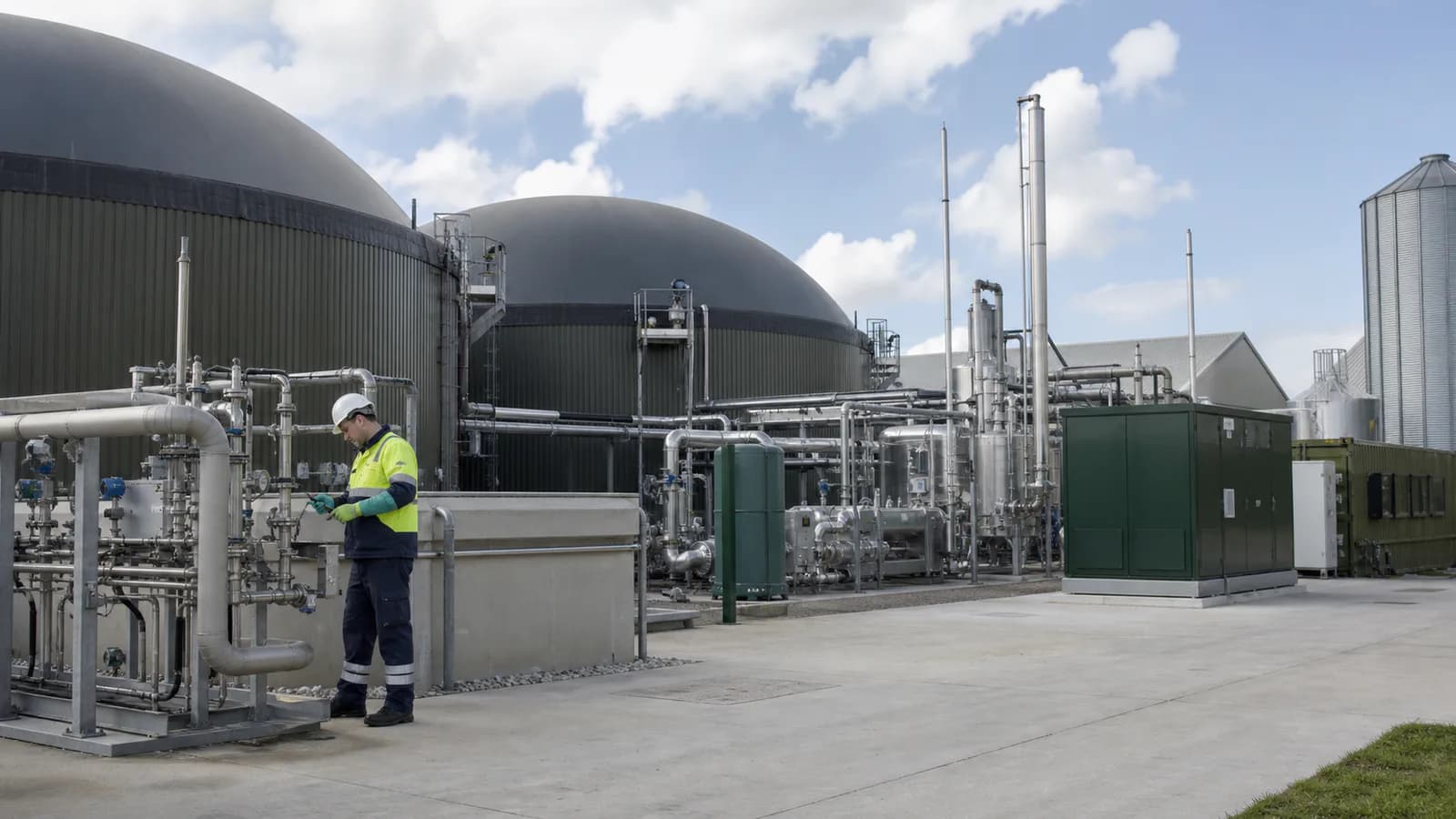
Green gas is biogas that has been upgraded to natural gas quality and can be injected into the gas grid. Biogas itself is produced by the digestion of organic material such as manure, food and garden waste, and sewage sludge. It is a raw mixture of mainly methane and carbon dioxide. Only after cleaning and upgrading does it become green gas, a sustainable alternative to fossil natural gas.
- Clear definition
- Data-driven assessment
- Risks and opportunities visible
- Practical next steps
Biogas and green gas: scattered information versus Energy Intelligence
The Netherlands wants to move away from fossil natural gas, but many homes, factories and vehicles still run on it. Green gas can replace part of that natural gas without replacing installations, because it behaves identically. Think of a dairy farmer digesting manure, or a water authority using sewage sludge. A residual stream that would otherwise decompose becomes an energy source. For companies with a natural gas connection or an organic residual stream, this is a concrete route to becoming more sustainable.
- Biogas is released during the digestion of organic material and consists mainly of methane, the combustible part, and carbon dioxide, plus traces such as hydrogen sulphide.
- During upgrading the carbon dioxide and impurities are removed, so the quality matches natural gas and the gas may enter the grid.
- The sustainable origin of green gas is recorded with a Guarantee of Origin for gas, issued in the Netherlands by VertiCer.
Insight
Traditional approach
Information is scattered across portals, documents, invoices or separate spreadsheets.
Modern approach
Data, context and interpretation are brought together into a clear decision picture.
Decision-making
Traditional approach
Choices are made based on averages, assumptions or occasional analyses.
Modern approach
Scenarios, KPIs and current measurement data make the trade-off more concrete and repeatable.
Follow-up
Traditional approach
Actions often stay non-committal or disappear into separate reports.
Modern approach
Follow-up actions, monitoring and reporting are linked to the same energy data.
What is the difference between biogas and green gas?
Biogas and green gas are not the same, even though the terms are often used interchangeably. Biogas is produced by digestion: micro-organisms break down organic material in a sealed, oxygen-free tank. Usable feedstocks include manure, food and garden waste, sewage sludge, and residual streams from the food industry. The result is a raw mixture of mainly methane and carbon dioxide, with small amounts of hydrogen sulphide and water vapour. This raw biogas can be burned locally, but it does not simply fit onto the gas grid. Green gas is biogas that has been cleaned and upgraded: the carbon dioxide and impurities are removed until the composition matches natural gas.
- Biogas is produced by digesting organic material without oxygen.
- Raw biogas consists mainly of methane and carbon dioxide, with traces such as hydrogen sulphide.
- Green gas is upgraded biogas, with the same quality as natural gas.
- Only green gas can be injected into the natural gas grid without objection.
What is green gas used for?
Green gas uses residual streams that would otherwise go unused and thereby replaces fossil natural gas. Because its quality equals natural gas, it can travel through the same pipes, boilers and appliances. That makes it usable for heating buildings, for example in monumental properties or rural homes where a fully electric heat pump is difficult. In industry, green gas can feed processes that require high temperatures above 100 degrees Celsius. In road transport it serves as an alternative fuel for cars and trucks. It also helps heat networks absorb peaks when there is little sun or wind. This keeps the energy system reliable.
- Heating buildings as a replacement for natural gas, often with a hybrid heat pump.
- Heat for industrial processes that require temperatures above 100 degrees Celsius.
- Fuel for passenger and freight transport on the road.
- Absorbing peaks in heat networks when there is little sun or wind.
What should you pay attention to?
Green gas is not an unlimited resource. Production depends on available organic feedstocks, and those are finite: there is only so much manure, organic waste and residual stream. Animal manure is one of the most common sustainable organic feedstocks for green gas in the Netherlands. Upgrading and grid injection cost money and require a connection with the grid operator. The sustainable origin is safeguarded with a Guarantee of Origin for gas: a digital certificate proving that a quantity of gas was produced sustainably. In the Netherlands, VertiCer issues these certificates.
- The availability of organic feedstocks limits how much green gas is possible.
- Upgrading and grid injection require investment and a connection with the grid operator.
- A Guarantee of Origin proves the green origin; VertiCer issues them in the Netherlands.
Curious what this looks like with your own data?
In a no-obligation call, a specialist looks at your meters, sites and energy questions with you. Response within one business day.
Search the knowledge base
Find the answer to your question.
Search using your own words. Abbreviations and spelling variants are recognised, so EMS also finds the articles on energy management systems.
Topic