
Community energy
Article 5 of 7 · Energy cooperatives and community energyEnergy community under RED III: a guide for businesses
Direct answer
An energy community under RED III is a renewable energy community: a legal entity in which citizens, SMEs and local authorities jointly generate, share, store and use renewable energy. The concept originates from the European Renewable Energy Directive. Directive (EU) 2023/2413, known as RED III, is the current revision of that directive. The primary purpose of such a community is value for its members and local area, not financial profit.
- Clear definition
- Data-driven assessment
- Risks and opportunities visible
- Practical next steps
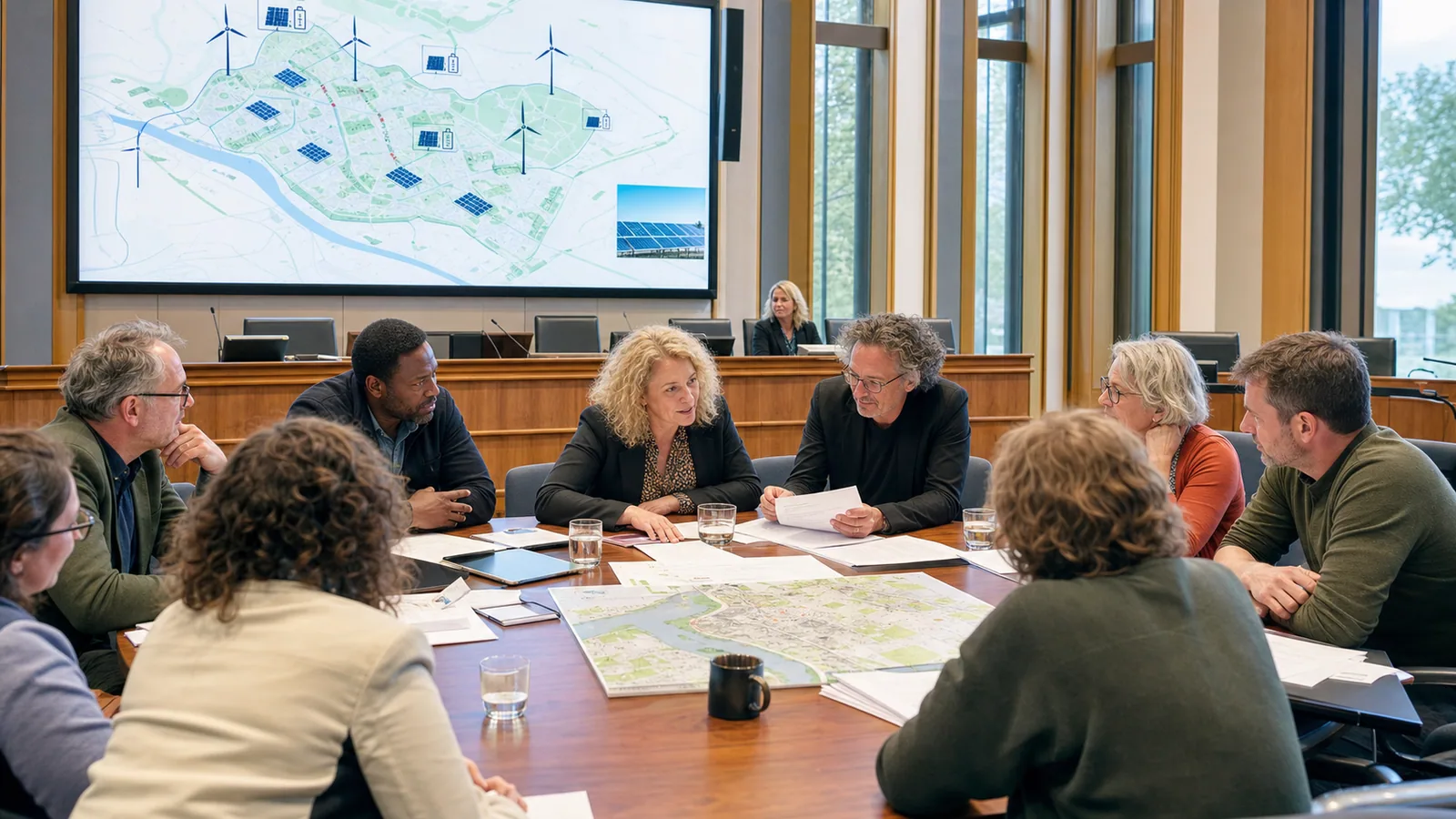
Energy community under RED III: scattered information versus Energy Intelligence
Grid congestion and rising energy costs make local cooperation attractive. Picture a business park where one company has surplus solar power while its neighbour wants to charge electric forklifts. The EU wants citizens and businesses to take such an active role in the energy market and has anchored the energy community in law for that purpose. For cooperatives, owners' associations and business associations, this is the legal basis for generating and sharing together. The Netherlands has now translated these European rules into the Energy Act.
- The renewable energy community (REC) is defined in the Renewable Energy Directive; the citizen energy community (CEC) is defined in the Electricity Directive (EU) 2019/944.
- An energy community may generate, consume, share and store electricity, supply it to members, and offer flexibility services.
- In the Netherlands, the Energy Act (Energiewet), in force since 1 January 2026, regulates energy communities and energy sharing.
Insight
Traditional approach
Information is scattered across portals, documents, invoices or separate spreadsheets.
Modern approach
Data, context and interpretation are brought together into a clear decision picture.
Decision-making
Traditional approach
Choices are made based on averages, assumptions or occasional analyses.
Modern approach
Scenarios, KPIs and current measurement data make the trade-off more concrete and repeatable.
Follow-up
Traditional approach
Actions often stay non-committal or disappear into separate reports.
Modern approach
Follow-up actions, monitoring and reporting are linked to the same energy data.
Two European concepts: REC and CEC
EU law recognises two types of energy communities. The renewable energy community (REC) originates from the Renewable Energy Directive (EU) 2018/2001, Article 22. Members are located near the projects and the community works with renewable energy. RED III, Directive (EU) 2023/2413, revises this directive: the binding EU target for renewable energy in 2030 was raised to at least 42.5 percent and permitting procedures must become faster. The core rules for communities remain in place. The citizen energy community (CEC) is defined in the Electricity Directive (EU) 2019/944, Article 16. That form is technology neutral, applies only to electricity and has no proximity requirement. Both forms are legal entities with open and voluntary participation, in which value for members and the local area comes first.
- REC: renewable energy, proximity to the projects, regulated in the Renewable Energy Directive
- CEC: electricity only, technology neutral, no proximity requirement, regulated in the Electricity Directive
- RED III raises the EU target for 2030 and speeds up permitting
- Both forms: legal entity, open participation, profit is not the primary purpose
What may an energy community do?
An energy community may generate, consume, store and sell electricity, and share the energy it produces with its own members. Flexibility services are also included: the community can offer demand response and storage to the market or the grid operator. Member states must establish an enabling framework so that communities can access energy markets on a level playing field with other market participants. The revised Renewable Energy Directive also allows member states to promote community participation in offshore wind and in district heating and cooling networks. Governance is essential: control lies with the members. In a citizen energy community, larger companies may also be members, but effective control remains with natural persons, local authorities and small enterprises.
- Generating, consuming, storing and selling electricity
- Sharing energy with its own members, both households and businesses
- Providing flexibility services through demand response and storage
- Access to energy markets on a level playing field with other market participants
- Control lies with the members, not with large commercial parties
How does this work in the Netherlands and what does it mean for you?
The Netherlands has implemented both European concepts in the Energy Act (Energiewet), which replaced the Electricity Act 1998 and the Gas Act on 1 January 2026. The act recognises the energy community as a separate category: a legal entity controlled by its members, whose primary purpose is benefits for members and the local area rather than profit. Such a community may sell and supply electricity produced by its members. Energy sharing is possible when the supplier offers it and the participants are customers of that supplier. Under European rules, this is being extended to energy sharing with free choice of supplier. For your business, this means you can generate and share jointly with neighbours on a business park or with a local cooperative. For SMEs, one condition applies to renewable energy communities: participation may not be your primary commercial activity.
- The Energy Act replaced the Electricity Act 1998 and the Gas Act on 1 January 2026
- Energy community: primary purpose is value for members and the local area, control held by the members
- Supplying electricity produced by members is regulated by law
- Energy sharing with free choice of supplier is being extended under EU rules
- SMEs may participate as long as it is not their primary commercial activity
Curious what this looks like with your own data?
In a no-obligation call, a specialist looks at your meters, sites and energy questions with you. Response within one business day.
Search the knowledge base
Find the answer to your question.
Search using your own words. Abbreviations and spelling variants are recognised, so EMS also finds the articles on energy management systems.
Topic