
Community energy
Article 4 of 7 · Energy cooperatives and community energyLocal energy system: a guide for businesses
Direct answer
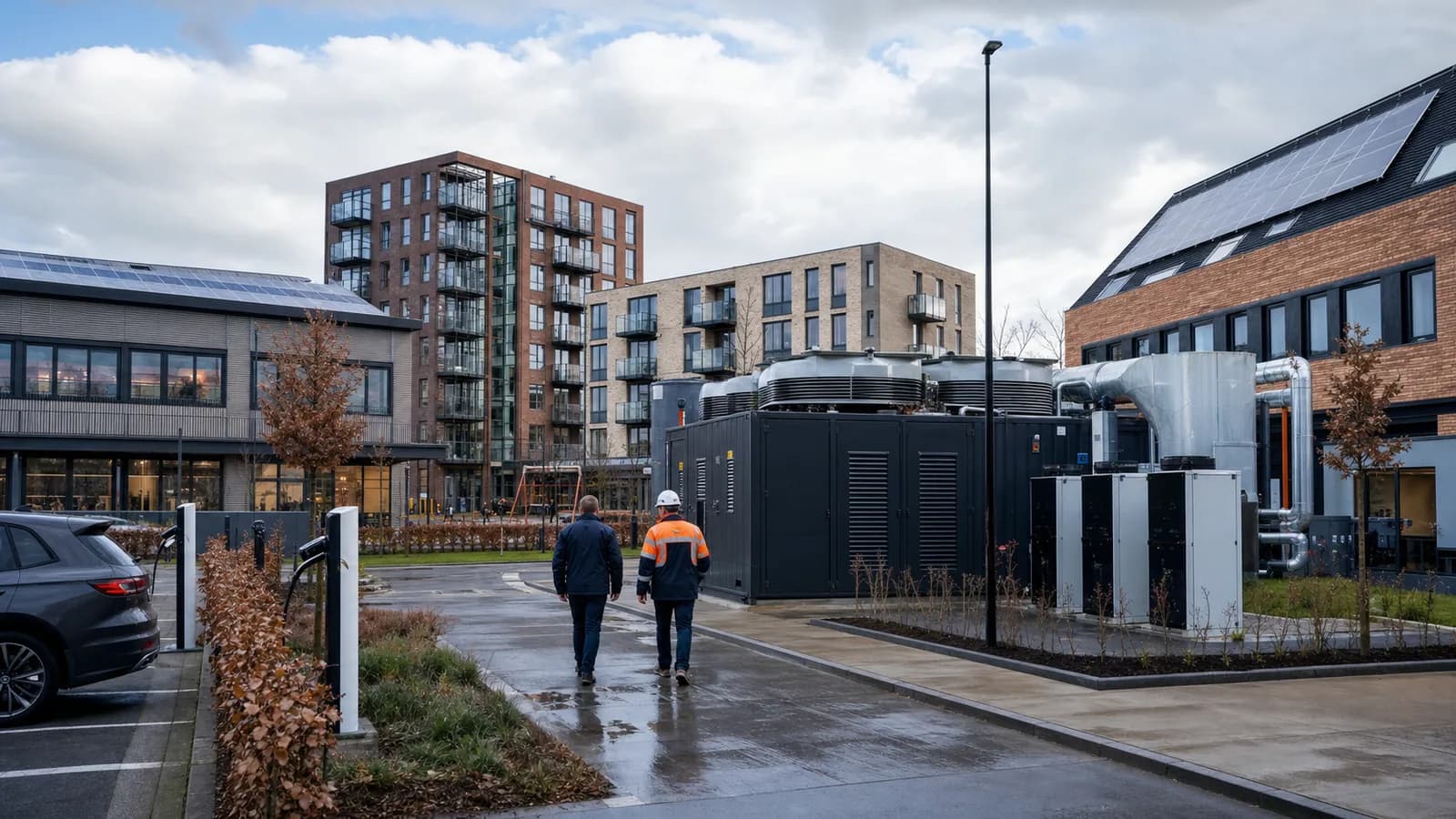
A local energy system is a coherent combination of energy generation, storage, consumption and smart control within a defined area, such as a business park, neighbourhood or village. Participants use locally generated energy directly where possible or store it temporarily. This limits the load on the electricity grid, which helps to counter grid congestion.
- Clear definition
- Data-driven assessment
- Risks and opportunities visible
- Practical next steps
Local energy system: scattered information versus Energy Intelligence
In many parts of the Netherlands the electricity grid is full. Businesses wait for a heavier connection and new solar projects cannot always feed their power into the grid. Picture a business park where one company has a roof full of solar panels, while its neighbour needs a lot of power during the day. Combining those flows locally creates room the grid alone cannot offer. This makes local energy systems interesting for businesses, municipalities and energy cooperatives.
- Participants align generation, consumption and storage through smart control, which reduces peaks on the electricity grid.
- An energy hub is a well-known form: businesses on one site jointly conclude a group contract with the grid operator on shared transport capacity.
- The Dutch Energy Act, in force since 1 January 2026, allows self-generated energy to be shared with other users.
Insight
Traditional approach
Information is scattered across portals, documents, invoices or separate spreadsheets.
Modern approach
Data, context and interpretation are brought together into a clear decision picture.
Decision-making
Traditional approach
Choices are made based on averages, assumptions or occasional analyses.
Modern approach
Scenarios, KPIs and current measurement data make the trade-off more concrete and repeatable.
Follow-up
Traditional approach
Actions often stay non-committal or disappear into separate reports.
Modern approach
Follow-up actions, monitoring and reporting are linked to the same energy data.
How does a local energy system work?
In a local energy system, locally generated energy, for example from solar or wind, is used directly where possible or stored temporarily. Smart control ensures that demand, supply and storage match each other. That limits peak loads on the electricity grid. The system remains connected to the wider grid, so shortages and surpluses can still be balanced. Participants can exchange energy among themselves: one party supplies solar power during the day, another consumes it at that moment. On business parks such a collaboration is often called an energy hub. The ideal form differs per area and depends on the participants, the available energy sources and the local grid situation. Some systems manage a great deal themselves, others remain largely dependent on energy from outside the area.
- Local generation is used directly, stored or shared with other participants
- Smart control continuously aligns demand, supply and storage
- The area always remains connected to the public electricity grid
- An energy hub on a business park is a common form
What is needed to set up a local energy system?
A local energy system requires four building blocks. First, insight and control: connections must be properly measurable and an energy management system steers consumption and generation. Second, flexibility: storage in batteries, or consumption that can shift to moments with plenty of local supply. Third, legal agreements between the participants. This often starts with a letter of intent and grows into a legal form that acts on behalf of the group; the Netherlands Enterprise Agency (RVO) offers a sample letter of intent and refers to model agreements. Fourth, agreements with the grid operator. The operator can conclude a group contract with the group, such as a group transport agreement on shared transport capacity, or a contract in which the group limits consumption when the grid is full. The grid operator first assesses whether the plan is technically feasible.
- Measurable connections and an energy management system form the technical basis
- Storage or flexible consumption absorbs differences between generation and demand
- Participants record their agreements and set up a joint entity
- The grid operator concludes the group contract and assesses technical feasibility
What room does the Energy Act offer and where are the limits?
The Dutch Energy Act has applied since 1 January 2026 and replaces the Gas Act and the Electricity Act 1998. The Act enables energy sharing: sharing self-generated energy with other users via the grid, based on mutual agreements. In practice, limitations still apply. For instance, participants who want to share energy must currently be customers of the same supplier, and not every supplier offers energy sharing yet; the government is working on widening those rules. A local energy system also does not automatically solve grid congestion: that only works if the peak load on the grid demonstrably falls. Setting one up furthermore takes time and organisation, because several parties must agree on technology, costs and responsibilities. Those who take these steps gain more control over their own energy supply.
- Energy sharing has been legally anchored in the Energy Act since 1 January 2026
- Participants currently still need the same energy supplier to share energy
- Congestion relief only counts if the peak load demonstrably falls
- Setting up requires coordination on technology, costs and responsibilities
Curious what this looks like with your own data?
In a no-obligation call, a specialist looks at your meters, sites and energy questions with you. Response within one business day.
Search the knowledge base
Find the answer to your question.
Search using your own words. Abbreviations and spelling variants are recognised, so EMS also finds the articles on energy management systems.
Topic