
Community energy
Article 3 of 7 · Energy cooperatives and community energyCollective solar projects: a guide for businesses
Direct answer
Collective solar projects are solar rooftops or solar farms that a group of participants develops, finances and shares together, for example through an energy cooperative, an owners' association (VvE) or businesses on the same industrial estate. Participants buy shares or certificates and share in the proceeds of the electricity generated. This allows organisations and households without a suitable roof of their own to benefit from solar power.
- Clear definition
- Data-driven assessment
- Risks and opportunities visible
- Practical next steps
Collective solar projects: scattered information versus Energy Intelligence
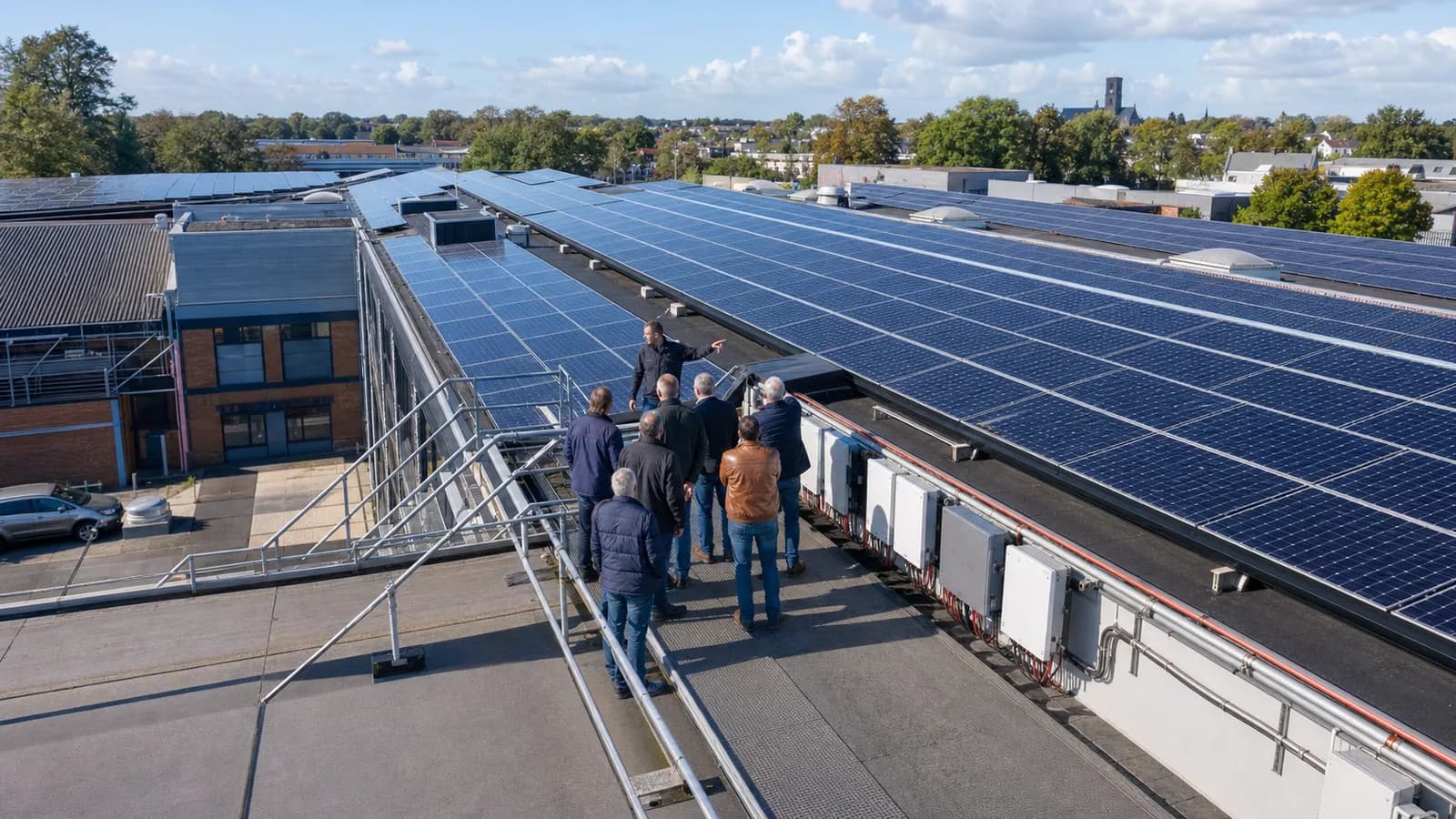
More and more organisations want solar power, but not every building has a roof that is suitable or large enough. Generating collectively solves this: a group pools capital and uses the best available location. Picture an energy cooperative installing panels on the roof of a distribution centre, with local residents and businesses as participants. For facility managers and business owners this is also a route when their own premises are rented or when the local electricity grid is full.
- A cooperative solar rooftop is often installed on a rented roof of a school, warehouse or business premises; the cooperative records long term agreements with the roof owner.
- Energy cooperatives and owners' associations can use the Dutch Subsidy scheme for Cooperative Energy Generation (SCE); larger projects with a large consumer grid connection typically fall under the SDE++ scheme.
- The grid connection is a critical point: in areas with grid congestion, feed-in capacity may be limited, so check this early with the grid operator.
Insight
Traditional approach
Information is scattered across portals, documents, invoices or separate spreadsheets.
Modern approach
Data, context and interpretation are brought together into a clear decision picture.
Decision-making
Traditional approach
Choices are made based on averages, assumptions or occasional analyses.
Modern approach
Scenarios, KPIs and current measurement data make the trade-off more concrete and repeatable.
Follow-up
Traditional approach
Actions often stay non-committal or disappear into separate reports.
Modern approach
Follow-up actions, monitoring and reporting are linked to the same energy data.
What forms do collective solar projects take?
There are three common forms. With a cooperative solar rooftop, an energy cooperative rents the roof of a school, sports hall or distribution centre, for example. The cooperative installs and manages the system, while the roof owner makes the roof available. A collective solar farm is ground mounted, often on farmland or a leftover site, and is larger in scale. The third form is the shared business park rooftop project: several businesses on one estate share the panels on one or more roofs and divide the proceeds. An owners' association can also generate collectively on the shared roof of an apartment complex. In all cases there is one legal owner, usually a cooperative or a separate project entity, which signs contracts and manages the project on behalf of the participants.
- Cooperative solar rooftop: the cooperative's system on a rented roof owned by another party
- Collective solar farm: ground mounted, larger in scale and often supported by SDE++
- Shared business park rooftop project: businesses on one estate share roofs and proceeds
- Owners' association project: residents share the generation on the shared roof of their complex
How do participation and revenue sharing work?
Participation usually takes place through shares or certificates. You make a one off contribution and in return receive a right to part of the installation and its proceeds. The cooperative sells the electricity generated to an energy supplier and may receive a subsidy per kilowatt hour delivered. After deducting costs for management, insurance and maintenance, the cooperative distributes the result among the participants in proportion to their contribution. Members decide on major matters together at the general meeting. The SCE scheme uses the postcode rose: participants must live or be established in the postcode area of the installation or in the directly adjacent postcode areas. For an owners' association, at least three quarters of the members must currently live or be established within that area.
- Share or certificate: your stake in the installation and its proceeds
- Revenue comes from electricity sales and any subsidy, after deduction of management costs
- The cooperative's general meeting decides on major matters
- SCE projects work with a postcode rose around the installation
What should you pay attention to in a collective solar project?
Start with the roof or the site. Have the load bearing capacity of the structure assessed and coordinate the installation with the building's insurer, because solar panels affect the risk profile. Record the agreements with the roof owner for the full duration of the project, for example through a right of superficies. This keeps the ownership of the panels legally separate from the building. Also check early with the grid operator whether transport capacity is available for feeding electricity into the grid. In areas with grid congestion, a new project can wait a long time for a connection. Finally, expect a long duration: subsidy and rental contracts run for many years and exiting early is not always straightforward. Factor this into your financial planning.
- A structural assessment and coordination with the building's insurer are essential
- A right of superficies separates the ownership of the panels from the building
- Request transport capacity from the grid operator early in the process
- Expect a duration of many years and limited options for early exit
Curious what this looks like with your own data?
In a no-obligation call, a specialist looks at your meters, sites and energy questions with you. Response within one business day.
Search the knowledge base
Find the answer to your question.
Search using your own words. Abbreviations and spelling variants are recognised, so EMS also finds the articles on energy management systems.
Topic