
Community energy
Article 6 of 7 · Energy cooperatives and community energySmart energy community business case: a guide for businesses
Direct answer
The smart energy community business case is the commercial rationale for a smart energy community: a neighbourhood or business park that shares generation, storage and smart control. Value comes from higher self-consumption, shared investments, flexibility and joint purchasing. These are offset by costs for installations, metering and control systems, organisation and legal set-up. Reliable metering data determine whether costs and benefits can be divided fairly.
- Clear definition
- Data-driven assessment
- Risks and opportunities visible
- Practical next steps
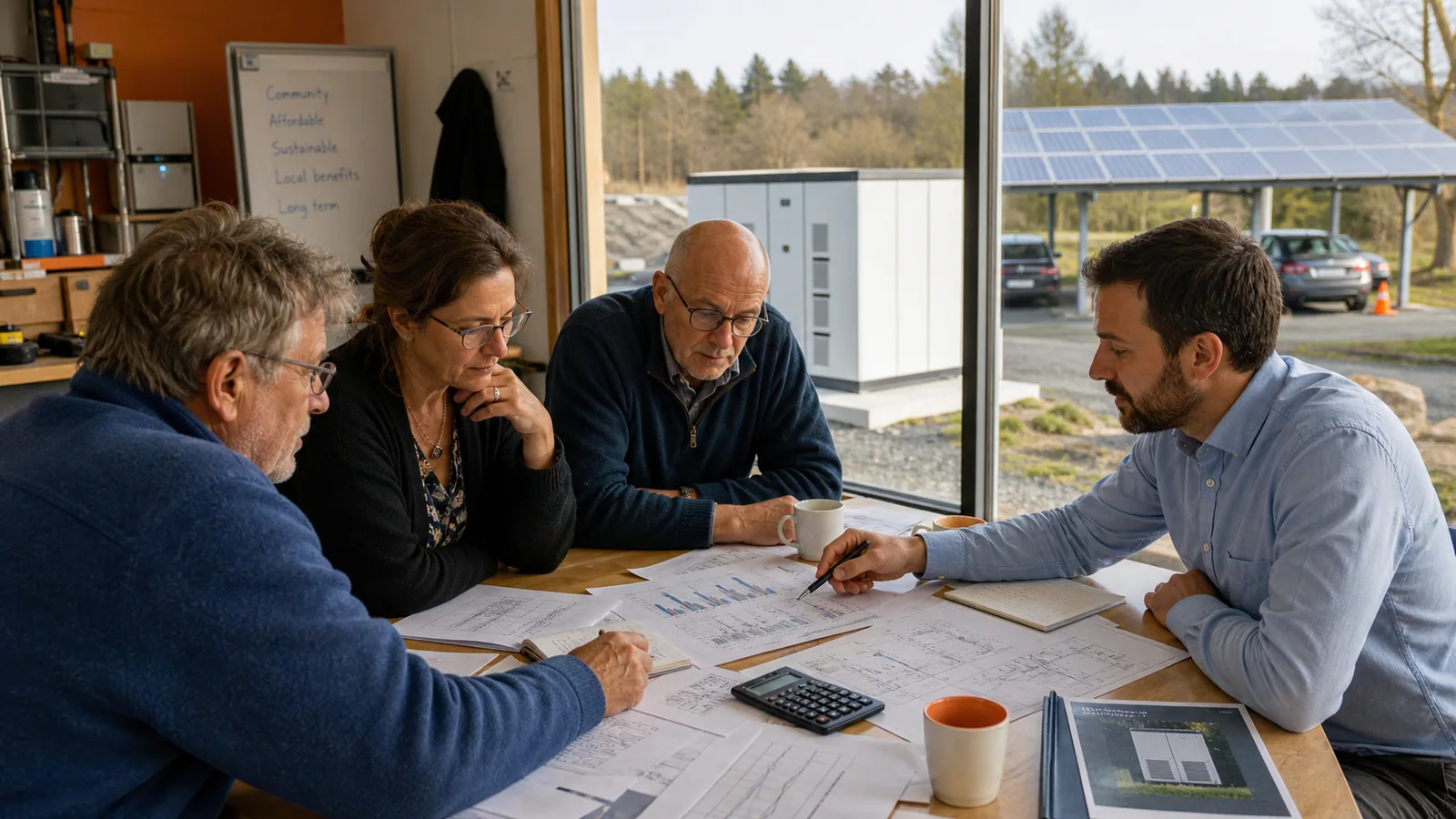
Smart energy community business case: scattered information versus Energy Intelligence
More and more neighbourhoods and business parks in the Netherlands are running into the limits of the electricity grid. A business owner who wants to expand is told there is no transport capacity, while the neighbour's roof is covered in solar panels. A smart energy community links that local generation, storage and consumption together. Since the Dutch Energy Act, in force from 1 January 2026, the energy community has a legal basis in the Netherlands. The question then becomes: when does such a partnership also make commercial sense?
- Local self-consumption of shared generation reduces grid offtake and with it the participants' collective energy costs.
- Flexibility, such as storage and controllable consumption, has value for congestion management and can defer or avoid grid reinforcement.
- Without reliable metering data per participant, a fair division of costs and benefits is impossible and support collapses.
Insight
Traditional approach
Information is scattered across portals, documents, invoices or separate spreadsheets.
Modern approach
Data, context and interpretation are brought together into a clear decision picture.
Decision-making
Traditional approach
Choices are made based on averages, assumptions or occasional analyses.
Modern approach
Scenarios, KPIs and current measurement data make the trade-off more concrete and repeatable.
Follow-up
Traditional approach
Actions often stay non-committal or disappear into separate reports.
Modern approach
Follow-up actions, monitoring and reporting are linked to the same energy data.
Where does the value come from?
The main source of value is self-consumption: electricity that participants generate and use locally does not need to come from the grid. Energy sharing within a community also makes this possible when the installation sits on another connection, through arrangements with the grid operator and the energy supplier. Participants also share the investments in, for example, solar roofs and batteries, which makes projects feasible that would be too large for one party. Flexibility is a third source: those who can shift consumption or storage help relieve grid congestion and can receive compensation for this through congestion management. Finally, a community can defer or avoid grid reinforcement by absorbing peaks locally, and it stands stronger as a collective in the joint purchasing of energy and installations.
- Self-consumption: using locally generated electricity directly reduces grid offtake
- Shared investments make larger installations feasible
- Flexibility has value for congestion management
- Absorbing peaks locally can defer or avoid grid reinforcement
- Joint purchasing strengthens the negotiating position
Which costs and risks are involved?
The benefits are offset by substantial cost items. The installations themselves require the largest investment: generation, storage and their connections. In addition, a metering and control system is needed that tracks and steers generation, consumption and storage per participant. The organisation also costs money and time: a legal form such as a cooperative, contracts with the grid operator and supplier, administration and technical management. TNO points to the legal and technical complexity of energy communities and the professionalisation this demands. Also account for risks. Participants may leave, shifting the coverage of fixed costs. Laws and regulations around energy sharing are still evolving. Grid congestion can delay connections or expansions. And without clear arrangements on decision-making and control, the governance, conflicts arise over the division.
- Installations for generation and storage are the largest investment
- A metering and control system is a fixed cost item
- Organisation: legal form, contracts, administration and management
- Legal and technical set-up is complex and requires expert advice
- Risks: participant turnover, changing rules, grid congestion and governance
Why does metering data carry the business case?
An energy community divides costs and benefits across many participants. That division stands or falls with reliable metering data. Who generated, consumed or stored how much, and when? Only with fine-grained data per connection can you establish which share of the generation was consumed locally and who delivered which share of the flexibility. Inaccurate or missing data lead to skewed settlement and undermine trust between participants. Metering data are also indispensable externally: the division of shared energy runs through arrangements with the grid operator and the energy supplier, and they require verifiable figures. Anyone considering a smart energy community therefore starts with the metering system: first gain insight into your own consumption and generation profiles, and only then invest in shared installations.
- Dividing costs and benefits requires metering data per participant
- Fine-grained data show which share of generation was consumed locally
- Poor data lead to skewed settlement and loss of trust
- Grid operator and supplier require verifiable figures
- Start measuring before investing in shared installations
Curious what this looks like with your own data?
In a no-obligation call, a specialist looks at your meters, sites and energy questions with you. Response within one business day.
Search the knowledge base
Find the answer to your question.
Search using your own words. Abbreviations and spelling variants are recognised, so EMS also finds the articles on energy management systems.
Topic