
Community energy
Article 1 of 7 · Energy cooperatives and community energySetting up an energy cooperative: a guide for businesses
Direct answer
Setting up an energy cooperative means citizens or businesses jointly establish a cooperative association that develops and manages renewable energy projects. Members own the cooperative together and take key decisions in the general members' meeting. Formation requires a notarial deed with articles of association, after which the notary registers the cooperative with the Chamber of Commerce (KVK). Nearly all initiatives choose the U.A. form, excluding member liability for debts.
- Clear definition
- Data-driven assessment
- Risks and opportunities visible
- Practical next steps
Setting up an energy cooperative: scattered information versus Energy Intelligence
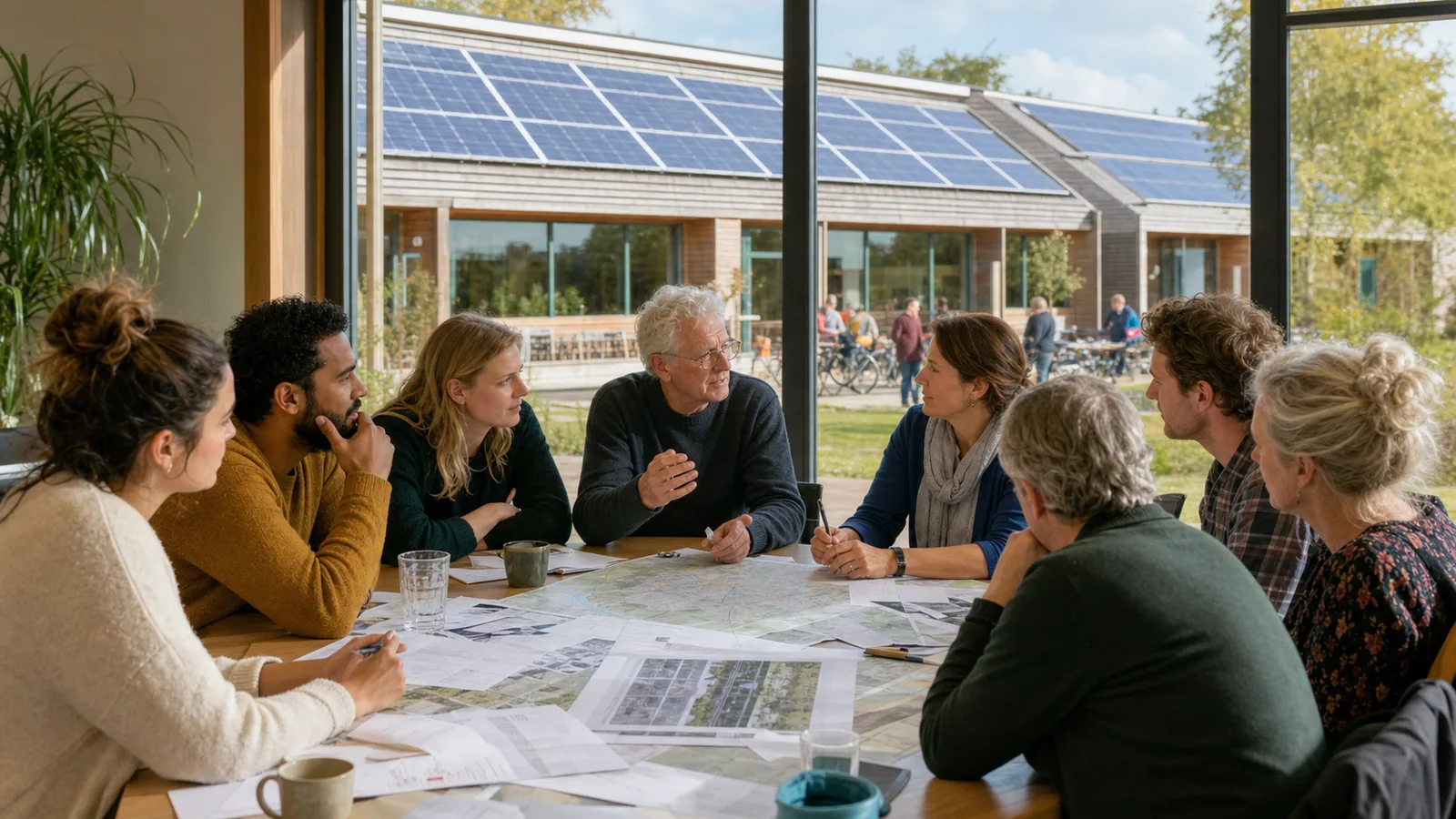
In many Dutch neighbourhoods and business parks, residents and entrepreneurs want direct control over their energy supply. Picture a village that wants solar panels on the sports hall roof, or businesses jointly exploring a wind project. A cooperative gives such an initiative a formal structure: one legal entity that can sign contracts, apply for subsidies and distribute proceeds fairly among the members. The Netherlands now counts hundreds of these local energy initiatives, united in a national umbrella organisation.
- The cooperative U.A. excludes personal liability of members for debts, even after bankruptcy.
- Formation requires a notarial deed; the notary then arranges registration in the KVK Business Register and the UBO register.
- The national umbrella organisation Energie Samen supports starting cooperatives with knowledge, development funds and advocacy.
Insight
Traditional approach
Information is scattered across portals, documents, invoices or separate spreadsheets.
Modern approach
Data, context and interpretation are brought together into a clear decision picture.
Decision-making
Traditional approach
Choices are made based on averages, assumptions or occasional analyses.
Modern approach
Scenarios, KPIs and current measurement data make the trade-off more concrete and repeatable.
Follow-up
Traditional approach
Actions often stay non-committal or disappear into separate reports.
Modern approach
Follow-up actions, monitoring and reporting are linked to the same energy data.
How do you set up an energy cooperative?
It usually starts with an initiative group of engaged residents or entrepreneurs. That group defines the goal: for example joint solar power, a wind project or collective purchasing. The formal formation then takes place at a civil-law notary. The notary draws up the deed of formation and the articles of association, covering the purpose, member control and the liability form. Nearly all energy cooperatives choose U.A., excluded liability: members are then not liable for the cooperative's debts. The notary subsequently registers the cooperative in the KVK Business Register and records the ultimate beneficial owners in the UBO register. Be aware: anyone acting on behalf of a cooperative that is not yet registered is personally liable. After registration the cooperative can recruit members, open an account and sign contracts.
- Form an initiative group and define the goal and working area
- Have a notary draw up the deed of formation and articles of association
- Choose the liability form, in practice almost always U.A.
- The notary handles registration with KVK and the UBO register
- Then start recruiting members and selecting the first project
How do governance, funding and cooperation work?
A cooperative belongs to its members. The general members' meeting is the highest body: it appoints the board and decides on major expenditure and projects. Every member has voting rights. For funding, cooperatives usually combine member contributions with external sources. The Dutch Cooperative Energy Generation Subsidy Scheme (SCE), run by RVO, supports generation projects of energy cooperatives whose members live or are established within the postcode area around the installation. The umbrella organisation Energie Samen also offers development funds and practical guidance. Working with the municipality helps with locations, permits and local support. Early contact with the regional grid operator is wise: the operator determines whether and when your project can be connected to the electricity grid.
- The general members' meeting appoints the board and holds final control
- Funding often comes from member contributions, funds and the RVO SCE scheme
- The SCE uses a postcode area rule: members live or are established near the installation
- Involve the municipality early for locations, permits and local support
- Coordinate with the grid operator in good time about the grid connection
Which pitfalls should you expect?
Most starting cooperatives run entirely on volunteers. That makes the initiative vulnerable: if a key person drops out, the project stalls. Also expect long lead times. Several years often pass between the first idea and a working installation, due to permits, financing and member recruitment. A third risk is grid congestion: in many areas the electricity grid is full, so a request for a new connection or for feeding power back can end up on a waiting list. Apply for the grid connection early and have the feasibility assessed before you invest. You are not on your own: the national umbrella organisation Energie Samen shares knowledge and model documents, and many municipalities have an energy desk or sustainability adviser that helps local initiatives get started.
- Safeguard continuity: spread tasks across several active members
- Plan realistically: from idea to working installation often takes years
- Check grid capacity early with the regional grid operator
- Use the knowledge and model documents of the umbrella organisation Energie Samen
- Ask your municipality about the local energy desk
Curious what this looks like with your own data?
In a no-obligation call, a specialist looks at your meters, sites and energy questions with you. Response within one business day.
Search the knowledge base
Find the answer to your question.
Search using your own words. Abbreviations and spelling variants are recognised, so EMS also finds the articles on energy management systems.
Topic