
Generation
Article 1 of 20 · Generation and storageSolar panels for businesses: a guide for businesses
Direct answer
Solar panels for businesses are solar installations on often large commercial roofs, with which a company generates its own electricity and becomes more sustainable. The large roof surface offers room for many panels. You can use the generated electricity directly during the day, which lowers your purchasing. What you do not use, you feed back to the grid, provided the connection and the grid allow it.
- Clear definition
- Data-driven assessment
- Risks and opportunities visible
- Practical next steps
Solar panels for businesses: scattered information versus Energy Intelligence
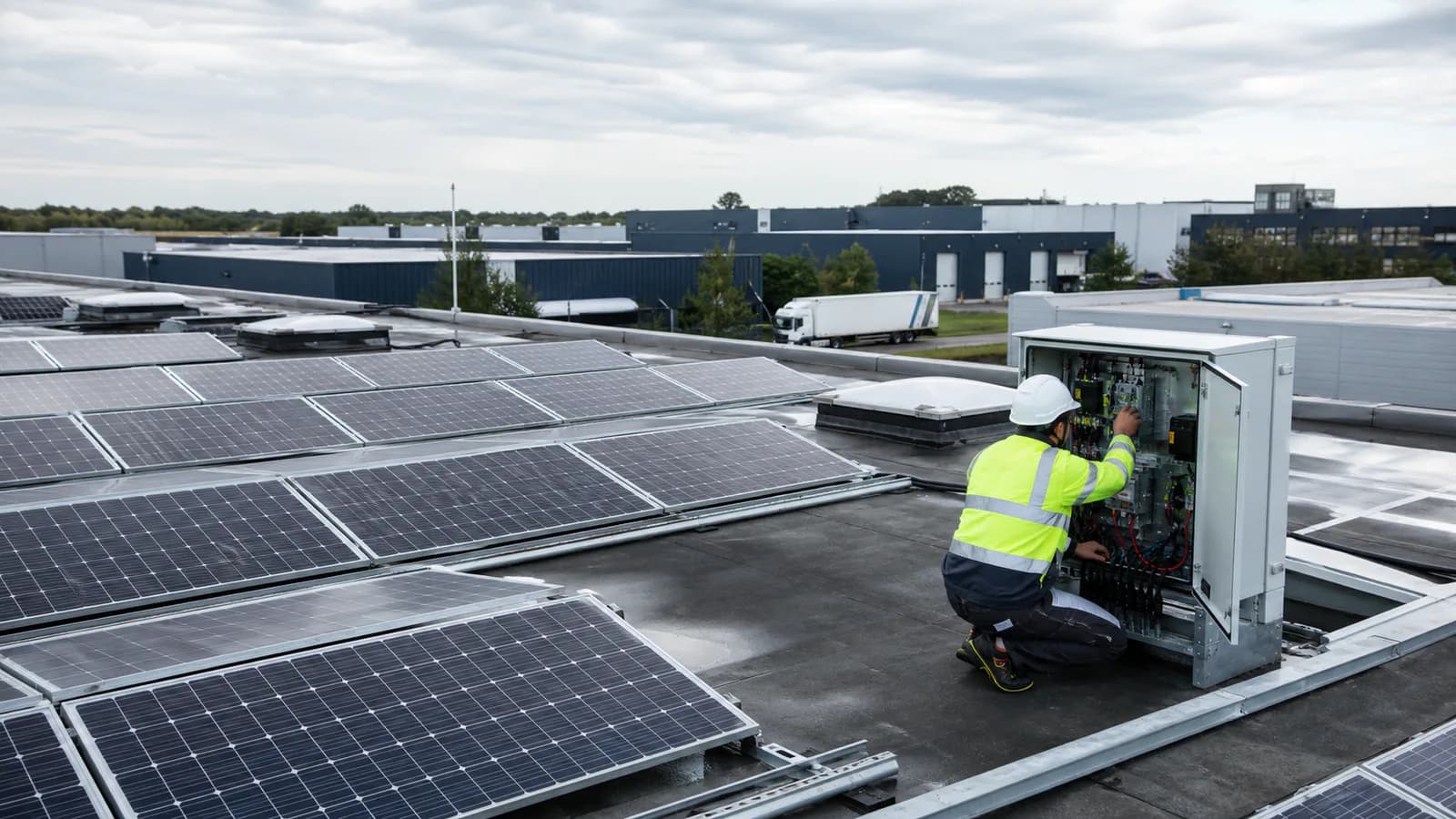
Many commercial buildings in the Netherlands have a large, flat roof that sits empty most of the year. A warehouse, distribution centre or production hall thus offers room for hundreds of panels. With these a company generates a substantial part of its own electricity and lowers its CO2 emissions. A business installation raises different questions than a home: the connection capacity, the grid situation in the region, the load-bearing capacity of the roof and the way you use the electricity.
- A large commercial roof offers room for many panels; the output is worth most when you use the electricity yourself during the day.
- On a congested part of the Dutch grid the grid operator may limit feed-in or refuse a heavier connection, so check this in advance.
- For installations from 15 kilowatt-peak on a large-consumer connection the Dutch SDE++ scheme is possible; since 2024 it only subsidises electricity delivered to the grid.
Insight
Traditional approach
Information is scattered across portals, documents, invoices or separate spreadsheets.
Modern approach
Data, context and interpretation are brought together into a clear decision picture.
Decision-making
Traditional approach
Choices are made based on averages, assumptions or occasional analyses.
Modern approach
Scenarios, KPIs and current measurement data make the trade-off more concrete and repeatable.
Follow-up
Traditional approach
Actions often stay non-committal or disappear into separate reports.
Modern approach
Follow-up actions, monitoring and reporting are linked to the same energy data.
Why do businesses choose solar panels?
Businesses mainly use solar panels to lower their own electricity consumption during the day. A production hall, cold store or office runs precisely when the sun shines. Electricity you generate and use immediately does not have to be purchased. That is the core of the business case: businesses with a large-consumer connection could never net meter, and for small-consumer connections the Dutch net-metering scheme ends on 1 January 2027. Sustainability also matters: own generation lowers CO2 emissions and helps with purchasing requirements, tenders and reporting obligations. The large roof surface of a commercial building makes a substantial installation possible, without needing to free up land for it.
- Own consumption during the day directly lowers electricity purchasing.
- Large, flat roofs offer room for many panels without extra land.
- Own generation lowers CO2 emissions and supports sustainability requirements.
- Net metering only applies to small-consumer connections and ends in 2027; self-consumption therefore becomes more important than feed-in.
What should businesses pay attention to?
Start with the connection and the grid. In many Dutch regions the grid is full: the grid operator can then refuse a heavier connection or limit feed-in. Such a feed-in limit is recorded in a capacity restriction contract or congestion management contract, sometimes against a payment. Check this in advance with your grid operator. Then look at the roof: panels and mounting add weight, so have the load-bearing capacity of the structure assessed. Also coordinate the installation with your insurer, because solar panels affect fire safety and policy conditions. If the connection does not match what you want to feed back, self-consumption or storage is the way forward.
- Check connection capacity and grid situation in advance with the grid operator.
- On a full grid, feed-in can be limited through a capacity restriction contract.
- Have the load-bearing capacity of the roof structure assessed before placing panels.
- Coordinate fire safety and policy conditions with your insurer.
How do you get the most out of it?
The value of a business installation lies mainly in the electricity you use yourself. Schedule energy-intensive processes, charging moments and cooling as much as possible in the hours with plenty of sun. This increases self-consumption and lowers feed-in, which is favourable now feed-in yields less. A battery can help: it stores surplus electricity for later in the day or the evening, and lowers the peak on your connection. That is valuable on a full grid, where feed-in is limited. For large-scale generation from 15 kilowatt-peak on a large-consumer connection the SDE++ scheme may fit. Since the 2024 round this operating subsidy only covers electricity delivered to the grid. Weigh up per situation whether subsidy, storage or self-consumption alone fits best.
- Schedule heavy consumption in the sunny hours to increase self-consumption.
- A battery stores surplus electricity and lowers the peak on the connection.
- The SDE++ scheme is possible from 15 kilowatt-peak on a large-consumer connection and only subsidises grid delivery.
- Weigh up per situation between self-consumption, storage and subsidy.
Curious what this looks like with your own data?
In a no-obligation call, a specialist looks at your meters, sites and energy questions with you. Response within one business day.
Search the knowledge base
Find the answer to your question.
Search using your own words. Abbreviations and spelling variants are recognised, so EMS also finds the articles on energy management systems.
Topic