
What is grid congestion?
Direct answer
Grid congestion is the situation in which demand for electricity transport exceeds the capacity of the power grid at a specific location and time. In short, grid congestion is a traffic jam on the electricity grid. In congested areas of the Netherlands, new or heavier connections and additional transport capacity are not immediately available and applicants join a waiting list.
- Clear definition
- Data-driven assessment
- Risks and opportunities visible
- Practical next steps
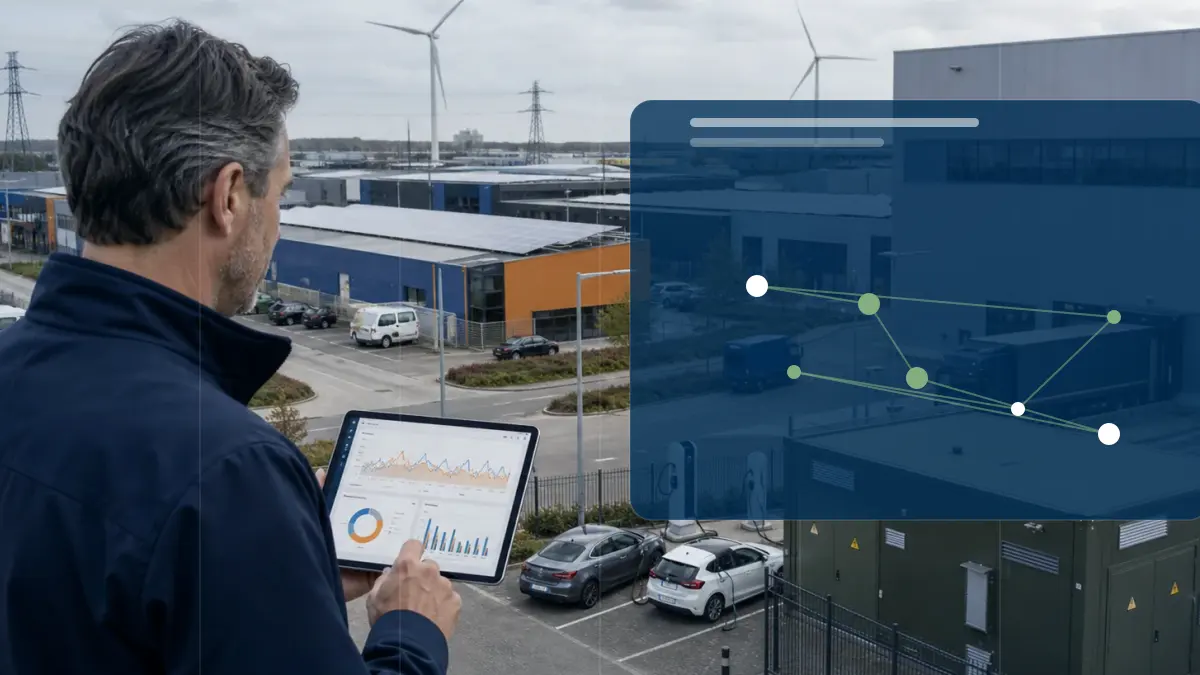
What is grid congestion: scattered information versus Energy Intelligence
The Netherlands is electrifying rapidly. Companies are switching to heat pumps, electric fleets and rooftop solar, while the electricity grid is expanding more slowly than demand. As a result, a business applying for a larger connection for a new production line increasingly hears that no transport capacity is available. This affects facility managers, property developers and industrial companies in large parts of the country. Understanding the mechanism behind grid congestion helps you plan better and use alternatives in time.
- Grid congestion is bound to time, place and direction: it occurs at peak moments, varies by region and can affect both electricity offtake and feed-in.
- In a congestion area, Dutch grid operators must investigate whether flexible capacity from users can free up space; participants receive compensation for this.
- Companies on the waiting list can often still move forward: by shifting consumption, deploying storage or sharing grid capacity with other businesses.
Insight
Traditional approach
Information is scattered across portals, documents, invoices or separate spreadsheets.
Modern approach
Data, context and interpretation are brought together into a clear decision picture.
Decision-making
Traditional approach
Choices are made based on averages, assumptions or occasional analyses.
Modern approach
Scenarios, KPIs and current measurement data make the trade-off more concrete and repeatable.
Follow-up
Traditional approach
Actions often stay non-committal or disappear into separate reports.
Modern approach
Follow-up actions, monitoring and reporting are linked to the same energy data.
How does grid congestion arise?
The Dutch electricity grid was designed for the usage patterns of decades ago. The energy transition is changing those patterns fast: solar farms and rooftop panels feed power back into the grid, while heat pumps, charging stations and electrified processes demand more power. Generation and consumption rarely happen in the same place at the same time. At peak moments, the grid therefore hits its local limits. Grid operators compare this to a traffic jam: the road exists, but at busy times no more traffic fits. Congestion also has two directions. With offtake congestion, there is insufficient room to draw power from the grid. With feed-in congestion, there is insufficient room to supply power back, for example from solar panels.
- Peak moments differ: solar panels feed in mostly around midday, while electric cars often charge in the early evening.
- Bound to place: one street or region can be full while a neighbouring area still has room.
- Bound to direction: an area can be full for feed-in while still having room for offtake, or the other way around.
- Outside peak hours, many locations still have room on the grid.
When will your business encounter it?
You mainly notice grid congestion when applying for a new connection, a heavier connection or additional transport capacity. In a congestion area, the grid operator cannot grant such a request immediately and places you on a waiting list. Existing connections and contracts continue as normal: the power does not go out. As soon as capacity becomes available, for example through grid expansion or congestion management, the grid operator allocates it to parties on the waiting list. Societal prioritisation applies here: organisations with a societal function, or parties that actually relieve the congestion, can receive a higher position. You can check whether your location is in a congestion area on the capacity map published by Netbeheer Nederland.
- Expansion, sustainability upgrades or relocation are delayed when no transport capacity is available.
- The Netbeheer Nederland capacity map shows per area whether there is room, scarcity or a queue.
- Congestion areas are assessed separately for offtake and for feed-in.
- Societal prioritisation can influence the order of the waiting list.
What do grid operators do, and what can you do yourself?
The structural solution is expanding and reinforcing the grid, but that takes years due to staff shortages and permit procedures, among other factors. Grid operators therefore apply congestion management: a temporary solution in which they distribute the available transport capacity more intelligently. In every congestion area, the grid operator carries out a congestion study and asks businesses to offer flexible capacity. Those who draw or feed in less power at peak moments receive compensation, for example through a capacity limitation contract. You can also create room yourself. Shift consumption to quiet hours, deploy battery storage, share a connection with neighbouring businesses or collaborate in an energy hub. This makes better use of existing grid capacity and reduces your dependence on the waiting list.
- Congestion management is explicitly a temporary solution until the grid has been expanded.
- Participating in congestion management earns compensation for flexible electricity use.
- Shifting consumption to moments with abundant wind and solar power relieves the grid.
- Storage, shared connections and energy hubs make better use of existing grid capacity.
- The Netherlands Enterprise Agency (RVO) offers businesses an online guide that points to suitable solutions per situation.
Curious what this looks like with your own data?
In a no-obligation call, a specialist looks at your meters, sites and energy questions with you. Response within one business day.
Search the knowledge base
Find the answer to your question.
Search using your own words. Abbreviations and spelling variants are recognised, so EMS also finds the articles on energy management systems.
Topic