
TSO vs. DSO: a guide for businesses
Direct answer
TSO vs. DSO describes the distinction between the national grid operator and the regional grid operators in the Netherlands. The TSO (Transmission System Operator) manages the national high-voltage grid and continuously keeps supply and demand in balance. The DSO (Distribution System Operator) manages the regional distribution grid and delivers the electricity to your connection.
- Clear definition
- Data-driven assessment
- Risks and opportunities visible
- Practical next steps
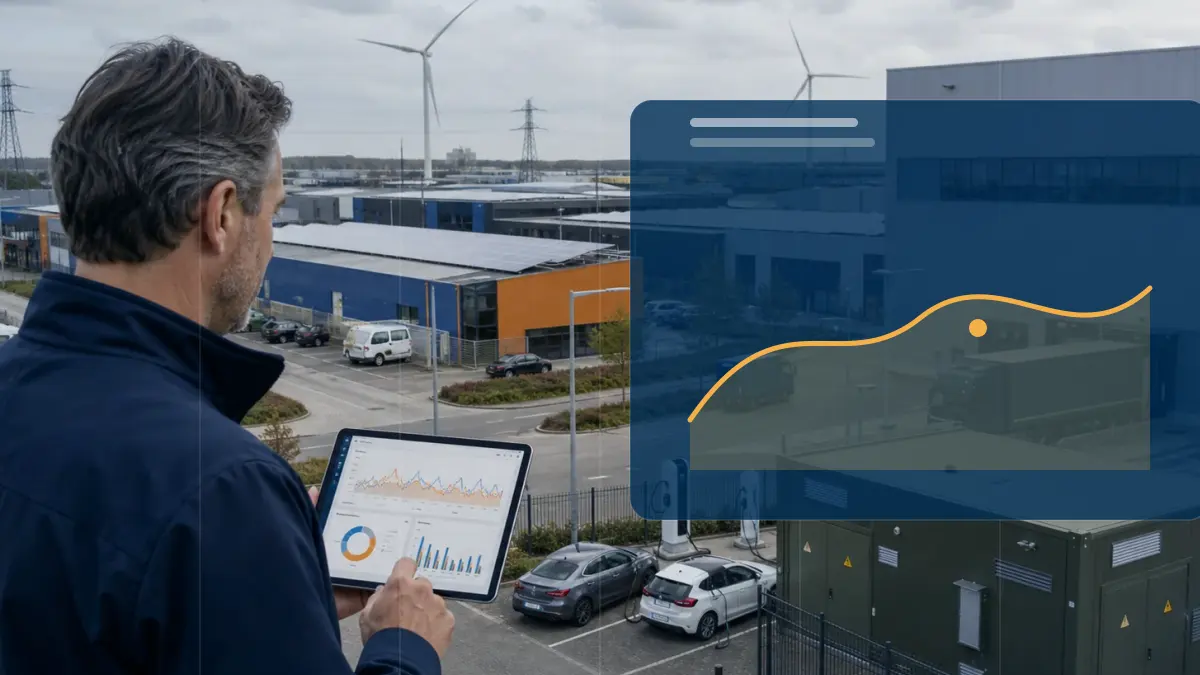
TSO vs. DSO: scattered information versus Energy Intelligence
Your premises receive electricity through two layers of grid management. Which party you contact about a connection or a capacity problem depends on that distinction. A large consumer needing substantial capacity sometimes deals directly with the national grid operator, while an ordinary office or business connection runs through the regional grid operator. Who plays which role determines where you turn.
- In the Netherlands, TenneT is the only TSO and manages the national high-voltage grid.
- Six regional grid operators act as DSOs, managing the medium- and low-voltage grids your connection sits on.
- Both carry out statutory tasks under supervision of the ACM, which sets the tariffs each year.
Insight
Traditional approach
Information is scattered across portals, documents, invoices or separate spreadsheets.
Modern approach
Data, context and interpretation are brought together into a clear decision picture.
Decision-making
Traditional approach
Choices are made based on averages, assumptions or occasional analyses.
Modern approach
Scenarios, KPIs and current measurement data make the trade-off more concrete and repeatable.
Follow-up
Traditional approach
Actions often stay non-committal or disappear into separate reports.
Modern approach
Follow-up actions, monitoring and reporting are linked to the same energy data.
What does the TSO do and what does the DSO do?
The TSO manages the national high-voltage grid, the backbone that transports electricity over long distances. This operator continuously maintains the balance between supply and demand on the grid. The DSO manages the fine-meshed distribution grid with a regional character and distributes electricity from the high-voltage grid to end users. In the Netherlands, TenneT is the designated operator of the national transmission grid, roughly from 110 kilovolts and above. Six regional grid operators manage the medium- and low-voltage grids to which most consumers are connected. Those six are Liander, Stedin, Enexis, Westland Infra, Rendo and Coteq.
- TSO: national high-voltage grid, long-distance transport.
- TSO: safeguards the balance between supply and demand.
- DSO: regional distribution grid, medium and low voltage.
- DSO: delivers the electricity to your connection.
When do you deal with which one?
For a normal business connection your regional grid operator is the point of contact: it handles the connection, maintenance and transport on medium and low voltage. If you request very large capacity, a connection to the national grid operator's high-voltage grid may apply. Both operators hold a statutory monopoly in their area, so you do not choose them; they are tied to the location of your connection. With grid congestion the two layers often cooperate, because bottlenecks can arise on both the regional and the national grid.
- Regular connection: contact runs through the regional grid operator.
- Very large capacity: possibly a connection to the national grid.
- You do not choose your grid operator; it belongs to your location.
- Grid congestion can occur on both grid layers.
Supervision and tariffs
The ACM supervises both the national and the regional grid operators. Because a grid operator holds a monopoly position and faces virtually no competition, the ACM sets the maximum tariffs that grid users pay for carrying out the statutory tasks. Those tasks include transporting electricity, connecting grid users and laying out, maintaining and managing the grids. The ACM first fixes a regulatory method for several years and then sets the tariffs definitively each year. Separate tariff decisions apply to the national grid operator and the regional grid operators, because their grids and tasks differ.
- The ACM sets the grid tariffs each year.
- Grid operators hold a statutory monopoly in their area.
- Statutory tasks: transport, connection, construction, maintenance and management.
- National and regional have separate tariff decisions.
Curious what this looks like with your own data?
In a no-obligation call, a specialist looks at your meters, sites and energy questions with you. Response within one business day.
Search the knowledge base
Find the answer to your question.
Search using your own words. Abbreviations and spelling variants are recognised, so EMS also finds the articles on energy management systems.
Topic