
Solving electricity transport scarcity: a guide for businesses
Direct answer
A solution for electricity transport scarcity is a measure that keeps a business running while the grid is full and the operator cannot supply extra transport capacity. Examples include congestion management, a flexible contract, or steering demand behind your own connection. The operator meanwhile works on structural grid reinforcement.
- Clear definition
- Data-driven assessment
- Risks and opportunities visible
- Practical next steps
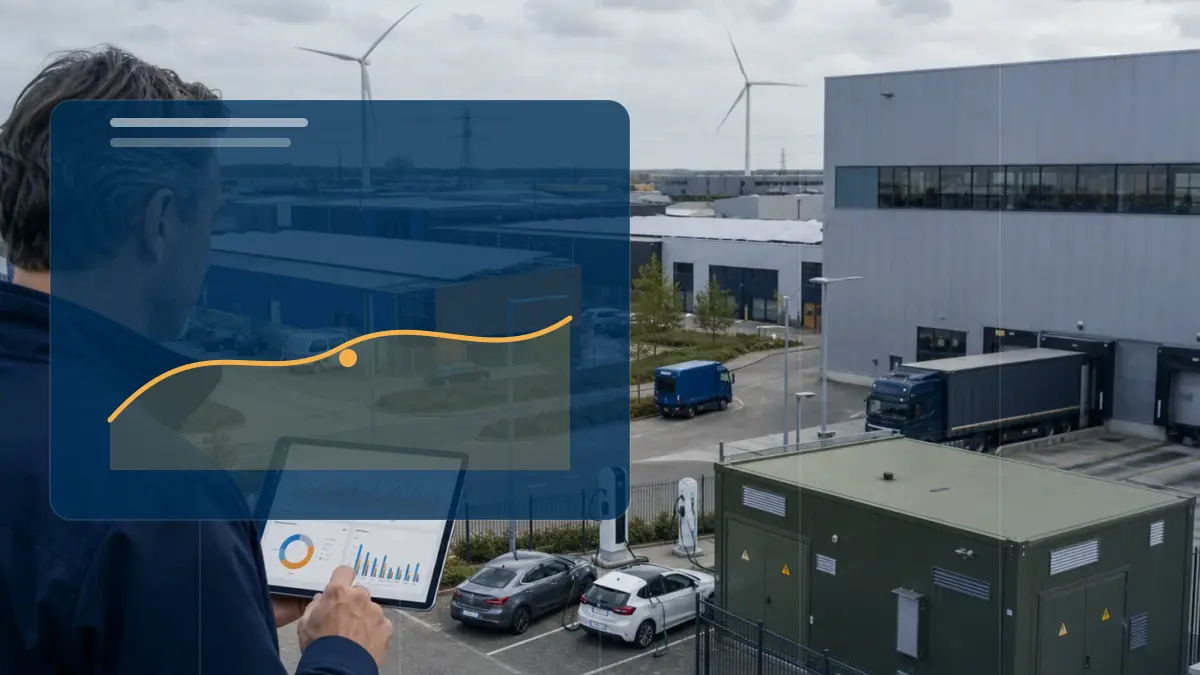
Solving electricity transport scarcity: scattered information versus Energy Intelligence
More and more businesses are told that no extra transport capacity is temporarily available: the grid is full. A new production line, charging points, or solar panels then no longer fit on the connection. Waiting for grid reinforcement often takes years. That is why solutions exist that create room sooner, partly through the grid operator and partly within your own operations.
- Congestion management shares the available room: connected users temporarily consume or feed in less during peak moments, in return for compensation.
- A capacity-limiting contract grants extra transport capacity as long as you can throttle back at peak times.
- Behind your own connection you can flatten peaks with energy management, storage, or combining sources on a single connection.
Insight
Traditional approach
Information is scattered across portals, documents, invoices or separate spreadsheets.
Modern approach
Data, context and interpretation are brought together into a clear decision picture.
Decision-making
Traditional approach
Choices are made based on averages, assumptions or occasional analyses.
Modern approach
Scenarios, KPIs and current measurement data make the trade-off more concrete and repeatable.
Follow-up
Traditional approach
Actions often stay non-committal or disappear into separate reports.
Modern approach
Follow-up actions, monitoring and reporting are linked to the same energy data.
How does transport scarcity arise?
Transport scarcity arises when demand for electricity transport exceeds what the grid can currently handle. This is driven by rapid growth in electric consumption and in decentralised generation such as solar and wind. The grid operator can then no longer promise you extra transport capacity. Only grid reinforcement solves this structurally, but that requires careful procedures and years of lead time. In the meantime, operators look for ways to distribute the existing room more cleverly and to load the grid more heavily.
- Demand for transport exceeds the available grid capacity at a location.
- Growth in consumption and in solar and wind generation deepens the bottleneck.
- Grid reinforcement is the structural solution, but takes years.
- Until then the operator distributes the existing room.
Which solutions does the grid operator offer?
Once transport scarcity is structural, the operator investigates whether congestion management offers temporary room. Connected users then consume or feed in less during busy moments, in return for compensation. Flexible contract forms also exist. A capacity-limiting contract grants extra transport capacity, provided you can throttle back at peak times. The ACM sets the rules for these contracts. This lets the operator serve more connected users on the same grid, without endangering security of supply.
- Congestion management distributes scarce room in return for compensation.
- A capacity-limiting contract trades peak capacity for extra transport room.
- The ACM sets the conditions for these contracts.
- The operator remains responsible for a reliable supply.
What can you do yourself behind the meter?
Within your own connection there is often more room to free up than expected. With energy management you align the use of appliances and flatten peaks. A battery stores surpluses and returns them when the grid allows. With cable pooling you combine several sources on a single connection, so the available capacity is used better. Together with other businesses you can align consumption and generation within an energy hub. This way you get more out of the capacity that already exists.
- Energy management aligns appliances and flattens consumption peaks.
- A battery shifts surpluses to quiet moments on the grid.
- Cable pooling bundles sources on a single connection.
- An energy hub lets businesses align consumption and generation.
Curious what this looks like with your own data?
In a no-obligation call, a specialist looks at your meters, sites and energy questions with you. Response within one business day.
Search the knowledge base
Find the answer to your question.
Search using your own words. Abbreviations and spelling variants are recognised, so EMS also finds the articles on energy management systems.
Topic