
Time-based transport tariffs explained for businesses
Direct answer
Time-based transport tariffs are network tariffs where the price for transporting electricity depends on when you use the grid: using the grid during peak hours is charged more heavily, while use during off-peak hours becomes cheaper. The ACM lays down this form of peak charge in the Electricity Tariff Code to spread peak load.
- Clear definition
- Data-driven assessment
- Risks and opportunities visible
- Practical next steps
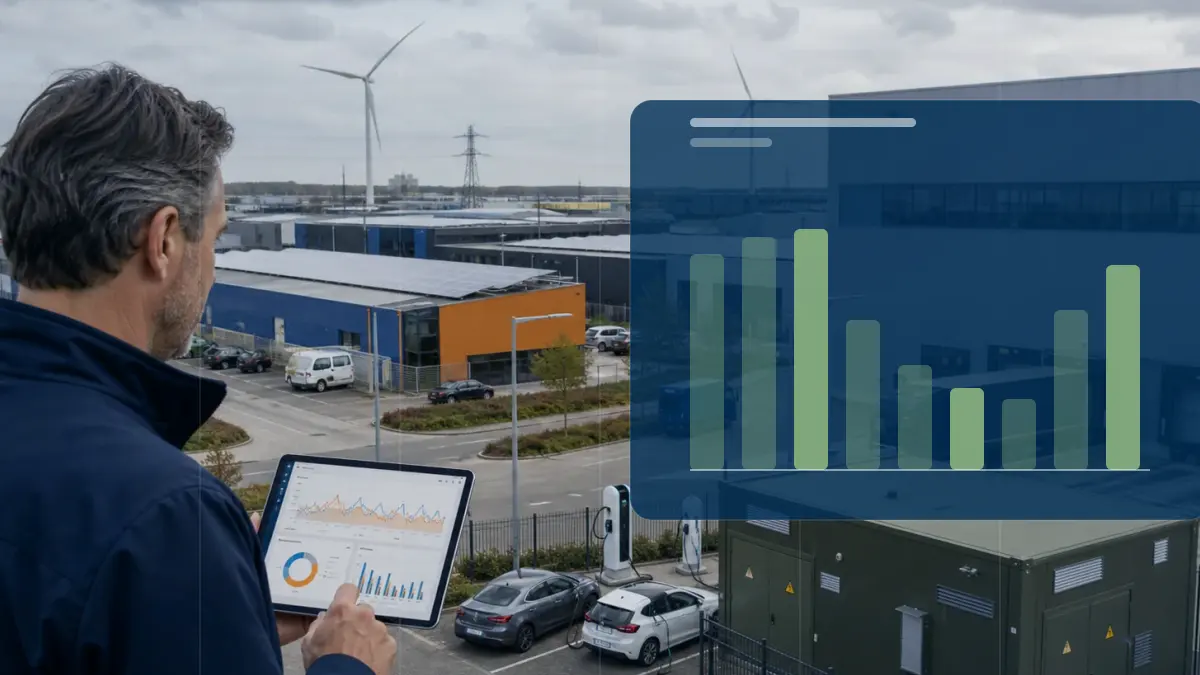
Time-based transport tariffs explained: scattered information versus Energy Intelligence
The electricity grid is increasingly full at peak moments, while capacity remains at quiet times. Yet for a long time the timing of your grid use made no difference to your transport costs. That is changing. Think of a cold storage business running hard around the evening peak: with a time-based tariff that very moment counts more heavily, and shifting consumption to quieter hours starts to pay off.
- The tariff works as a peak charge: off-peak use is cheaper, peak use is charged more heavily.
- For large consumers on TenneT's national high-voltage grid these tariffs have already been introduced.
- For large consumers on the regional grids, Netbeheer Nederland has submitted a proposal to the ACM that is not yet in force.
Insight
Traditional approach
Information is scattered across portals, documents, invoices or separate spreadsheets.
Modern approach
Data, context and interpretation are brought together into a clear decision picture.
Decision-making
Traditional approach
Choices are made based on averages, assumptions or occasional analyses.
Modern approach
Scenarios, KPIs and current measurement data make the trade-off more concrete and repeatable.
Follow-up
Traditional approach
Actions often stay non-committal or disappear into separate reports.
Modern approach
Follow-up actions, monitoring and reporting are linked to the same energy data.
How does it work?
With a time-based transport tariff, the price for grid transport depends on when you draw or feed back power. The scheme works as a peak charge: use during off-peak hours becomes cheaper, while use during peak hours is charged more heavily. This makes the tariffs reflect the real costs better. A party that contributes strongly to the grid peak causes more costs, because a higher peak requires more investment in transport capacity. The ACM sets out this structure in the Electricity Tariff Code. If you shift consumption from peak to off-peak, the grid is used more efficiently and room appears to connect new parties.
- The transport price depends on the time of use, not only on your connection.
- Off-peak hours are cheaper; peak hours are charged more heavily.
- The ACM anchors the scheme in the Electricity Tariff Code.
- The aim is to align tariffs better with the costs that use causes.
When do you encounter this?
That depends on your type of connection and which grid you use. For large consumers on TenneT's national high-voltage grid, time-based transport tariffs have already been introduced. For large consumers on the grids of the regional network operators, the distribution system operators, Netbeheer Nederland has submitted a proposal to the ACM; that is still a proposal and not yet in force. In addition, a proposal for time-dependent tariffs for small consumers is being prepared. In this way the tariffs are introduced step by step for all grid users. When it affects you therefore depends on where your connection sits.
- On TenneT's high-voltage grid these tariffs already apply to large consumers.
- For large consumers on the regional grids a proposal is with the ACM.
- A similar proposal is being prepared for small consumers.
- The rollout is step by step, not for everyone at once.
What can you do?
The essence is to move your consumption out of peak hours and into off-peak hours as much as possible. Those who avoid the peak are cheaper off than those who do not. First map your consumption profile per hour: when do you run hard, and which processes can you move. Consider shifting an energy-intensive process to the night or the weekend, or using storage to flatten peak demand. This way you use the grid at quiet moments and help lower peak load. A more even grid use also limits the need for costly grid reinforcements over time.
- Map your electricity use per hour to recognise peak and off-peak.
- Where possible, shift consumption to quiet hours, such as the night or the weekend.
- Storage can help to flatten peak demand.
- A flatter profile lowers your load on the grid at peak moments.
Curious what this looks like with your own data?
In a no-obligation call, a specialist looks at your meters, sites and energy questions with you. Response within one business day.
Search the knowledge base
Find the answer to your question.
Search using your own words. Abbreviations and spelling variants are recognised, so EMS also finds the articles on energy management systems.
Topic