
Home battery vs. business battery: a guide for businesses
Direct answer
A home battery is a small unit at a house or small business, with a capacity of a few kilowatt-hours, meant to use more of your own solar power yourself. A business battery is much bigger, often large-scale, and sits behind a large consumer connection. It focuses on shaving peak demand, lowering grid costs and trading on the energy markets.
- Clear definition
- Data-driven assessment
- Risks and opportunities visible
- Practical next steps
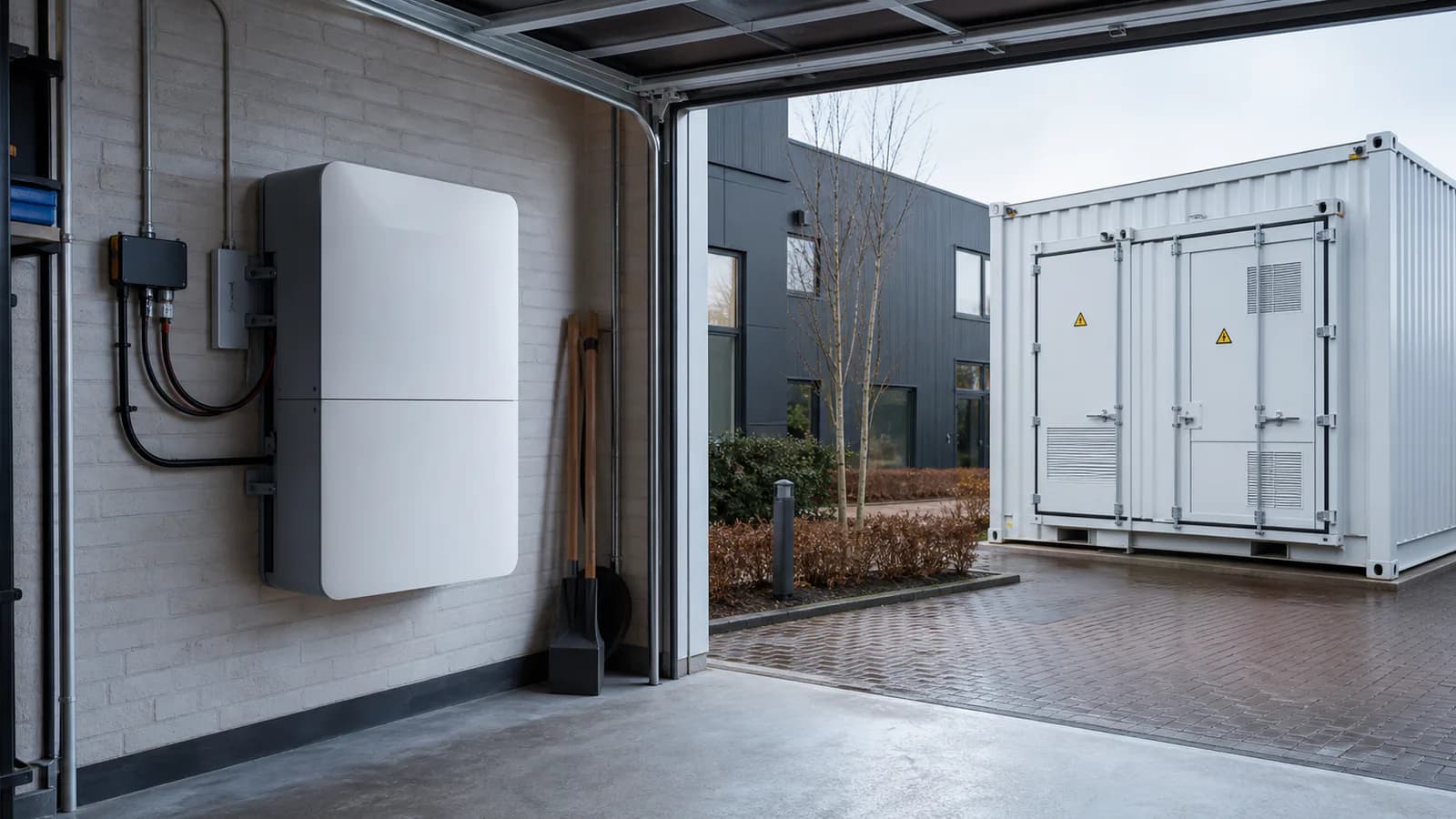
Home battery vs. business battery: scattered information versus Energy Intelligence
The word battery covers two very different things. Behind a household's meter sits a unit of a few kilowatt-hours that stores solar power during the day for the evening. On a business site stands a system that is many times larger and runs on the energy markets. Both store electricity, but their size, purpose and business model differ strongly. This distinction matters to every homeowner with solar panels and to every entrepreneur facing a full electricity grid in the Netherlands.
- A home battery (roughly 2 to 20 kilowatt-hours) raises how much of your own solar power you use yourself, from about 30 to over 50 percent, and becomes more attractive now the Dutch net-metering scheme is being phased out.
- A business battery sits behind a large consumer connection and mainly serves to shave consumption peaks, enable a cheaper grid contract and use room on a congested grid.
- Charging or discharging at the same time can actually increase the peak on the grid; grid operators therefore ask for clear rules on how batteries behave.
Insight
Traditional approach
Information is scattered across portals, documents, invoices or separate spreadsheets.
Modern approach
Data, context and interpretation are brought together into a clear decision picture.
Decision-making
Traditional approach
Choices are made based on averages, assumptions or occasional analyses.
Modern approach
Scenarios, KPIs and current measurement data make the trade-off more concrete and repeatable.
Follow-up
Traditional approach
Actions often stay non-committal or disappear into separate reports.
Modern approach
Follow-up actions, monitoring and reporting are linked to the same energy data.
What is the difference between a home battery and a business battery?
A home battery hangs on a small consumer connection and has a capacity of roughly 2 to 20 kilowatt-hours. Its purpose is simple: solar power you generate during the day but do not use straight away is stored for the evening. That way you use more of your own power instead of feeding it back. A business or large-scale battery sits behind a large consumer connection and is a multiple bigger. Such a system is not only about self-sufficiency, but about steering power: shaving peaks, enabling a cheaper grid contract and responding to prices and imbalance on the energy markets. The scale, the connection and the purpose make the distinction.
- Home battery: small consumer connection, a few kilowatt-hours, aimed at using your own solar power.
- Business battery: large consumer connection, much bigger, aimed at power steering and grid costs.
- The Dutch net-metering scheme ends from 2027, making self-consumption at home more attractive.
- A large battery requires an analysis of the energy profile and coordination with the grid operator.
Which business models suit which battery?
For a home battery the value lies mainly in self-consumption. You store your own solar power and buy less during expensive hours. Some households combine this with a dynamic contract and charge when power is cheap. For a business battery the picture is broader. Peak shaving lowers the peak in your consumption, which enables a cheaper grid contract. In addition, such a battery can trade on the wholesale market and take part in the balancing markets, where supply and demand on the grid are kept in balance. A battery also helps to expand within an existing connection in a congestion area. Each business model sets its own demands on size, control and contracts.
- Home: use more of your own solar power, buy less during expensive hours.
- Business: shave peak demand to enable a cheaper grid contract.
- Business: trade on the wholesale market and take part in the balancing markets.
- Business: expand within an existing connection in an area with grid congestion.
What should you watch for and when does which fit?
Look at your situation first. If you have a home with solar panels and want to use more of your own power, a home battery fits, certainly now net metering is being phased out. If you want to expand a business despite a full grid, or you have heavy consumption peaks, a business battery comes into view. Watch a few things with both. Connection capacity and grid congestion determine what is allowed and what pays off. Charging or discharging at the same time without agreements can actually raise the peak on the grid, which is why grid operators ask for clear rules. Also consider fire safety, a suitable location and whether the battery pays for itself within its lifespan. Do not count on a fixed return; that depends on your profile and tariffs.
- Home: suits solar panels and the wish to use more of your own power.
- Business: suits expansion on a full grid or heavy consumption peaks.
- Connection capacity and grid congestion set the possibilities and the limits.
- Consider safety, location and whether the investment pays for itself within its lifespan.
Curious what this looks like with your own data?
In a no-obligation call, a specialist looks at your meters, sites and energy questions with you. Response within one business day.
Search the knowledge base
Find the answer to your question.
Search using your own words. Abbreviations and spelling variants are recognised, so EMS also finds the articles on energy management systems.
Topic