
Thermal storage: a guide for businesses
Direct answer
Thermal storage is the storing of heat or cold to use it at a later moment. This way thermal storage decouples the moment of generation from the moment of heat demand. Heat from the summer, or from cheap, green electricity, is stored and only used once demand arrives, in a buffer tank, in the ground or in a dedicated storage material.
- Clear definition
- Data-driven assessment
- Risks and opportunities visible
- Practical next steps
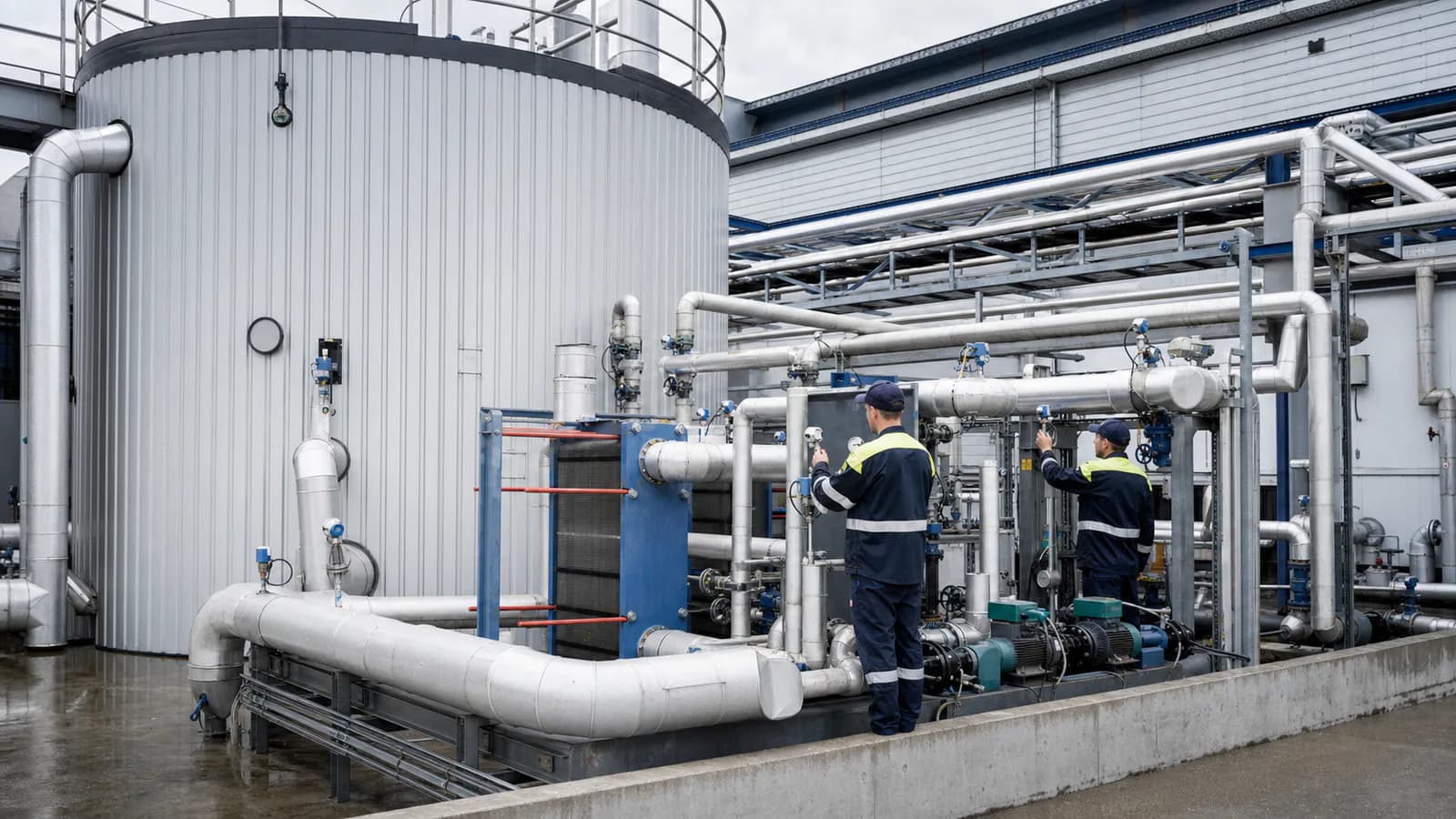
Thermal storage: scattered information versus Energy Intelligence
Generation and heat demand rarely coincide. Solar heat is abundant in summer, while heat demand peaks in winter. Green electricity is sometimes plentiful and cheap, and sometimes scarce. Anyone using heat only when it is needed has to store it in the meantime. Thermal storage bridges that gap. It matters to operators of heat networks, to process industry, and to businesses that want to use cheap electricity for their heat demand.
- The most common form is sensible heat: a medium such as water is made warmer or colder, for example in a buffer tank or hot water tank.
- For the longer term, an aquifer thermal energy storage system (in Dutch: WKO) stores heat and cold in the ground, so summer heat is available in winter and winter cold in summer.
- Latent storage in phase change materials (PCM) and high-temperature storage for industry offer more storage in less space, but are partly still in development.
Insight
Traditional approach
Information is scattered across portals, documents, invoices or separate spreadsheets.
Modern approach
Data, context and interpretation are brought together into a clear decision picture.
Decision-making
Traditional approach
Choices are made based on averages, assumptions or occasional analyses.
Modern approach
Scenarios, KPIs and current measurement data make the trade-off more concrete and repeatable.
Follow-up
Traditional approach
Actions often stay non-committal or disappear into separate reports.
Modern approach
Follow-up actions, monitoring and reporting are linked to the same energy data.
How does thermal storage work?
Thermal storage keeps energy as heat or cold and releases it later. The simplest form is sensible heat: a medium is made warmer or colder. Water is especially suitable for this, because it has a high heat capacity and is cheap. A buffer tank or hot water tank thus captures heat, for example from a solar collector or a heat pump. There is also latent storage in phase change materials, known as PCM. These materials absorb or release a lot of heat as they melt and solidify, always at the same temperature. As a result, over a small temperature difference a PCM stores more heat per kilogram than water, in less space. This technique is partly still in development.
- Sensible heat: a medium such as water is made warmer or colder in a buffer tank or tank.
- Water is popular because of its high heat capacity and low cost.
- Latent storage uses the heat released or needed during a phase change of a PCM.
- Over a small temperature difference a PCM stores more heat per kilogram than water, but the technique is partly still in development.
What other forms are there?
For the longer term, heat or cold is stored in the ground with an aquifer thermal energy storage system, in Dutch a WKO. This is a form of ground energy that uses the heat and the groundwater in the subsurface, down to several hundred metres deep. A WKO works as a seasonal buffer: heat left over in summer is used to heat in winter, and cold from winter is used to cool in summer. Offices and residential areas often apply this. For process industry there is also high-temperature storage, which keeps heat at a high temperature level. This keeps the stored heat usable for processes that require a high temperature.
- Aquifer thermal energy storage (WKO) keeps heat and cold in the ground as a seasonal buffer.
- WKO is a form of ground energy that uses the heat in the subsurface and the groundwater.
- Summer heat provides heating in winter, winter cold provides cooling in summer.
- High-temperature storage keeps heat available at a high level for industry.
What is it used for?
Thermal storage makes the heat system more flexible. With power-to-heat, for example via an electric boiler, cheap or green electricity is converted into heat. That heat goes into a buffer and is only used when demand arrives. This lets you use electricity at favourable moments, without the heat demand itself having to shift. In heat networks, a buffer helps to absorb peaks in demand and lets the heat source run more steadily. Process industry uses storage to keep residual heat and reuse it later. In all cases, storage decouples the moment of generation from the moment of use, which makes the system better able to cope with fluctuations.
- Power-to-heat converts cheap or green electricity into heat, which waits in a buffer for demand.
- In heat networks a buffer absorbs demand peaks and lets the heat source run more steadily.
- Process industry keeps residual heat to reuse it later.
- Storage decouples the moment of generation from the moment of use.
Curious what this looks like with your own data?
In a no-obligation call, a specialist looks at your meters, sites and energy questions with you. Response within one business day.
Search the knowledge base
Find the answer to your question.
Search using your own words. Abbreviations and spelling variants are recognised, so EMS also finds the articles on energy management systems.
Topic