
Smart grid explained for businesses
Direct answer
A smart grid is an intelligent electricity network that uses metering data and digital control to continuously match power supply and demand. In the Dutch context, grid operators use it to make better use of existing network capacity. That way more connections fit on the same grid before new cables are laid.
- Clear definition
- Data-driven assessment
- Risks and opportunities visible
- Practical next steps
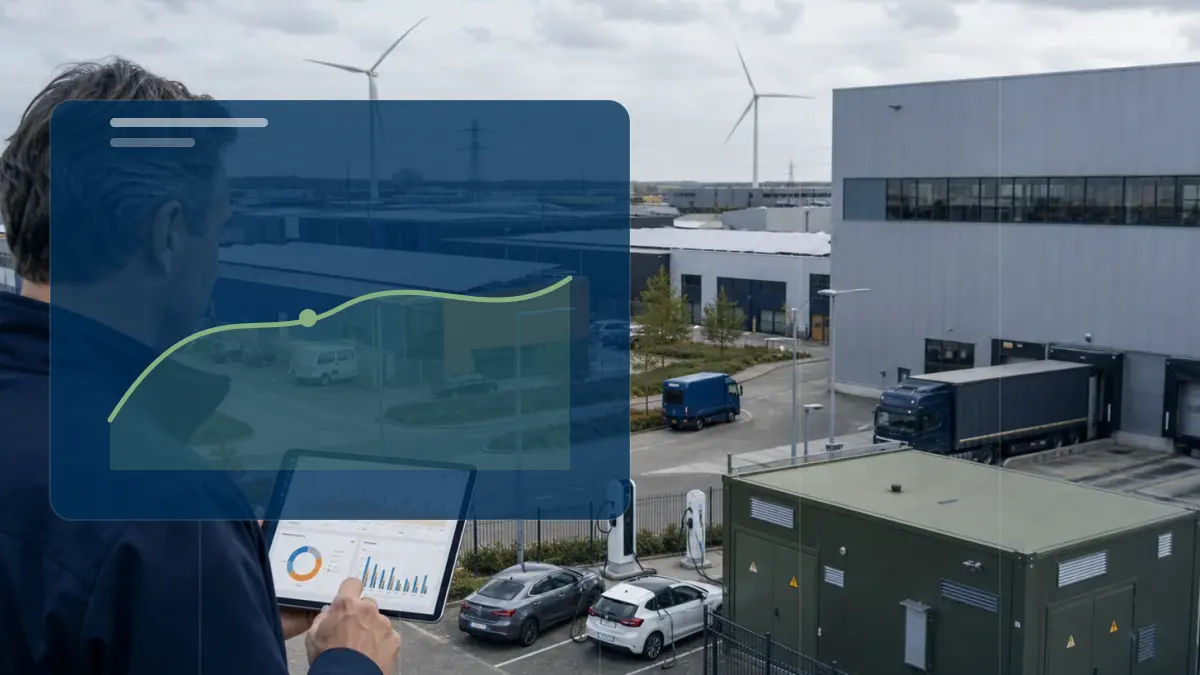
Smart grid explained: scattered information versus Energy Intelligence
The Dutch electricity grid is filling up in more and more places, because the country is electrifying fast while solar and wind deliver variably. Expanding with new cables and substations takes years. A company that wants to grow or install charging points then runs into waiting times. A smart grid uses the existing infrastructure more intelligently, so more becomes possible on the same grid before the steel is in the ground.
- A smart grid links metering data to control, so electricity generation and use coincide better in time.
- Dutch grid operators deploy smarter grid use alongside network expansion to absorb congestion.
- Flexible devices such as charging points, home batteries and heat pumps can be steered away from peak hours.
Insight
Traditional approach
Information is scattered across portals, documents, invoices or separate spreadsheets.
Modern approach
Data, context and interpretation are brought together into a clear decision picture.
Decision-making
Traditional approach
Choices are made based on averages, assumptions or occasional analyses.
Modern approach
Scenarios, KPIs and current measurement data make the trade-off more concrete and repeatable.
Follow-up
Traditional approach
Actions often stay non-committal or disappear into separate reports.
Modern approach
Follow-up actions, monitoring and reporting are linked to the same energy data.
How does an intelligent electricity grid work?
A smart grid combines measuring and steering. Smart meters and sensors give grid operators insight into peaks in demand and the supply of generated power. On that basis, consumption is spread across the day rather than concentrated in a few hours. Software links that data to devices that can shift their consumption. This makes the load on the grid less erratic and leaves more capacity available at the moments when it is tight.
- Smart meters supply the data on consumption and feed-in patterns.
- Software translates that data into switching flexible devices on and off.
- The grid is loaded more evenly, which flattens peaks.
- Grid management is non-profit and kept separate from energy supply.
When do you encounter this?
You notice a smart grid mainly when your region faces grid congestion, where demand for electricity transport is higher than the grid can handle. If you then want to expand, upgrade your connection or install charging points, the grid operator may ask you to shift consumption. Large consumers can receive compensation through congestion management if they temporarily reduce their offtake during busy hours. Households can also have charging points, home batteries and heat pumps steered intelligently.
- Congestion arises when transport demand exceeds network capacity.
- Large consumers can join congestion management in return for compensation.
- Shifting consumption to quiet hours creates room on the grid.
- Comfort stays intact in principle: the car is charged by morning.
What can you do yourself?
You can align your consumption with the moments when the grid is quieter, usually outside the evening peak. Devices that can shift their charging or heating moment are most suitable for this. Grid operators work with governments and the regulator ACM in the National Grid Congestion Action Programme on faster construction, smarter use and more flexible offtake. As a consumer you supply the flexibility; the grid operator uses it to connect more parties on the same grid.
- Shift heavy consumption to off-peak hours outside the evening peak.
- Charging points, home batteries and heat pumps lend themselves to steering.
- Flexible contracts and congestion management reward that shift.
- Grid operators and ACM cooperate in the National Grid Congestion Action Programme.
Curious what this looks like with your own data?
In a no-obligation call, a specialist looks at your meters, sites and energy questions with you. Response within one business day.
Search the knowledge base
Find the answer to your question.
Search using your own words. Abbreviations and spelling variants are recognised, so EMS also finds the articles on energy management systems.
Topic