
Smart charging as flexibility: a guide for businesses
Direct answer
Smart charging, also called slim laden in Dutch, is steering the moment and the power at which electric vehicles charge, based on the electricity price, the load on the grid or solar generation, without harming the driving need. You simply plug in; the charge point picks the best moment. This shifts charging to off-peak hours or the solar peak and keeps charging peaks on the connection limited.
- Clear definition
- Data-driven assessment
- Risks and opportunities visible
- Practical next steps
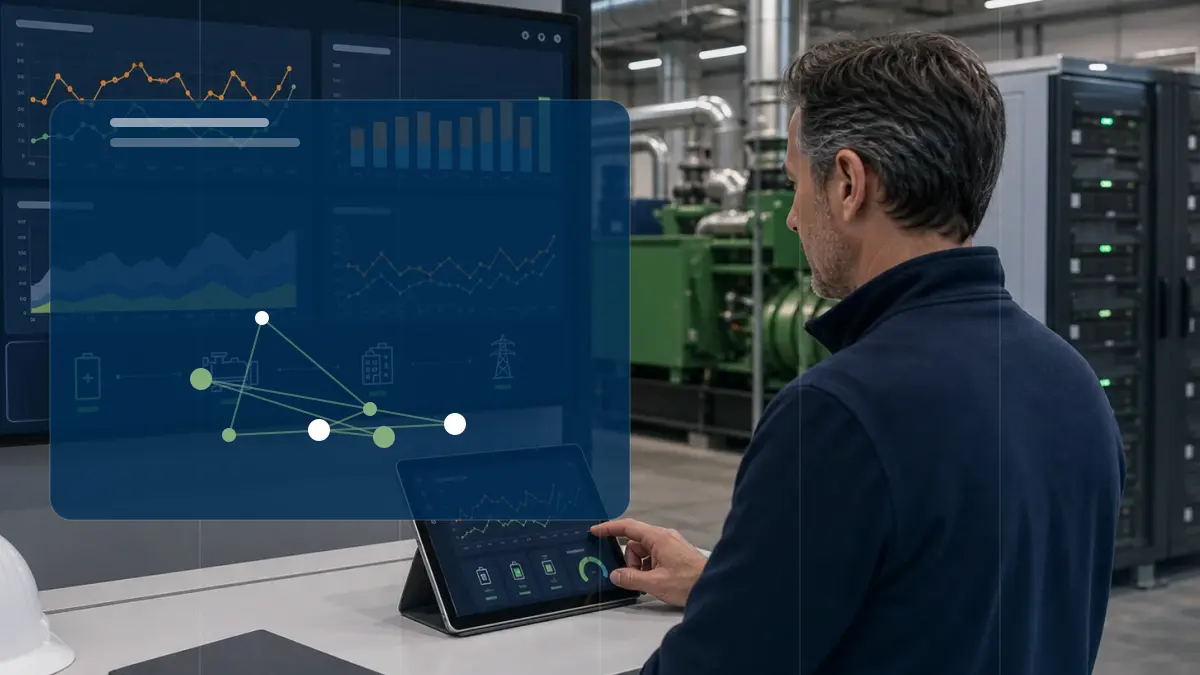
Smart charging as flexibility: scattered information versus Energy Intelligence
Electric driving is growing fast, and with many vehicles charging at once a new problem appears: charging peaks. If everyone plugs in after work, demand coincides with the evening peak on a grid that is already full in many places. Think of a company that parks fifteen delivery vans at the chargers at the end of the afternoon. Smart charging was created to spread those peaks and to let charging coincide with cheap, clean power, without a vehicle leaving later than needed.
- Smart charging shifts the charging moment to times with plenty of renewable generation or a quiet grid, while the vehicle is full in time for the trip.
- For a vehicle fleet or charging plaza, charge management, or load balancing, divides the available power across the charge points, keeping the peak on the connection low.
- Smart charging only steers charging and returns nothing to the grid; that return is called Vehicle to Grid (V2G) and is a separate, more advanced technology.
Insight
Traditional approach
Information is scattered across portals, documents, invoices or separate spreadsheets.
Modern approach
Data, context and interpretation are brought together into a clear decision picture.
Decision-making
Traditional approach
Choices are made based on averages, assumptions or occasional analyses.
Modern approach
Scenarios, KPIs and current measurement data make the trade-off more concrete and repeatable.
Follow-up
Traditional approach
Actions often stay non-committal or disappear into separate reports.
Modern approach
Follow-up actions, monitoring and reporting are linked to the same energy data.
What is smart charging?
Smart charging is steering the timing and the speed of charging with technology. You park, plug in, and the system decides when and how fast it charges. That can be based on the electricity price, the current load on the grid or solar generation. When the sun is on the roof, the car charges faster. When the grid peaks after work, the charge point waits and starts when the price and the grid load are lower. The driving need stays leading: the vehicle is sufficiently charged at the agreed departure time. Smart charging works at home, at work and at public charge points.
- Steering on electricity price, grid load or own solar generation, automatically after plugging in.
- Charging shifts to off-peak hours or the solar peak instead of the evening peak.
- The car is sufficiently charged at the set departure time.
- Works for charging at home, at work and at public charge points.
Why is smart charging an important source of flexibility?
Charging is one of the few forms of consumption you can shift widely in time without anyone being inconvenienced. A car often stands still for hours, while charging itself takes much less time. That room to move makes electric vehicles a flexible source. By moving charging to moments with plenty of wind or sun, and away from the peak, smart charging helps prevent grid congestion. On a connection with many charge points it prevents all vehicles from drawing full power at once. This keeps the requested peak below the limit of the connection, which can postpone a costly upgrade or a longer wait for extra transport capacity.
- A parked vehicle offers hours of room to shift the charging moment.
- Steering charging towards wind and solar peaks uses renewable power better.
- Avoiding peaks on the connection helps prevent grid congestion.
- A lower peak can postpone an upgrade or extra transport capacity.
How does a company with a fleet or charging plaza use it?
With multiple charge points on one connection, charge management is the core. A central system divides the available power across the connected vehicles: this is called load balancing. If everyone draws at once, the system shares the power or charges vehicles one after another, so the connection is not exceeded. Then comes the flexibility layer: within the available time the system picks the best moments, for example when power is cheap or the own solar panels deliver. For a fleet it starts with the departure times and the range needed per vehicle. You enter those conditions, after which the charge management optimises within them. This keeps service levels intact while the peak and the costs fall.
- Load balancing divides the power so the connection is not exceeded.
- Vehicles charge simultaneously at lower power or one after another in sequence.
- Within the available time the system steers on price, grid and own generation.
- Departure times and the range needed per vehicle are the hard conditions.
Curious what this looks like with your own data?
In a no-obligation call, a specialist looks at your meters, sites and energy questions with you. Response within one business day.
Search the knowledge base
Find the answer to your question.
Search using your own words. Abbreviations and spelling variants are recognised, so EMS also finds the articles on energy management systems.
Topic