
Calculating a flex business case: a guide for businesses
Direct answer
A business case for energy flexibility weighs the value of your flexible capacity against the cost of delivering it. You add up the value streams: lower grid costs, arbitrage on price differences, payment for balancing and congestion services, and deferred grid reinforcement. Against that stand the costs of technology, control and aggregation. The balance shows whether flexible use pays off for you.
- Clear definition
- Data-driven assessment
- Risks and opportunities visible
- Practical next steps
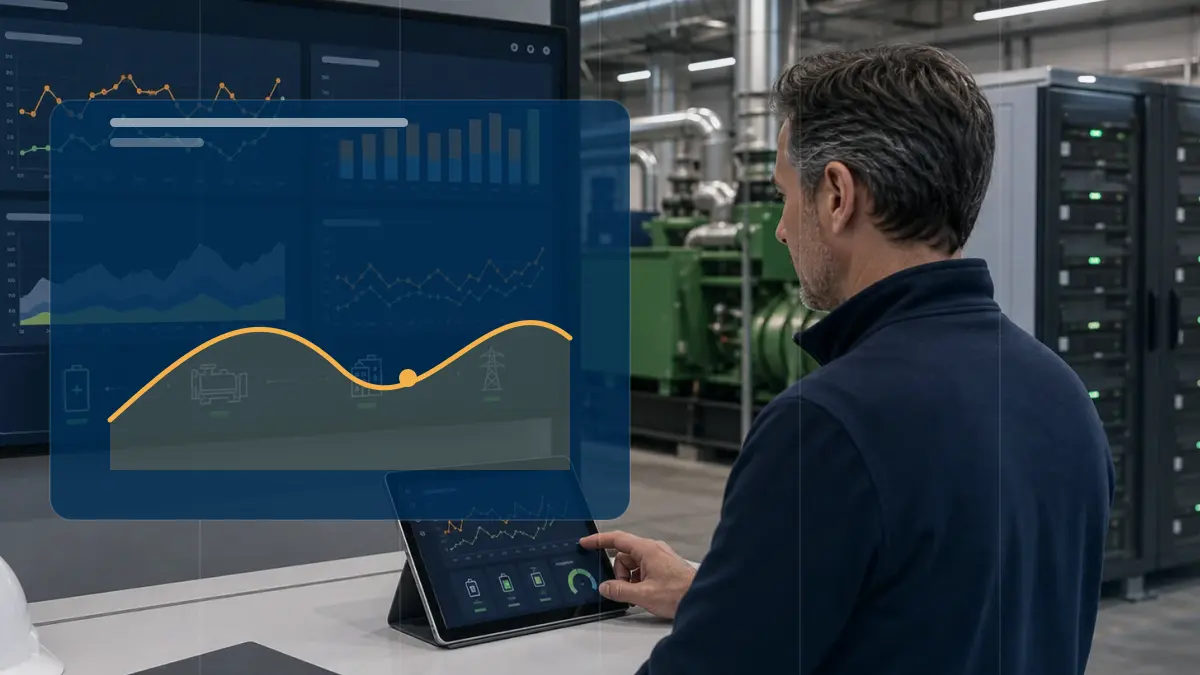
Calculating a flex business case: scattered information versus Energy Intelligence
More and more Dutch businesses can shift their electricity use: a cold store lowering its machines briefly, a factory postponing a process, a site with a battery. That flexibility has value, because the grid is full and prices fluctuate. Before you invest, you want to know whether it pays off. A business case makes that visible. This matters to businesses with a large connection who doubt whether flexible use will recover the investment in technology and control.
- Your flexible capacity can earn several value streams at once: saved grid costs, energy arbitrage, payment for balancing and congestion services, and deferred grid reinforcement.
- Against that value stand costs: technology such as a battery or control system, aggregator or service provider fees, and wear on equipment under intensive use.
- You need three kinds of data to calculate: your consumption or generation profile, how much capacity you can free up, and the relevant market prices and payments.
Insight
Traditional approach
Information is scattered across portals, documents, invoices or separate spreadsheets.
Modern approach
Data, context and interpretation are brought together into a clear decision picture.
Decision-making
Traditional approach
Choices are made based on averages, assumptions or occasional analyses.
Modern approach
Scenarios, KPIs and current measurement data make the trade-off more concrete and repeatable.
Follow-up
Traditional approach
Actions often stay non-committal or disappear into separate reports.
Modern approach
Follow-up actions, monitoring and reporting are linked to the same energy data.
Which value streams can you build?
Flexibility creates value in several ways. You save on grid costs by lowering your peak or through a flexible contract with your grid operator, for which you receive a payment or discount. You can do arbitrage: shift use to moments with lower prices, or deploy stored power when prices are high. You can offer your capacity for balancing services to the national grid operator and for congestion services via the GOPACS platform, for which the grid operator pays. And you help defer or avoid grid reinforcement. Importantly, you may stack value, combining several streams, as long as the moments of deployment do not exclude one another.
- Saved grid costs through peak reduction or a flexible contract with payment or discount.
- Energy arbitrage: shifting use or deploying storage based on price differences.
- Payment for balancing services and for congestion services via GOPACS.
- Deferred or avoided grid reinforcement, for you and for the grid.
- Stacking value is allowed, provided the moments of deployment do not exclude one another.
Which costs and data are involved?
Against the value stand costs. Technology is one: a battery, an energy management system or control of your processes. Often you work with an aggregator or service provider who brings your capacity to the market; they charge a fee or a share of the revenue. Intensive switching also causes wear, such as degradation of a battery. To calculate, you need three kinds of data. Your consumption or generation profile shows when and how much you can shift. Your flex volume is the capacity you can actually free up. And the market prices and payments determine what that capacity is worth at each moment.
- Technology costs: battery, energy management system or process control.
- Aggregator or service provider fees, often a payment or share of the revenue.
- Wear and degradation from intensive switching, especially for batteries.
- Data: consumption or generation profile, available flex volume, current market prices and payments.
How do you avoid calculation errors?
The biggest pitfall is double counting. You cannot deliver the same capacity to two markets at the same moment, so only add up value if the moments of deployment stand apart. Be honest about assumptions too. Prices on the intraday and imbalance markets fluctuate strongly, so revenue from arbitrage or balancing is uncertain and varies per moment and per market. Calculate with scenarios instead of a single figure, and account for risk: how often is your offer actually called upon, and what happens if prices disappoint. A thinner but realistic business case is worth more than an optimistic one that does not materialise.
- Avoid double counting: only stack value from moments of deployment that do not exclude one another.
- Calculate with scenarios, because market and balancing prices fluctuate strongly.
- Include risk: how often you are called upon, and what if prices disappoint.
- Test your assumptions against your own profile and current market data, not loose examples.
Curious what this looks like with your own data?
In a no-obligation call, a specialist looks at your meters, sites and energy questions with you. Response within one business day.
Search the knowledge base
Find the answer to your question.
Search using your own words. Abbreviations and spelling variants are recognised, so EMS also finds the articles on energy management systems.
Topic