
Battery energy storage system (BESS) as a flex source: a guide for businesses
Direct answer
A BESS (battery energy storage system) is an electricity store with batteries that saves power and delivers it later. It is a versatile flexibility source: it can charge and discharge within seconds, so you use it to cap demand peaks, shift energy to more favourable moments and provide balancing services to the Dutch grid operator.
- Clear definition
- Data-driven assessment
- Risks and opportunities visible
- Practical next steps
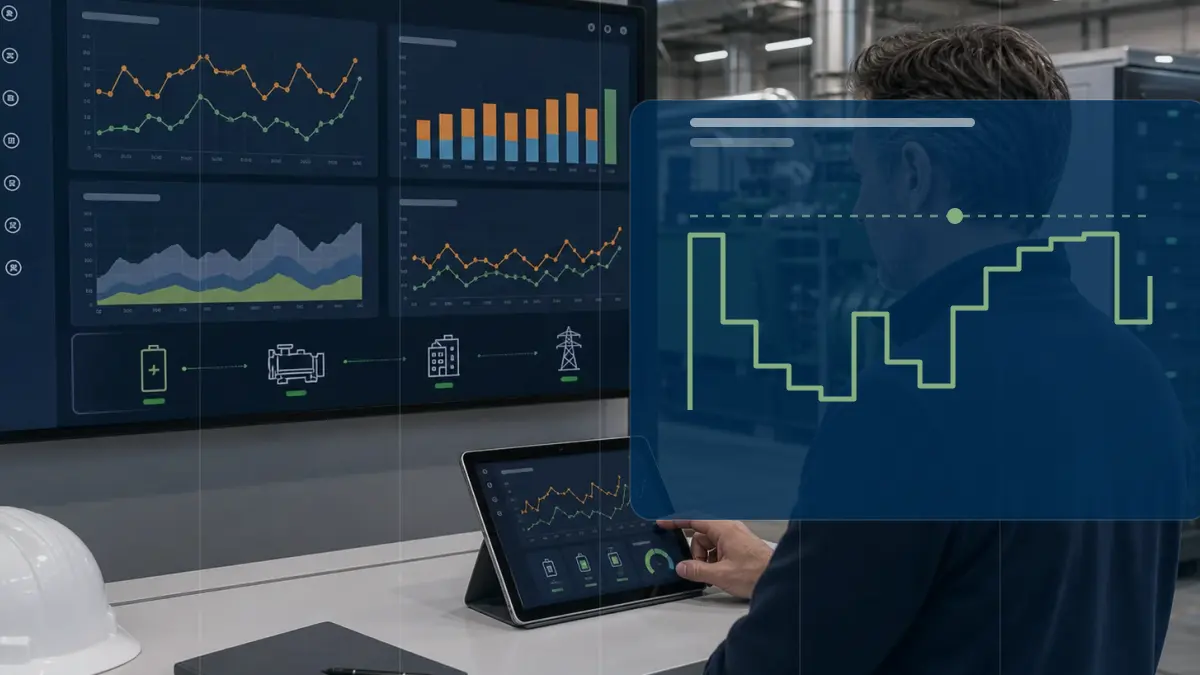
Battery energy storage system (BESS) as a flex source: scattered information versus Energy Intelligence
Businesses increasingly hit two walls: a connection that is too small at peak moments, and a grid that is full in many regions. Think of a production hall where machines and charging points switch on at the same time. A battery energy storage system stores electricity when it is available and returns it when you need it. That makes it not a single fix for one problem, but a flexible building block that can ease several bottlenecks at once.
- A BESS charges during a surplus and discharges during a shortage, lowering your peak and letting you use a busy connection more intelligently.
- The same battery can perform several tasks: peak reduction, trading on the energy market, and balancing services to TenneT such as FCR and aFRR.
- In a congestion area a battery may not add extra load to the grid, so Dutch grid operators use an integration framework and flexible contracts.
Insight
Traditional approach
Information is scattered across portals, documents, invoices or separate spreadsheets.
Modern approach
Data, context and interpretation are brought together into a clear decision picture.
Decision-making
Traditional approach
Choices are made based on averages, assumptions or occasional analyses.
Modern approach
Scenarios, KPIs and current measurement data make the trade-off more concrete and repeatable.
Follow-up
Traditional approach
Actions often stay non-committal or disappear into separate reports.
Modern approach
Follow-up actions, monitoring and reporting are linked to the same energy data.
Why is a BESS so versatile?
A BESS can switch between charging and discharging within seconds. That speed makes it suitable for a range of tasks. With peak shaving, the battery charges during quiet moments and discharges during your demand peaks, so your contracted capacity can stay lower. With energy arbitrage, you charge when power is plentiful and cheap and deliver back when it is scarce. In addition, a BESS can provide balancing services to grid operator TenneT, which keeps the grid frequency stable. FCR responds autonomously to frequency deviations within seconds, while aFRR then follows a control signal. Behind the meter, a battery increases your own consumption of self-generated solar energy.
- Peak shaving: the peak in your consumption or feed-in drops.
- Energy arbitrage: charge at low prices, deliver at high prices.
- Balancing services to TenneT: including FCR and aFRR for grid stability.
- Self-consumption: use more of your own solar energy instead of feeding it back.
- Imbalance: respond to the imbalance price of the moment.
How does a business deploy a BESS?
Start with your energy profile: when do you consume or deliver power, and where are the peaks. Based on that you determine the required power and storage capacity. Many businesses earn back the investment in several ways at once, known as stacking revenue streams. You reduce your own peak, use more self-generated energy, and offer the remaining flexibility on the market or to the grid operator. Trading on the energy market requires knowledge; many businesses hire a specialised party for it. The control of the battery determines the result: a smartly controlled battery delivers value, while a wrongly configured battery can actually worsen grid congestion.
- Map your consumption and generation profile and choose power and capacity.
- Stack revenue streams: peak reduction, self-consumption, trading and balancing.
- Consider a specialist for trading on the energy market.
- Control is decisive: wrongly configured, a battery worsens congestion.
- Register a system larger than 1 megawatt well in advance with the grid operator.
Where are the limits and points of attention?
The first limit is your connection. In a congestion area a battery may not add extra load to the existing transport capacity. Dutch grid operators therefore use an integration framework with area categories and work with flexible contracts, such as a capacity limitation contract, in which the battery scales back on request as soon as transport scarcity threatens. Mind safety too: storing batteries falls under the PGS 37-1 guideline, and your insurer and municipality set requirements for placement and distance to homes. Batteries wear out through use; this degradation reduces the usable capacity over time. Finally, batteries contain critical raw materials such as lithium, with environmental and collection obligations.
- In a congestion area the battery may not add extra load to the grid.
- An integration framework and flexible contracts govern when the battery scales back.
- Safety: PGS 37-1, plus requirements from your insurer and municipality.
- Degradation: the usable capacity gradually decreases through use.
- Raw materials: batteries contain critical materials with a collection obligation.
Curious what this looks like with your own data?
In a no-obligation call, a specialist looks at your meters, sites and energy questions with you. Response within one business day.
Search the knowledge base
Find the answer to your question.
Search using your own words. Abbreviations and spelling variants are recognised, so EMS also finds the articles on energy management systems.
Topic