
Demand side management vs. demand response: a guide for businesses
Direct answer
Demand side management is the broad approach to steering electricity demand on the user side: saving, working more efficiently and shifting consumption to more favourable moments. Demand response is one part of it: briefly adjusting your consumption in response to a price or grid signal. Demand side management is the strategy, demand response is a concrete action within it.
- Clear definition
- Data-driven assessment
- Risks and opportunities visible
- Practical next steps
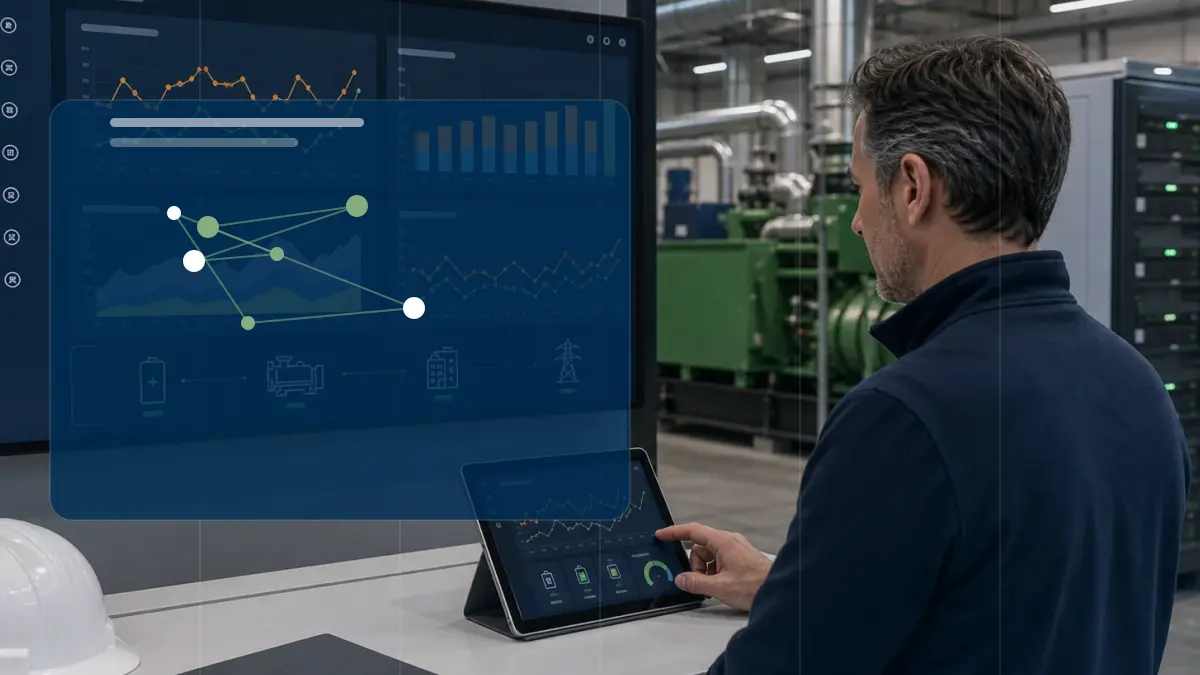
Demand side management vs. demand response: scattered information versus Energy Intelligence
The Dutch electricity grid is reaching its limits in more and more places, and the price of power varies sharply by the hour. That makes it worthwhile to look not only at how much you consume, but also at when you consume it. A cold store that turns its machines down while the grid is full does something different from a business that becomes structurally more efficient. Both belong to steering the demand side, but on a different time scale and with a different aim.
- Demand side management is the overarching approach: structural saving, greater efficiency and shifting consumption to better align demand with supply.
- Demand response is a specific, short-lived reaction to a signal, for example a price peak or a grid operator's request to briefly consume less.
- Every demand response is demand side management, but not every form of demand side management is demand response; saving and efficiency also fall under it.
Insight
Traditional approach
Information is scattered across portals, documents, invoices or separate spreadsheets.
Modern approach
Data, context and interpretation are brought together into a clear decision picture.
Decision-making
Traditional approach
Choices are made based on averages, assumptions or occasional analyses.
Modern approach
Scenarios, KPIs and current measurement data make the trade-off more concrete and repeatable.
Follow-up
Traditional approach
Actions often stay non-committal or disappear into separate reports.
Modern approach
Follow-up actions, monitoring and reporting are linked to the same energy data.
What is demand side management?
Demand side management is the collective term for everything with which you influence energy demand on the user side. It is about the demand side rather than generation. Traditionally, supply followed demand: more was generated when people needed more power. Demand side management reverses that and adjusts demand to the available supply. This happens in different ways and on different time scales. You can save structurally, make your installations more efficient, or shift your consumption to moments with plenty of sun and wind or a lower price. It is therefore a strategy that covers both lasting measures and short interventions.
- It is an overarching approach, not a single technique or contract.
- Aim: to make electricity demand align better with supply.
- Covers structural saving, improving efficiency and shifting consumption.
- Works on multiple time scales, from lasting measures to interventions of minutes.
What is demand response and how does it differ?
Demand response is the short-lived adjustment of your consumption in response to a signal. That signal is usually a price that varies by the hour, or a request from the grid operator to draw less from the grid during a peak. You then temporarily lower your consumption, or shift it to a quieter moment. Examples are a cold store turning its cooling machines down, a factory postponing a production step, or a battery relieving the grid. The difference with demand side management lies in scope and time scale: demand response is a concrete, short action, while demand side management is the broad approach in which that action fits.
- Demand response reacts briefly to a price or grid signal.
- Often automated, because the moments are not known in advance.
- Examples: turning cooling down, postponing production, deploying a battery.
- It is a part of demand side management, not something separate.
When does a business do what?
Start with the broad approach: map when and how much you consume, and where saving or efficiency is possible. That is demand side management at its core, and it often gives the most certainty, because the gain is lasting. Demand response comes into play if you are flexible in your processes and can react to signals. That requires consumption you can postpone or turn down without harm, and usually automation. The two do not exclude each other: many businesses save structurally and, on top of that, deploy their remaining flexibility through demand response. Mind the limits: not every process is movable, and processes that affect safety are left untouched.
- First map your consumption profile and saving opportunities.
- Structural saving and improving efficiency give lasting gains.
- Demand response only works with processes you can shift or turn down.
- Combine both: first reduce demand structurally, then deploy the rest flexibly.
Curious what this looks like with your own data?
In a no-obligation call, a specialist looks at your meters, sites and energy questions with you. Response within one business day.
Search the knowledge base
Find the answer to your question.
Search using your own words. Abbreviations and spelling variants are recognised, so EMS also finds the articles on energy management systems.
Topic