
FCR aFRR mFRR balancing products: a guide for businesses
Direct answer
FCR, aFRR and mFRR are the three balancing products that grid operator TenneT uses to keep the grid frequency around 50 hertz. FCR (Frequency Containment Reserve) stabilises the frequency instantly and fully automatically. aFRR (automatic Frequency Restoration Reserve) then restores the balance, also automatically. mFRR (manual Frequency Restoration Reserve) is called up manually for larger or longer deviations.
- Clear definition
- Data-driven assessment
- Risks and opportunities visible
- Practical next steps
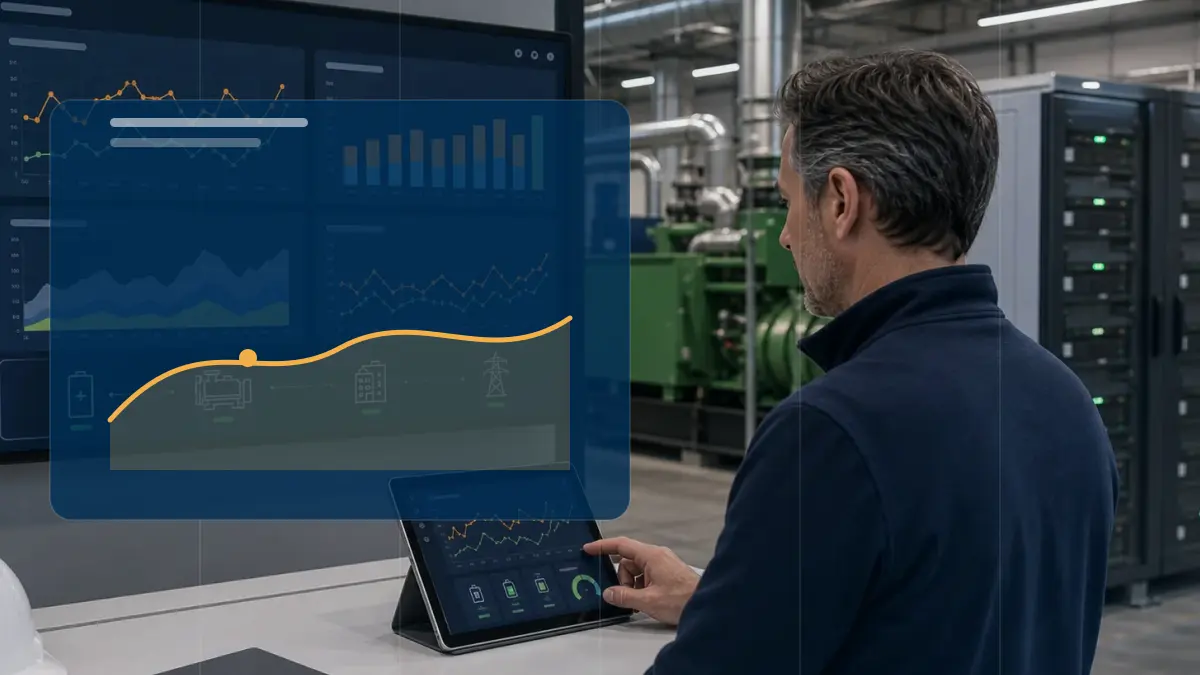
FCR aFRR mFRR balancing products: scattered information versus Energy Intelligence
The electricity grid only works if supply and demand match at every moment. When they do not, the frequency drifts away from 50 hertz and outages loom. Think of a large power plant that suddenly trips, or of solar and wind changing faster than forecast. TenneT safeguards that balance and procures reserve capacity for it. This matters to anyone with controllable capacity: a business with a battery, a backup generator or a process it can adjust for a while.
- FCR reacts fastest: fully automatically on the measured frequency, fully activated within 30 seconds, and stabilises the deviation immediately.
- aFRR is controlled automatically by TenneT and restores the frequency back to 50 hertz; mFRR is called up manually by TenneT for larger or prolonged imbalances.
- Companies take part as a connected party or through an aggregator that pools small installations; participation requires prequalification and a contract with TenneT.
Insight
Traditional approach
Information is scattered across portals, documents, invoices or separate spreadsheets.
Modern approach
Data, context and interpretation are brought together into a clear decision picture.
Decision-making
Traditional approach
Choices are made based on averages, assumptions or occasional analyses.
Modern approach
Scenarios, KPIs and current measurement data make the trade-off more concrete and repeatable.
Follow-up
Traditional approach
Actions often stay non-committal or disappear into separate reports.
Modern approach
Follow-up actions, monitoring and reporting are linked to the same energy data.
What do FCR, aFRR and mFRR do?
The three products act one after the other, each slower but more targeted. FCR is the first layer, also called primary reserve. It responds fully automatically to the measured frequency and is fully activated within 30 seconds. FCR stabilises the deviation, but does not bring the frequency back to exactly 50 hertz. That is done by aFRR, the secondary reserve: TenneT controls it automatically and restores the balance, usually within a few minutes. If the imbalance persists, TenneT deploys mFRR, the tertiary reserve. It is called up manually from a service provider, typically within 15 minutes, for larger or longer lasting deviations.
- FCR: primary, fully automatic on frequency, stabilises immediately within 30 seconds.
- aFRR: secondary, controlled automatically by TenneT, restores the frequency to 50 hertz.
- mFRR: tertiary, called up manually, typically deployable within 15 minutes.
- Together they keep the frequency in the narrow band around 50 hertz.
How do the products differ?
The distinction lies in speed and the way of activation. FCR is the fastest and works entirely without intervention: each participating installation measures the frequency itself and responds. aFRR is also automatic, but is controlled centrally by TenneT through a signal, not by the local frequency measurement. mFRR is the slowest layer and is activated manually when TenneT deems it necessary. The products also differ in procurement. For FCR and aFRR, TenneT contracts parties to keep capacity available and to deliver bids. For mFRR, separate arrangements apply, with capacity standing ready on call. This way TenneT builds layer upon layer: fast and coarse first, more targeted and slower afterwards.
- FCR responds locally and autonomously to the frequency itself.
- aFRR follows a central control signal from TenneT, fully automatically.
- mFRR is called up manually by TenneT, as the last layer.
- Procurement and contract form differ per product.
How does your business take part?
Companies rarely supply balancing capacity directly. Usually you join an aggregator, a party that pools the flexibility of many small installations into a portfolio large enough for the market. The formal role towards TenneT is called Balancing Service Provider. To take part, your installation must first prequalify: TenneT checks whether it responds fast enough and reliably enough to the requirements of the product. Those requirements differ: FCR demands a very fast, fully automatic response, whereas mFRR allows more time. Thresholds also apply, such as a minimum bid size. Batteries, combined heat and power units and controllable processes are suitable sources, provided they meet the required response speed.
- Participation usually runs through an aggregator that pools small installations.
- The formal market role towards TenneT is called Balancing Service Provider.
- Prequalification is mandatory: TenneT checks speed and reliability.
- Technical requirements and a minimum bid size differ per product.
Curious what this looks like with your own data?
In a no-obligation call, a specialist looks at your meters, sites and energy questions with you. Response within one business day.
Search the knowledge base
Find the answer to your question.
Search using your own words. Abbreviations and spelling variants are recognised, so EMS also finds the articles on energy management systems.
Topic