
Demand response explained for businesses
Direct answer
Demand response is demand-side flexibility: you actively adjust your electricity demand to signals such as the price, the grid situation or imbalance. You reduce or shift your consumption at peak moments. This helps relieve the grid and can lower your costs or earn you a fee. In the Netherlands it mainly applies to businesses with flexible processes and a large connection.
- Clear definition
- Data-driven assessment
- Risks and opportunities visible
- Practical next steps
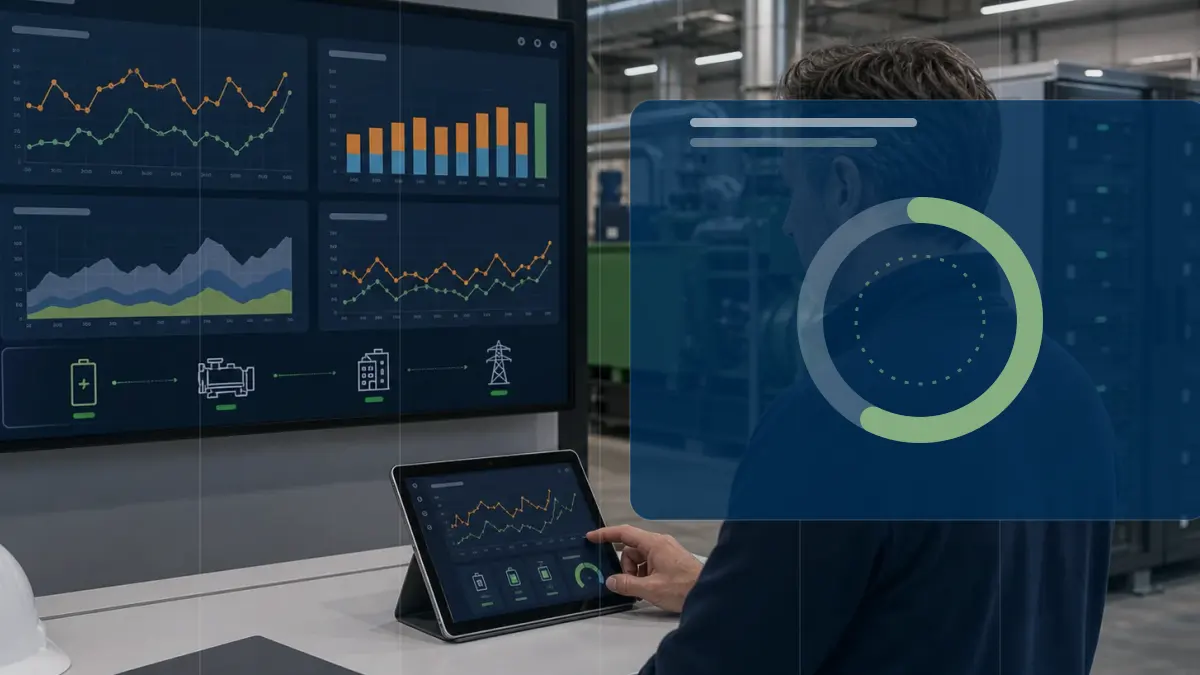
Demand response explained: scattered information versus Energy Intelligence
The Dutch electricity grid is hitting its limits in many places. At peak moments there is too little room, while during quiet hours the grid sits half empty. Demand response flips that logic: instead of the grid following demand, you adjust your demand to the grid. Think of a cold store lowering its refrigeration for a while when the grid is full. It matters to businesses with a large connection and processes that allow some room to manoeuvre.
- Demand response means lowering or shifting your consumption when the grid is full or power is expensive, either manually or automatically.
- A business does this to cut costs, help solve grid congestion, or receive a fee through congestion management or the Dutch balancing markets.
- It only works if you can temporarily adjust a process, cooling, storage or charging without harming your operations.
Insight
Traditional approach
Information is scattered across portals, documents, invoices or separate spreadsheets.
Modern approach
Data, context and interpretation are brought together into a clear decision picture.
Decision-making
Traditional approach
Choices are made based on averages, assumptions or occasional analyses.
Modern approach
Scenarios, KPIs and current measurement data make the trade-off more concrete and repeatable.
Follow-up
Traditional approach
Actions often stay non-committal or disappear into separate reports.
Modern approach
Follow-up actions, monitoring and reporting are linked to the same energy data.
How does demand response work?
Demand response starts with a signal: a high market price, a call from the grid operator, or an imbalance on the grid. In response you lower or shift your consumption. That can be manual, by deliberately moving a process, or automatic, through a control system that steers devices. You can arrange it yourself or outsource it to an intermediary that bundles your flexibility and offers it on the market, often called an aggregator or congestion service provider. The core is always the same: move consumption away from the peak, towards moments when there is room and often cheaper power. Batteries, charging points, cooling and heating lend themselves well to it.
- The signal comes from the price, the grid operator, or the imbalance on the grid.
- You respond manually, by shifting processes, or automatically, through control systems.
- You arrange it yourself or via an aggregator that bundles and sells your flexibility.
- Suitable sources include batteries, charging points, cooling, heating and movable production.
Why does a business use demand response?
There are three reasons. First, cost: by shifting consumption to cheap hours, you pay less for your power, especially with a contract that follows the hourly price. Second, grid congestion: on a full grid you may not get extra transport capacity, but flexible consumption can still move you forward. Third, a fee: you can sell your flexibility. Through congestion management the grid operator buys room, for example with a capacity control contract or via redispatch on the GOPACS platform. On the balancing markets of the Dutch transmission operator TenneT, the national grid operator pays for flexibility that keeps the whole grid in balance. For those markets you usually engage a specialised intermediary.
- Cost: shifting consumption to cheap hours lowers your energy bill.
- Grid congestion: flexible consumption can make a project possible on a full grid.
- A fee through congestion management, where the grid operator buys room via GOPACS.
- A fee through TenneT's balancing markets, usually via an intermediary.
Where are the limits?
Demand response only works if you are genuinely flexible. A process that must run at full power continuously offers little room. You need to be able to reduce or shift consumption without harming your production, comfort or safety. There is also often a threshold: many arrangements target large connections, larger than 3 times 80 amperes, meaning a large-consumer connection. If your business has more than 1 megawatt of contracted transport capacity, the grid operator can even oblige you to investigate whether you can become more flexible. Businesses that are essential for safety and health, such as hospitals, do not have to take part. So start with a clear picture of your consumption profile and your controllable processes.
- You need processes you can adjust without harming your operations.
- Many arrangements apply from a large connection, larger than 3 times 80 amperes.
- From 1 megawatt of transport capacity, the grid operator can require a flexibility study.
- Organisations with a vital function, such as hospitals, are exempt.
Curious what this looks like with your own data?
In a no-obligation call, a specialist looks at your meters, sites and energy questions with you. Response within one business day.
Search the knowledge base
Find the answer to your question.
Search using your own words. Abbreviations and spelling variants are recognised, so EMS also finds the articles on energy management systems.
Topic