
Second-life batteries: a guide for businesses
Direct answer
Second-life batteries are used batteries, usually from electric vehicles, that no longer meet the demands of driving but still hold enough capacity for a second life as stationary energy storage. After years of use in a car, such a battery often retains a large share of its original capacity. That remaining capacity buffers solar and wind power, absorbs consumption peaks and supports the grid.
- Clear definition
- Data-driven assessment
- Risks and opportunities visible
- Practical next steps
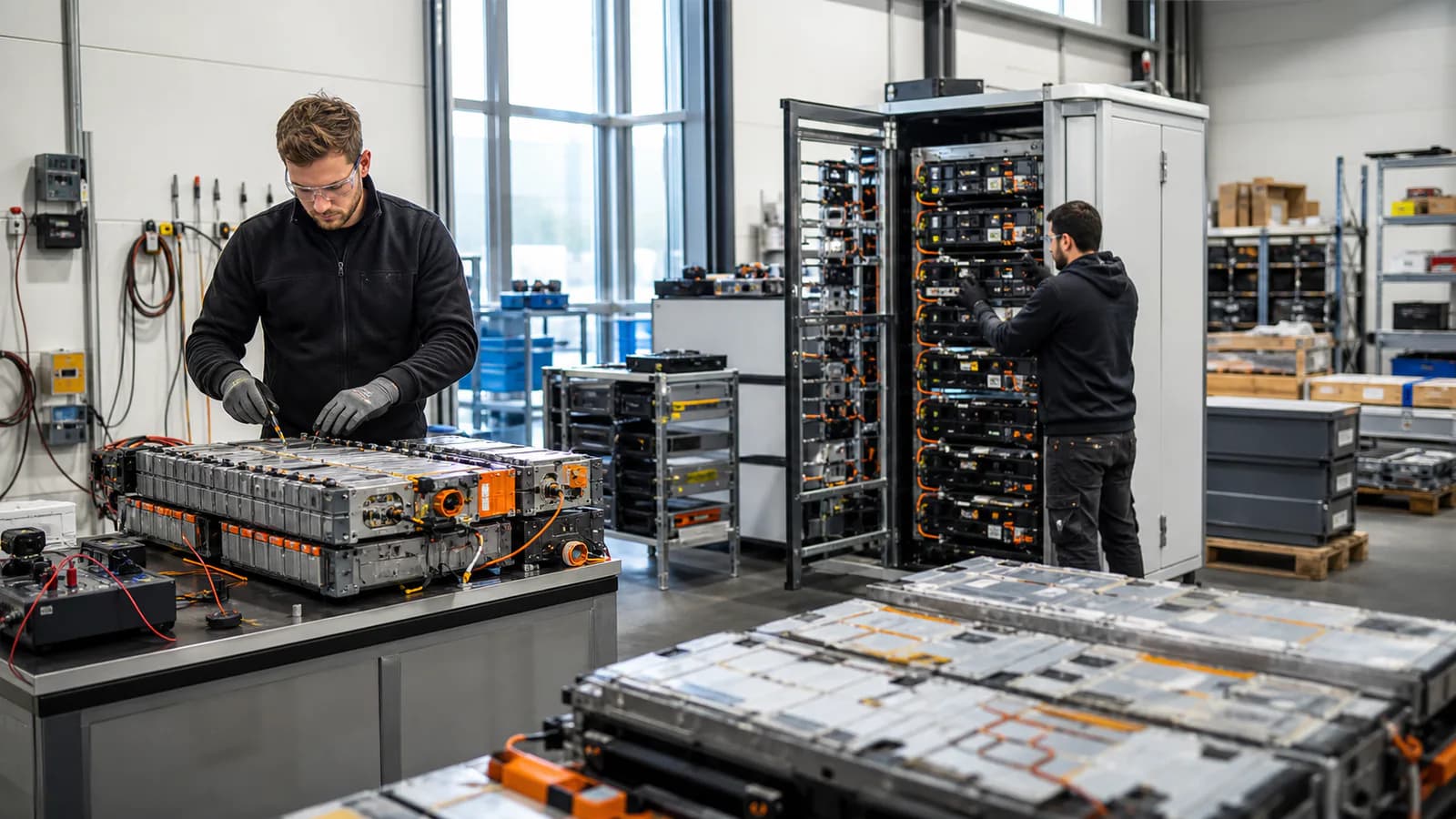
Second-life batteries: scattered information versus Energy Intelligence
Every electric car eventually wears down its battery. After years of use the capacity drops and the range shrinks, so the battery is rejected for the road. Yet at that point it is rarely truly spent. A business that wants to store solar power or flatten peaks can give that used battery a second life as a stationary battery. This matters to companies with their own generation, charging hubs or an expensive grid connection who want to steer their energy use without buying a brand-new battery.
- A battery from an electric vehicle no longer suffices for driving, but often keeps a large share of its capacity, enough for stationary use.
- Businesses use second-life batteries as a cheaper buffer for solar and wind, for peak shaving and for grid support behind the meter.
- Remaining capacity and lifespan differ per battery, so inspection, safety certification, warranty and management determine whether a second life is responsible.
Insight
Traditional approach
Information is scattered across portals, documents, invoices or separate spreadsheets.
Modern approach
Data, context and interpretation are brought together into a clear decision picture.
Decision-making
Traditional approach
Choices are made based on averages, assumptions or occasional analyses.
Modern approach
Scenarios, KPIs and current measurement data make the trade-off more concrete and repeatable.
Follow-up
Traditional approach
Actions often stay non-committal or disappear into separate reports.
Modern approach
Follow-up actions, monitoring and reporting are linked to the same energy data.
How do second-life batteries work?
A battery from an electric vehicle is replaced once it delivers too little range or charging speed. At that moment a substantial share of its original capacity often remains. For a car that is too little, for a stationary battery it is ample. Specialists inspect the battery, measure its condition, rebuild the packs and build a battery system with control electronics around it. That system stays put in a fixed location and charges and discharges at set moments. The load is much gentler than in a car, so the battery can sustain its second life for years. Exactly how many years depends on the starting condition and the usage pattern.
- The battery usually comes from an electric vehicle and has been rejected for driving.
- Often a large share of the capacity remains, enough for stationary use.
- A specialist inspects, measures and rebuilds the battery into a system with controls.
- Use is stationary and gentler than in a car, which extends the lifespan.
What do you use them for?
Second-life batteries do the same work as a new stationary battery, often at lower cost. You store solar or wind power when generation is high and use it later, when there is little sun or wind. You absorb consumption peaks, so you draw less power from the grid; this is called peak shaving. And you use the battery for grid support, for example as emergency power or to smooth fluctuations. For businesses with a tight or expensive grid connection this is attractive. The gain is not only financial: a second life saves raw materials such as lithium, cobalt and nickel and keeps the battery out of the waste stream longer.
- Buffer for solar and wind: store on surplus, use on shortage.
- Peak shaving: flatten consumption peaks and draw less power from the grid.
- Grid support and emergency power behind the meter.
- Circular benefit: fewer new raw materials and less waste.
What should you watch out for?
A second life is not a free life. Because every battery has its own usage history, the remaining capacity differs per pack and the remaining lifespan is harder to predict than for a new battery. So ask for an inspection report and a clear warranty on capacity and years. Safety demands attention: used batteries place requirements on fire safety, placement and the battery management system. The rules also matter. The EU Batteries Regulation treats reuse and repurposing as a separate step, with its own requirements for labelling and documentation; anyone giving a battery a second life takes on responsibilities. Finally, count on maintenance and monitoring throughout the whole period.
- Remaining capacity and lifespan differ per battery; ask for an inspection report.
- Record the warranty on capacity and years in writing.
- Fire safety, placement and the battery management system need attention.
- The EU Batteries Regulation sets requirements for reuse, labelling and documentation.
- Count on management, monitoring and maintenance throughout the whole period.
Curious what this looks like with your own data?
In a no-obligation call, a specialist looks at your meters, sites and energy questions with you. Response within one business day.
Search the knowledge base
Find the answer to your question.
Search using your own words. Abbreviations and spelling variants are recognised, so EMS also finds the articles on energy management systems.
Topic