
Roles of TenneT, Liander, Stedin, Enexis, Coteq and Westland: a guide for businesses
Direct answer
The division of roles between TenneT, Liander, Stedin, Enexis, Coteq and Westland sets out who manages which part of the Dutch electricity grid. TenneT manages the national high-voltage grid. Liander, Stedin, Enexis, Coteq and Westland are regional grid operators that manage the underlying networks and the connections of households and businesses.
- Clear definition
- Data-driven assessment
- Risks and opportunities visible
- Practical next steps
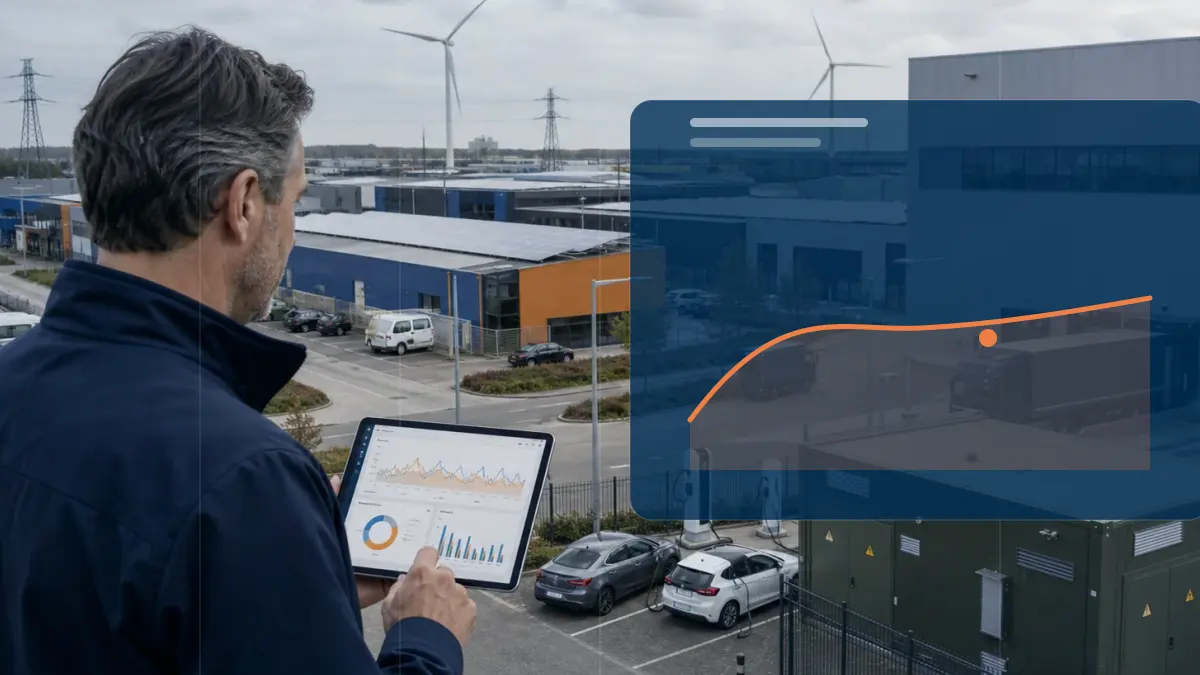
Roles of TenneT, Liander, Stedin, Enexis, Coteq and Westland: scattered information versus Energy Intelligence
Anyone requesting a large connection or dealing with grid congestion soon encounters more than one grid operator. One manages the national backbone, another the network in your street or on your business park. Knowing who is responsible for what saves time when you file a request or report a fault. This explainer places the tasks of TenneT and the regional grid operators side by side.
- TenneT manages the national high-voltage grid at 110, 150, 220 and 380 kilovolts and continuously safeguards the balance between supply and demand.
- Liander, Stedin and Enexis are the three large regional grid operators; Coteq and Westland are small regional grid operators with a limited service area.
- Your location determines which regional grid operator you have; each area has exactly one, so you cannot choose.
Insight
Traditional approach
Information is scattered across portals, documents, invoices or separate spreadsheets.
Modern approach
Data, context and interpretation are brought together into a clear decision picture.
Decision-making
Traditional approach
Choices are made based on averages, assumptions or occasional analyses.
Modern approach
Scenarios, KPIs and current measurement data make the trade-off more concrete and repeatable.
Follow-up
Traditional approach
Actions often stay non-committal or disappear into separate reports.
Modern approach
Follow-up actions, monitoring and reporting are linked to the same energy data.
Who does what?
TenneT is the national grid operator for electricity. It manages the high-voltage grid that transports power over long distances, at voltage levels of 110, 150, 220 and 380 kilovolts. TenneT connects large producers, regions and very large consumers and continuously safeguards the balance between generation and consumption. The regional grid operators manage the lower-voltage networks and the connections of homes and businesses. Liander, Stedin and Enexis are the three large ones; Coteq and Westland Infra are small operators with a limited service area.
- TenneT: national high-voltage grid and system balance.
- Liander, Stedin, Enexis: large regional grid operators.
- Coteq: small operator in several municipalities in Overijssel.
- Westland Infra: small operator in Westland and Midden-Delfland.
Which grid operator do you have?
Which regional grid operator you have depends on your location. Each area has exactly one regional grid operator, and you cannot choose. Liander manages networks in North Holland, Gelderland, Flevoland and Friesland and parts of South Holland, among others. Stedin operates in large parts of the Randstad, Zeeland and Utrecht. Enexis manages the networks in North Brabant, Limburg, Overijssel, Drenthe and Groningen. Coteq manages the network in several municipalities in Overijssel. Westland Infra manages the network in Westland and Midden-Delfland. TenneT alone manages the national grid.
- Your address determines the regional grid operator.
- Each area has one operator; choosing is not possible.
- TenneT is the national operator for everyone.
- The service areas are laid down by law.
Who arranges the large connections?
For a new connection, the requested capacity determines which party you deal with. High-capacity connections are arranged by TenneT on the high-voltage grid. Smaller connections run through the regional grid operator. Every grid operator has a legal duty to connect, to transport and to build, maintain and manage the network. The ACM supervises and sets the tariffs each year, because a grid operator holds a legal monopoly in its area and there is therefore no competition to keep the price down.
- Large connections run through TenneT on the high-voltage grid.
- Smaller connections run through the regional grid operator.
- Connecting and transporting is a legal duty.
- The ACM supervises and sets the tariffs.
Curious what this looks like with your own data?
In a no-obligation call, a specialist looks at your meters, sites and energy questions with you. Response within one business day.
Search the knowledge base
Find the answer to your question.
Search using your own words. Abbreviations and spelling variants are recognised, so EMS also finds the articles on energy management systems.
Topic