
Utilising residual heat: a guide for businesses
Direct answer
Residual heat is heat released by industrial processes, data centres, cooling installations or waste incineration that is otherwise discharged into the air or water. That heat is energy that has already been generated. You can reuse residual heat internally, upgrade it to a higher temperature with a heat pump, or supply it to a heat network or a neighbouring business. This lowers your energy consumption and CO2 emissions.
- Clear definition
- Data-driven assessment
- Risks and opportunities visible
- Practical next steps
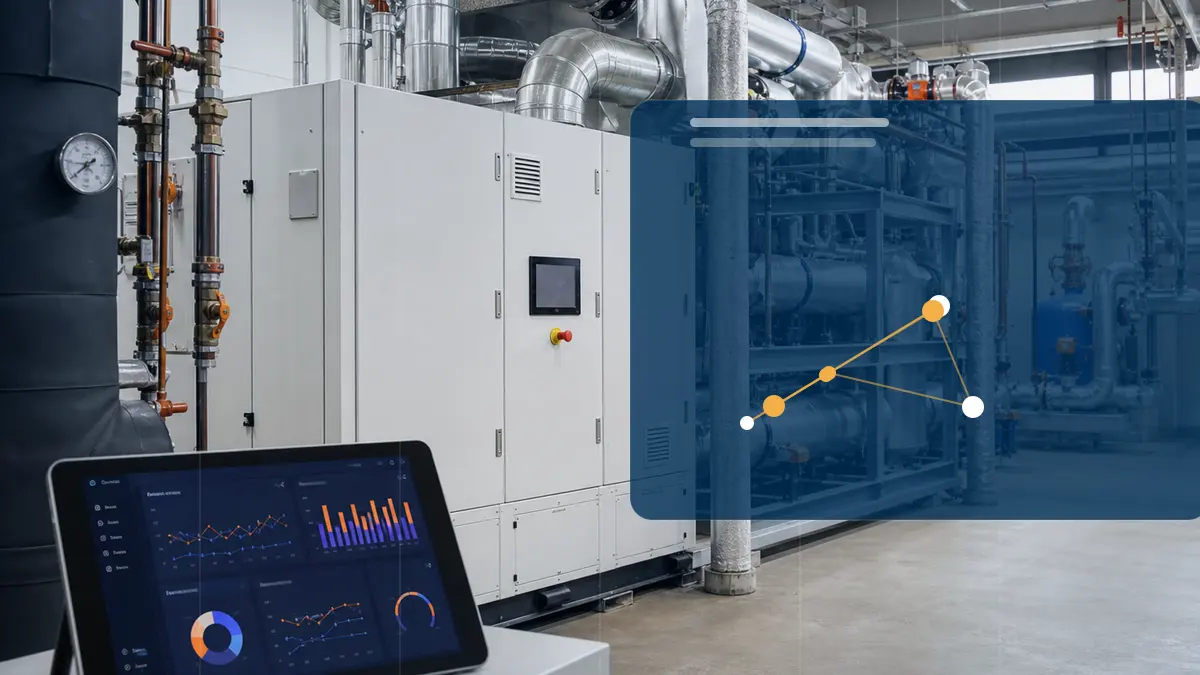
Utilising residual heat: scattered information versus Energy Intelligence
Heat escapes unnoticed from almost every business premises. A bakery blows hot oven air out through the roof while a boiler inside heats water. A data centre cools servers day and night and discharges that heat outside. At the same time, almost every business wants or needs to cut energy consumption. Residual heat utilisation is therefore on the agenda of a growing number of business owners, facility managers and municipalities: the heat is already there, the question is how to get it to the right place at the right time.
- Utilisation follows three routes: recovery within your own business, supply to another business nearby, or supply to the built environment through a heat network.
- According to the Netherlands Enterprise Agency (RVO), Dutch industry releases around 125 petajoules of residual heat above 100 degrees Celsius every year.
- Under the Dutch energy saving obligation and the investigation obligation, large energy users must periodically map which measures are feasible; heat recovery is part of that.
Insight
Traditional approach
Information is scattered across portals, documents, invoices or separate spreadsheets.
Modern approach
Data, context and interpretation are brought together into a clear decision picture.
Decision-making
Traditional approach
Choices are made based on averages, assumptions or occasional analyses.
Modern approach
Scenarios, KPIs and current measurement data make the trade-off more concrete and repeatable.
Follow-up
Traditional approach
Actions often stay non-committal or disappear into separate reports.
Modern approach
Follow-up actions, monitoring and reporting are linked to the same energy data.
Where does residual heat come from and how do you use it?
Residual heat arises wherever energy is used: in ovens, compressed air systems, cooling installations, server rooms and waste incineration plants. According to the Netherlands Enterprise Agency (RVO), Dutch industry releases around 125 petajoules of residual heat above 100 degrees Celsius every year. Utilisation follows three routes. The first is recovery within your own business, for example by preheating process water or ventilation air. The second is supply to a nearby business that needs heat. The third is supply to the built environment through a heat network. If the temperature is too low for the intended application, a heat pump upgrades the heat to a usable level. RVO offers an exploration tool, the Verkenning restwarmtebenutting, to assess these options in a structured way at the start of a project.
- Sources: industrial processes, data centres, cooling installations and waste incineration.
- Three routes: internal recovery, supply to a neighbouring business, or supply to a heat network.
- A heat pump upgrades low temperature heat to usable temperature levels.
- RVO's residual heat exploration tool helps with a first assessment of the options.
When will you encounter it?
Residual heat often lands on your desk through legislation. Businesses covered by the Dutch energy saving obligation must implement all recognised measures that pay for themselves within five years; heat recovery from cooling installations and compressed air systems, for example, is on that list for many sectors. Sites using more than 10 million kilowatt hours of electricity or 170,000 cubic metres of natural gas equivalent per year also have an investigation obligation: they report every four years on which sustainability measures are possible. The revised European Energy Efficiency Directive goes further: utilising or supplying residual heat requires a cost-benefit analysis that assesses internal use, supply to a heat network and the technical and economic feasibility. Even without an obligation, the question may come from a municipality or heat company looking for sources for a local heat network.
- The energy saving obligation requires measures with a payback period of five years or less.
- From 10 million kilowatt hours of electricity or 170,000 cubic metres of natural gas equivalent per year, an investigation obligation applies, with reporting every four years.
- The revised EED requires a cost-benefit analysis when utilising or supplying residual heat.
- Dutch municipalities and regions map available residual heat sources for the heat transition.
What should you pay attention to?
The biggest pitfall is the temperature level. Lukewarm heat from a data centre needs a different application than process heat above 100 degrees; upgrading with a heat pump consumes electricity and your grid connection must be able to handle that. Simultaneity also matters: your heat supply must coincide with the customer's demand, otherwise buffering is needed, for example with aquifer thermal energy storage. Distance determines the infrastructure: the further away the customer, the longer the piping and the tougher the business case. Security of supply is the mirror image: the customer wants to know what happens if your process stops or your business relocates, and usually arranges a backup facility. Therefore record volume, temperature, duration and liability in a long term supply contract.
- Check the temperature level of your heat stream and whether upgrading with a heat pump is needed.
- Map the simultaneity of supply and demand; buffering such as thermal storage absorbs peaks and troughs.
- The shorter the distance to the customer, the simpler the infrastructure.
- Agree on security of supply, backup and contract duration in a supply contract.
Curious what this looks like with your own data?
In a no-obligation call, a specialist looks at your meters, sites and energy questions with you. Response within one business day.
Search the knowledge base
Find the answer to your question.
Search using your own words. Abbreviations and spelling variants are recognised, so EMS also finds the articles on energy management systems.
Topic