
Going gas-free: a roadmap for businesses: a guide for businesses
Direct answer
For a business, getting off natural gas means replacing gas step by step with sustainable alternatives for heating, hot water and processes. A workable roadmap has five steps: map what you use gas for, reduce the heat demand, choose an alternative per function, arrange grid capacity and permits, and carry out the transition in phases. Disconnecting the gas connection is the very last step.
- Clear definition
- Data-driven assessment
- Risks and opportunities visible
- Practical next steps
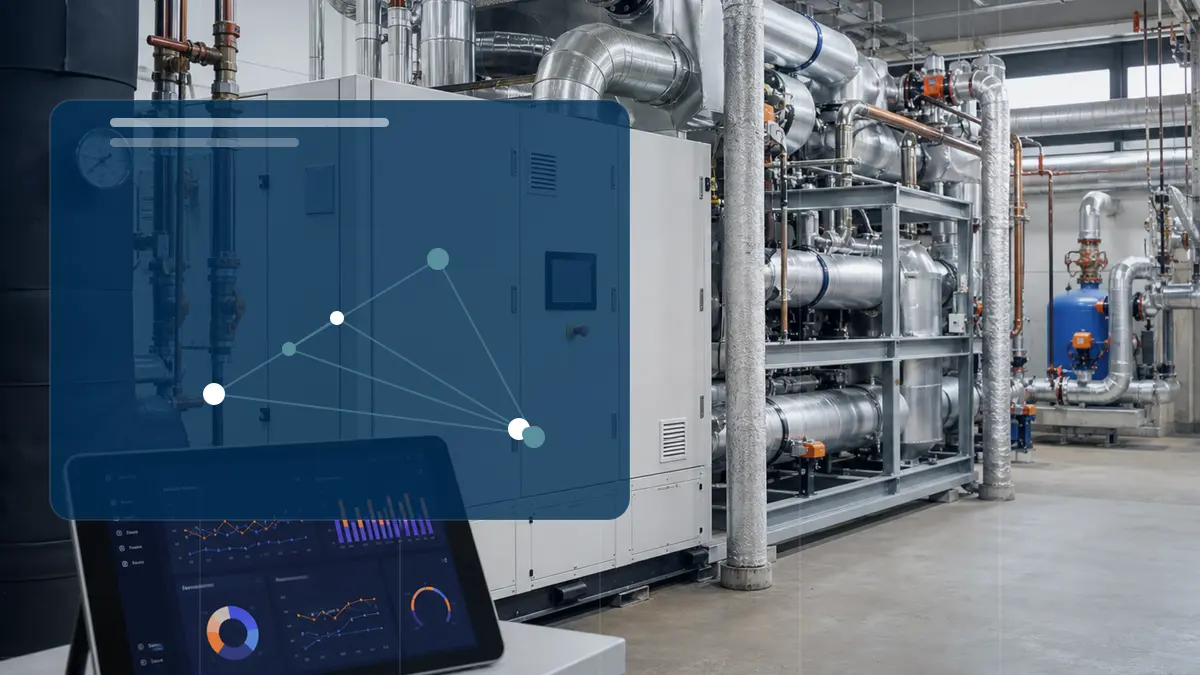
Going gas-free: a roadmap for businesses: scattered information versus Energy Intelligence
Many Dutch business premises still run entirely on natural gas: a boiler for the offices, gas fired heaters in the warehouse and sometimes a hot water boiler or process heat. Meanwhile, municipalities are drawing up plans for neighbourhoods without natural gas and the pressure to decarbonise is growing. Businesses that wait until the boiler breaks down must choose under time pressure and often pay for a rushed solution. This roadmap helps facility managers and business owners approach the transition methodically, in an order that works in practice.
- Start with insight: split your gas use into space heating, hot tap water and process heat, because each function needs a different alternative.
- Reduce the heat demand first with insulation, heat recovery and low temperature emitters; every alternative then becomes smaller and more feasible.
- Report extra electricity demand to your grid operator early: in areas with grid congestion, waiting for transport capacity can take years.
Insight
Traditional approach
Information is scattered across portals, documents, invoices or separate spreadsheets.
Modern approach
Data, context and interpretation are brought together into a clear decision picture.
Decision-making
Traditional approach
Choices are made based on averages, assumptions or occasional analyses.
Modern approach
Scenarios, KPIs and current measurement data make the trade-off more concrete and repeatable.
Follow-up
Traditional approach
Actions often stay non-committal or disappear into separate reports.
Modern approach
Follow-up actions, monitoring and reporting are linked to the same energy data.
Steps 1 and 2: map your gas use and reduce the heat demand
First map what your business uses gas for: space heating, hot tap water or process heat. Look at the annual consumption on your gas bill, hourly data from the smart meter and the installations on site. This shows which function uses the most gas and which replacement moment is coming up. Then reduce the heat demand before considering alternatives. Think of insulating the roof, facade and pipework, sealing gaps, recovering heat from ventilation air or process water, and preparing the emitter system for lower temperatures, such as underfloor heating or larger radiators. Every unit of heat you save never has to be generated electrically. The alternative you choose in step three then becomes smaller, more efficient and easier to fit within your electricity connection.
- Split your gas use into space heating, hot tap water and process heat.
- Use bills, smart meter data and an installation overview as your starting point.
- Insulate and seal gaps before replacing installations.
- Recover heat from ventilation air, cooling systems or process water.
- Prepare the emitter system for low temperatures.
Step 3: which alternative fits which function?
Choose an alternative per function, not one solution for everything. For space heating a heat pump is usually the first candidate; it works best in a well insulated building with low temperature emitters. For hot tap water a heat pump boiler or electric boiler is often enough. If a heat network runs nearby, connecting to it can be an alternative that requires no extra electrical capacity. For process heat the choice depends on the temperature: a heat pump for lower temperatures, an e-boiler for hot water or steam, and induction for specific heating processes. If the building cannot yet be heated fully electrically, a hybrid heat pump is an interim step: it covers most of the year and lets the gas boiler assist only on cold days.
- Heat pump for space heating in an insulated building with low temperature emitters.
- Heat pump boiler or e-boiler for hot tap water.
- Heat network if one runs nearby or is planned.
- E-boiler, industrial heat pump or induction for process heat, depending on the temperature.
- Hybrid heat pump as an interim step when fully electric is not yet feasible.
Steps 4 and 5: arrange the preconditions and execute in phases
Electrification increases your electricity demand. Check early whether your connection can handle the extra load and, if needed, apply to your grid operator for a heavier connection or extra transport capacity. In areas with grid congestion there are waiting lists; the Dutch grid operators' capacity map shows where the grid is full. Also check permits, for example for a ground source heat pump, and the noise requirements for outdoor units. Plan the work around natural moments: a renovation, a rebuild or a boiler nearing the end of its life. Also consult your municipality's heat transition plans, which set out per district when neighbourhoods will go off natural gas. Then execute in phases, function by function. Only when the last gas application has been replaced do you have the gas connection removed; that is a separate request to the grid operator.
- Apply early for a heavier connection or extra transport capacity; in congestion areas this can take years.
- Check permits and noise requirements before ordering installations.
- Use natural replacement moments such as a renovation or a written off boiler.
- Align with your municipality's heat plans for natural gas free districts.
- If your business falls under the Dutch energy saving obligation, many step two measures are already mandatory.
Curious what this looks like with your own data?
In a no-obligation call, a specialist looks at your meters, sites and energy questions with you. Response within one business day.
Search the knowledge base
Find the answer to your question.
Search using your own words. Abbreviations and spelling variants are recognised, so EMS also finds the articles on energy management systems.
Topic