
District heating pros and cons: a guide for businesses
Direct answer
District heating, in Dutch stadsverwarming, is collective heating through a heat network: your building receives hot water from a central source instead of heat from its own gas boiler. The core trade-off: less to manage in your own building, but you are tied to a single supplier. How sustainable and how attractive district heating turns out to be depends strongly on the heat source and the local network.
- Clear definition
- Data-driven assessment
- Risks and opportunities visible
- Practical next steps
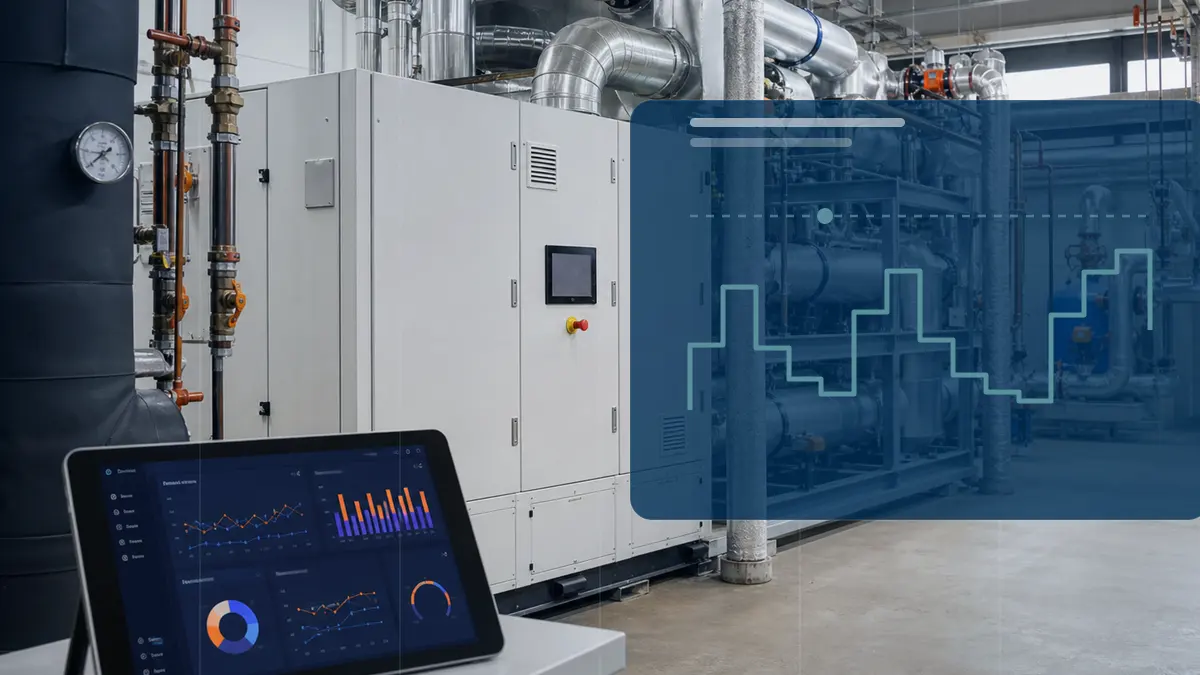
District heating pros and cons: scattered information versus Energy Intelligence
More and more Dutch municipalities are designating neighbourhoods that will move away from natural gas. In densely built areas, a heat network is often the preferred alternative. So you may well receive a letter as the owner or user of a building: your neighbourhood is switching, do you want to connect? That decision is hard to reverse and therefore deserves an honest assessment. This page sets out the advantages and disadvantages; how a heat network works technically is covered in the separate explainer on heat networks.
- Advantages: no gas connection and no boiler of your own, less maintenance, and the heat can be more sustainable if the source allows it.
- Disadvantages: you cannot switch supplier; the Dutch regulator ACM sets annual maximum tariffs, but standing charges and tariff structure remain a concern for many customers.
- Mainly relevant in neighbourhoods with a municipal gas-free transition plan, in new construction and for businesses in areas where a heat network already exists.
Insight
Traditional approach
Information is scattered across portals, documents, invoices or separate spreadsheets.
Modern approach
Data, context and interpretation are brought together into a clear decision picture.
Decision-making
Traditional approach
Choices are made based on averages, assumptions or occasional analyses.
Modern approach
Scenarios, KPIs and current measurement data make the trade-off more concrete and repeatable.
Follow-up
Traditional approach
Actions often stay non-committal or disappear into separate reports.
Modern approach
Follow-up actions, monitoring and reporting are linked to the same energy data.
What are the advantages of district heating?
Buildings connected to district heating no longer need a gas connection or their own boiler. A compact heat interface unit replaces the central heating boiler. That unit has no burner, requires little maintenance and does not need periodic replacement the way a boiler does. No combustion takes place inside the building, which removes the risk of carbon monoxide from a boiler of your own. Comfort remains comparable: heating and hot tap water are simply there, without you managing an installation yourself. Finally, district heating can be more sustainable than burning gas individually, provided the source allows it. Think of residual heat from industry, geothermal energy or heat from water. If the source of the network becomes greener, you benefit automatically, without investing in your own building.
- No gas connection and no central heating boiler of your own; a heat interface unit takes over heat delivery.
- Less maintenance: no burner, no boiler servicing of your own and no periodic boiler replacement.
- No combustion inside the building, so no risk of carbon monoxide from your own boiler.
- Can be more sustainable than burning gas, depending on the heat source of the network.
- When the source becomes greener, all connected buildings benefit automatically.
What are the disadvantages and concerns?
The biggest disadvantage is being tied in: each heat network has one supplier and switching is not possible. There is no competition. The Dutch regulator ACM supervises the market and sets annual maximum tariffs, but the tariff structure remains a concern for many customers, especially the fixed part you also pay when consuming little. Moreover, the maximum tariffs are currently still linked to the gas price, not to the actual costs of the network. Sustainability is not a given either: some networks partly run on fossil sources or gas-fired auxiliary boilers. Always ask about the heat source and the plans for it. Finally, connecting requires building work: the heat interface unit must be installed, pipework is adjusted, and anyone going fully gas-free must also switch to electric cooking.
- One supplier per network; switching to another heat supplier is not possible.
- The ACM sets annual maximum tariffs, but the standing charge remains a widely heard concern.
- The maximum tariffs are currently still linked to the gas price, not to actual costs.
- Sustainability depends entirely on the source; ask about it before you decide.
- Connecting requires building work, and going fully gas-free also means electric cooking.
For whom is district heating a logical choice?
District heating is a logical option mainly in three situations. In neighbourhoods with a municipal gas-free transition plan, the heat network is often the designated alternative, because fully electric individual heating is not always feasible there or does not suit the building. In new construction, which is delivered without a gas connection in the Netherlands, the connection is often already part of the plan. And for businesses in an area where a network already exists, connecting can be simpler than realising an alternative of their own. Also take new rules into account: the Dutch Collective Heat Act (Wet collectieve warmte) has been adopted and takes effect in phases. Over time it bases the maximum tariffs on actual costs instead of the gas price and requires majority public ownership of designated heat companies. That transition will take several years.
- Gas-free neighbourhood plans: the heat network is often the alternative chosen by the municipality.
- New construction is delivered without a gas connection; a heat network is a common solution there.
- Businesses in existing heat network areas can often connect relatively easily.
- The Collective Heat Act has been adopted and phases in cost-based tariffs and more public ownership of heat companies.
Curious what this looks like with your own data?
In a no-obligation call, a specialist looks at your meters, sites and energy questions with you. Response within one business day.
Search the knowledge base
Find the answer to your question.
Search using your own words. Abbreviations and spelling variants are recognised, so EMS also finds the articles on energy management systems.
Topic