
Power-to-heat in industry: a guide for businesses
Direct answer
Power-to-heat in industry means generating process heat or steam from electricity, usually with e-boilers, built as electrode or resistance boilers, or with industrial heat pumps. In the Netherlands, companies often install such a unit next to the existing gas boiler. They then switch between gas and electric based on the electricity price, reducing their gas consumption and CO2 emissions.
- Clear definition
- Data-driven assessment
- Risks and opportunities visible
- Practical next steps
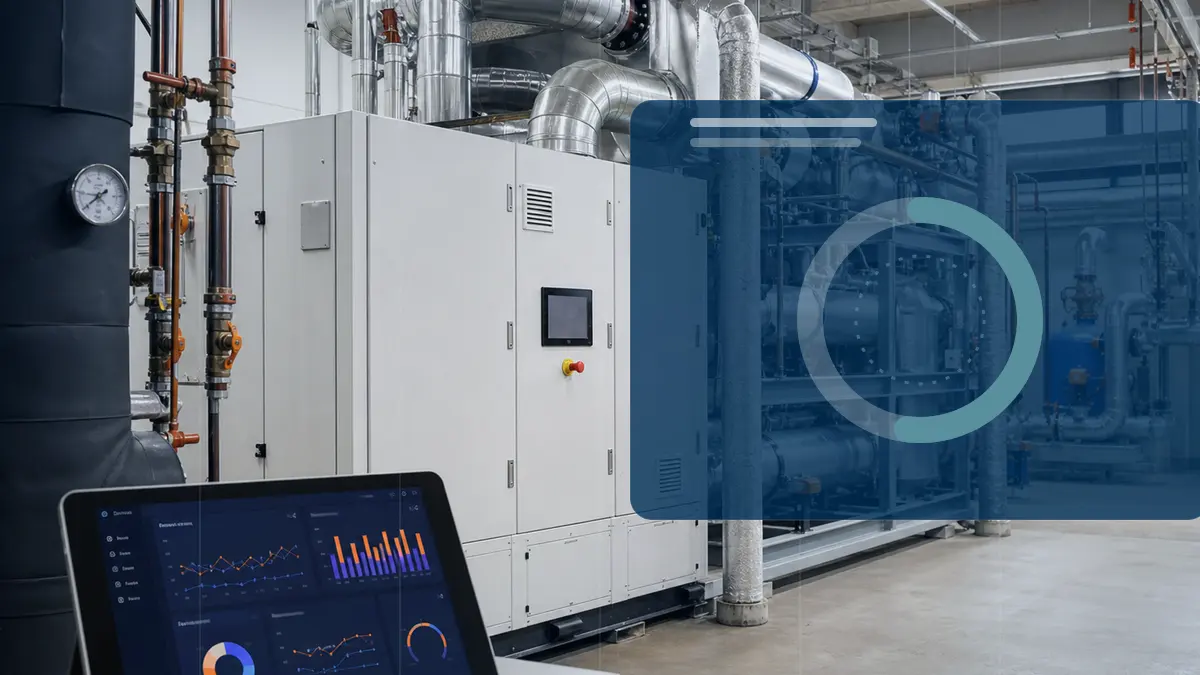
Power-to-heat in industry: scattered information versus Energy Intelligence
Most industrial energy consumption goes to heat, from drying processes to steam for reactors. Today that heat mainly comes from natural gas. At the same time, there are more and more hours with abundant solar and wind power, when electricity is widely available and sometimes even negatively priced. Picture a food factory that turns down its gas boiler at such moments and runs the e-boiler instead. This topic matters to every plant with a large heat demand and a large consumer grid connection.
- An e-boiler turns electricity into hot water or steam and often sits next to the gas boiler, so the company picks the cheapest heat source at any moment.
- Industrial heat pumps upgrade residual heat and mainly suit process heat at lower temperatures; for steam at higher pressure an electrode boiler is the more likely choice.
- Companies that can switch flexibly can use the installation to participate in TenneT's balancing markets or in congestion management run by the grid operator.
Insight
Traditional approach
Information is scattered across portals, documents, invoices or separate spreadsheets.
Modern approach
Data, context and interpretation are brought together into a clear decision picture.
Decision-making
Traditional approach
Choices are made based on averages, assumptions or occasional analyses.
Modern approach
Scenarios, KPIs and current measurement data make the trade-off more concrete and repeatable.
Follow-up
Traditional approach
Actions often stay non-committal or disappear into separate reports.
Modern approach
Follow-up actions, monitoring and reporting are linked to the same energy data.
Which installations does industry use?
In practice there are three types of installations. A resistance boiler heats water with heating elements and suits smaller capacities. An electrode boiler passes the current directly through the water and delivers hot water or steam at high capacities. An industrial heat pump upgrades residual heat into usable process heat and is most efficient at lower temperatures. Many companies choose a hybrid setup: the electric installation sits next to the existing gas boiler and both can serve the same heat demand. A heat buffer or steam accumulator makes operation even more flexible, because heat produced in cheap hours can be used later. The steam conditions do have to match: the pressure and temperature the process requires determine which technology fits.
- Resistance boilers suit smaller capacities, electrode boilers suit high capacities and steam.
- Industrial heat pumps use residual heat and mainly deliver heat at lower temperatures.
- A hybrid setup next to the gas boiler keeps the heat supply secure at all times.
- A heat buffer decouples the moment of electricity consumption from the heat demand.
How do you operate such an installation?
It comes down to smart switching on the electricity market. When prices are low, for example with lots of solar and wind, the e-boiler runs and the gas boiler is turned down. When electricity prices are high, the reverse happens. At negative prices a company is even paid on the wholesale market to consume power, although grid tariffs and energy taxes still apply. That flexibility is also valuable beyond the company's own heat demand. A fast-responding e-boiler can participate, independently or through an aggregator, in the balancing markets of TenneT, which keep supply and demand on the grid in balance. Congestion management is another option: the grid operator then compensates shifting or limiting consumption at moments when the grid is full.
- Run electric in hours with low or negative electricity prices, on gas when power is expensive.
- Fast-responding e-boilers can provide balancing services to TenneT.
- Through congestion management, the grid operator compensates flexible consumption at busy moments.
- Automated dispatch on day-ahead and imbalance prices gets the most out of the installation.
What does it deliver and where are the limits?
Power-to-heat reduces gas consumption and, as long as the electricity comes from renewable sources, also the CO2 emissions of the process. It also makes a plant less dependent on a single energy carrier, and the flexibility itself has value. There are hard preconditions, however. An e-boiler of several megawatts requires substantial connection capacity; in areas with grid congestion, extra transport capacity is often not immediately available. A hybrid setup within the existing connection is then more realistic than going fully electric. The technology also has to match the steam conditions of the process, and heat pumps cannot yet reach the highest process temperatures. Finally, the price difference between electricity and gas, including grid tariffs and energy taxes, determines how often running electric is genuinely attractive.
- Less gas consumption and lower CO2 emissions when renewable electricity is used.
- Connection capacity is the tightest precondition, especially in congestion areas.
- Heat pumps mainly cover the lower temperatures; very high process temperatures remain difficult.
- Grid tariffs and energy taxes weigh into the choice between gas and electric.
Curious what this looks like with your own data?
In a no-obligation call, a specialist looks at your meters, sites and energy questions with you. Response within one business day.
Search the knowledge base
Find the answer to your question.
Search using your own words. Abbreviations and spelling variants are recognised, so EMS also finds the articles on energy management systems.
Topic