
Leveraging the imbalance market as a business: a guide for businesses
Direct answer
Using the imbalance market as a business means letting your consumption, generation or storage respond to the imbalance price of Dutch grid operator TenneT, which moves per minute and is settled per quarter hour. You consume or charge more when that price is low or negative, and scale back when the price is high. This helps balance the grid and uses your flexibility more intelligently.
- Clear definition
- Data-driven assessment
- Risks and opportunities visible
- Practical next steps
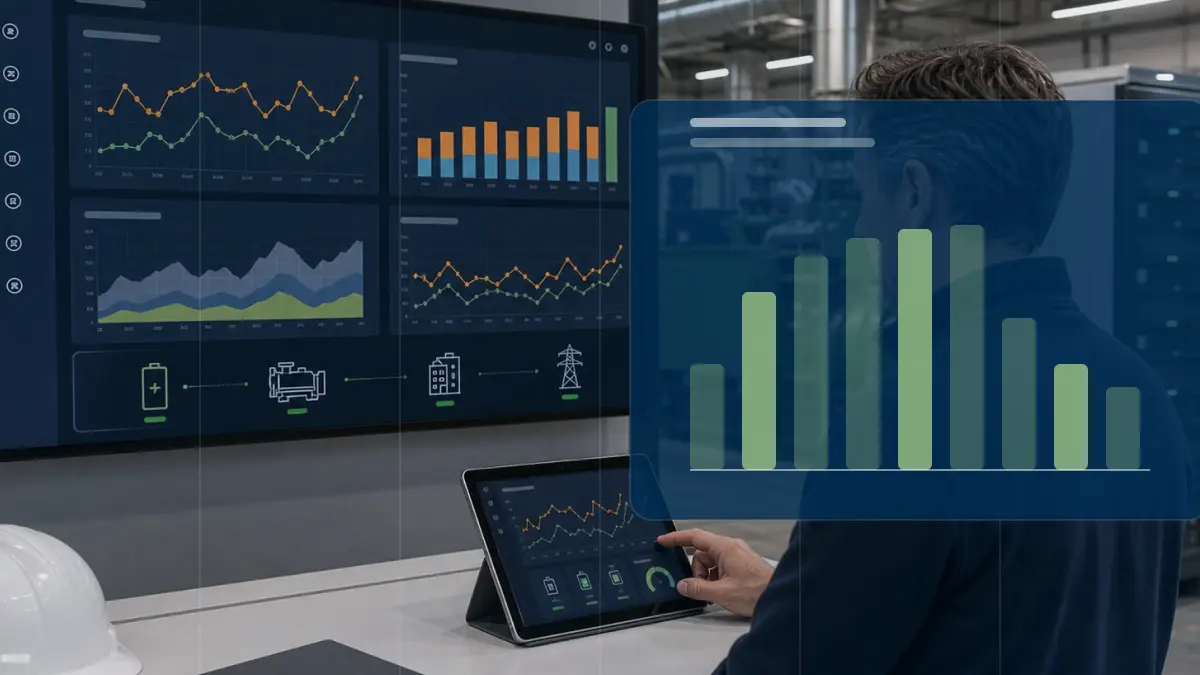
Leveraging the imbalance market as a business: scattered information versus Energy Intelligence
Dutch grid operator TenneT keeps the Dutch electricity grid in balance between supply and demand every quarter hour. When that does not happen by itself, imbalance arises and the imbalance price moves with it. For a business with controllable power, that is a signal. Think of a cold store that cools a little harder, a battery that charges, or a production line that shifts in time. A company that can move that consumption can respond to moments when electricity is cheap or even negatively priced.
- You respond with controllable power to the imbalance price: charging or consuming more at a low or negative price, scaling back at a high price.
- You need flexible power, live data and a forecast, plus a contract with imbalance settlement, often arranged through an aggregator.
- The imbalance price is volatile and hard to predict; a wrong estimate can cost money instead of earning it.
Insight
Traditional approach
Information is scattered across portals, documents, invoices or separate spreadsheets.
Modern approach
Data, context and interpretation are brought together into a clear decision picture.
Decision-making
Traditional approach
Choices are made based on averages, assumptions or occasional analyses.
Modern approach
Scenarios, KPIs and current measurement data make the trade-off more concrete and repeatable.
Follow-up
Traditional approach
Actions often stay non-committal or disappear into separate reports.
Modern approach
Follow-up actions, monitoring and reporting are linked to the same energy data.
How do you use the imbalance market in practice?
You let flexible power respond to the imbalance price. When the price is low or negative, you consume or charge more, for example by charging a battery or bringing a process forward. When the price is high, you scale back or feed power back. This is called passive balancing: you respond to the price without submitting a bid. In addition, active participation is possible through TenneT's balancing markets, where you offer capacity with a bid to increase or decrease. Active participation sets stricter requirements on response speed and metering and almost always runs through an aggregator or a balancing responsible party.
- Passive balancing: your consumption or generation follows the imbalance price, without a bid.
- Active balancing: you offer capacity through the balancing markets to regulate.
- The imbalance price moves per minute and is settled per quarter hour; it can fluctuate strongly.
- Active participation requires fast response, accurate metering and usually an intermediary.
What do you need to take part?
First you need controllable power: consumption, generation or storage that you can shift without problems. A battery is flexible, but cooling, heat, charging points or a shiftable production process can serve too. You also need live data and a forecast, so you know when steering pays off. Finally, you need a contract that allows imbalance settlement, either passive or active. Many businesses arrange this through an aggregator, who bundles the flexibility of several parties and handles the trading and communication with TenneT for you. That way you do not have to become balancing responsible yourself.
- Controllable power that you can shift in time without objection.
- Live metering data and a forecast of the imbalance price or consumption patterns.
- A contract with passive or active imbalance settlement.
- Often an aggregator that bundles the flexibility and settles with TenneT.
Who is it suitable for and what are the risks?
The imbalance market is mainly interesting for businesses with genuinely controllable power and processes that can run differently for a while. A battery, a cold store or charging hubs fit well; a process that must run at full power every hour does not. The main risk is the volatility of the imbalance price. That price moves per minute, is hard to predict and can work against you, so steering at the wrong moment costs money rather than earning it. The imbalance market also does not consider the local grid situation; if you use your room only for this, it does not automatically solve grid congestion on your connection. So start with an analysis of your own consumption and flexibility.
- Suitable for businesses with a battery, cooling, heat, charging infrastructure or shiftable processes.
- Less suitable if your process cannot tolerate any shift in time.
- The imbalance price is volatile and can work against you; losses are possible.
- The imbalance market does not look at local grid congestion on your connection.
Curious what this looks like with your own data?
In a no-obligation call, a specialist looks at your meters, sites and energy questions with you. Response within one business day.
Search the knowledge base
Find the answer to your question.
Search using your own words. Abbreviations and spelling variants are recognised, so EMS also finds the articles on energy management systems.
Topic