
Making better use of grid capacity: a guide for businesses
Direct answer
Making better use of grid capacity means using the existing room on the electricity grid more intelligently instead of waiting for the grid to be reinforced. Businesses spread their consumption across the day, shift it to quieter moments and use storage where needed. This keeps room available on a congested grid so more users can be connected.
- Clear definition
- Data-driven assessment
- Risks and opportunities visible
- Practical next steps
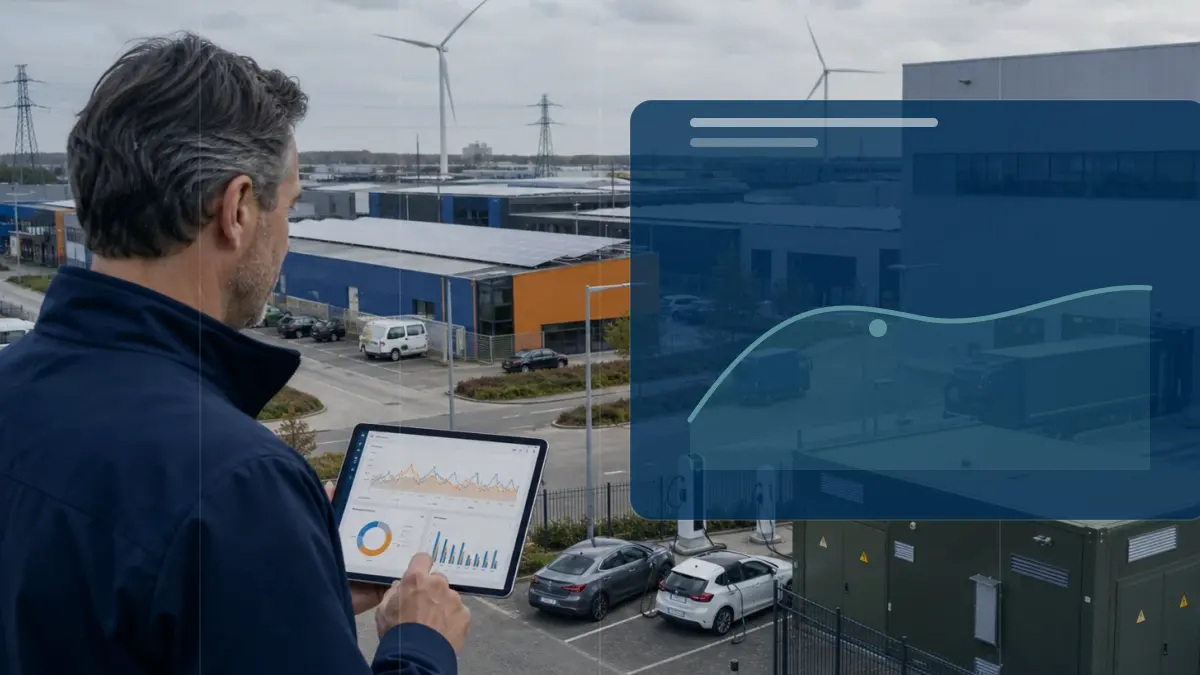
Making better use of grid capacity: scattered information versus Energy Intelligence
The Dutch electricity grid is filling up in more and more areas. Grid operators cannot expand the grid as fast as demand for transport capacity grows. A business that wants to electrify or feed in power is told there is no room. Yet the grid is far from full all the time: the peak often lasts only a few hours a day. Reducing your consumption during those hours keeps room free for yourself and for others.
- Congestion management, known in Dutch as spitsmijden or peak avoidance, asks businesses to temporarily consume or generate less electricity at busy moments.
- Through the National Grid Congestion Action Programme, grid operators, the regulator ACM and government work on three tracks: building faster, using the grid smarter and taking power more flexibly.
- You can start yourself by steering consumption to moments with plenty of sun or wind, buffering with storage or converting surplus power into heat.
Insight
Traditional approach
Information is scattered across portals, documents, invoices or separate spreadsheets.
Modern approach
Data, context and interpretation are brought together into a clear decision picture.
Decision-making
Traditional approach
Choices are made based on averages, assumptions or occasional analyses.
Modern approach
Scenarios, KPIs and current measurement data make the trade-off more concrete and repeatable.
Follow-up
Traditional approach
Actions often stay non-committal or disappear into separate reports.
Modern approach
Follow-up actions, monitoring and reporting are linked to the same energy data.
What is congestion management?
Congestion management, in practice called spitsmijden or peak avoidance, is the main way Dutch grid operators make better use of existing grid capacity. Businesses agree with their grid operator to temporarily consume or generate less electricity at peak moments. This is called deploying flexible electrical capacity. By spreading the load across the day, the grid stays within its limits and more users can be connected to the same cables. Grid operators are obliged to apply congestion management to help resolve congestion. They therefore call on large consumers to offer flexible capacity as early as the announcement of a congestion study. Those who join early determine how much capacity they offer and on what terms.
- Peak avoidance means temporarily consuming or generating less at busy moments.
- It applies both to consumption and to generation of electricity.
- Grid operators are obliged to apply congestion management when capacity is scarce.
- Large consumers are asked to offer flexible capacity already in the study phase.
- Joining early gives you more freedom in volume and terms.
How can you make better use of grid capacity yourself?
You do not have to wait for the grid operator to approach you. The Netherlands Enterprise Agency (RVO) names several routes to match your consumption to the available room. The first is energy steering: you use electricity at smart moments, for example when there is plenty of sun or wind, and reduce consumption during the evening peak. The second is a flexible contract with your grid operator, such as a capacity-limiting contract, in which you agree to take less at certain moments. The third is storage: a battery stores generation for later use, so your connection stays free at peak moments. Finally, you can convert surplus electricity into heat or hydrogen. Regional grid operators such as Enexis offer flexibility solutions that support this.
- Energy steering: shift consumption to moments with plenty of sun or wind.
- A flexible or capacity-limiting contract with your grid operator.
- Storage with a battery keeps your connection free at peak moments.
- Convert surplus electricity into heat or hydrogen.
- Grid operators offer flexibility solutions and advice.
When will you encounter this?
You encounter better use of capacity as soon as you are in a congestion area or plan to operate there. If you want to expand, electrify or feed in power, grid reinforcement is often not ready in time. Using the existing room more intelligently is then the quickest way forward. Grid operators can also make participation in congestion management mandatory. According to Netbeheer Nederland, this obligation applies in principle to every connected party in a congestion area with a connection of 1 megawatt or more, both for consumption and for generation. The obligation comes into play when voluntary peak avoidance does not free up enough room. It therefore pays to map your consumption profile early and discuss your options with the grid operator.
- Better use becomes relevant once you expand or feed in within a congestion area.
- Grid reinforcement is often not ready in time; smarter use is faster.
- Participation in congestion management can be made mandatory.
- The obligation applies in principle from a connection of 1 megawatt.
- Map your consumption profile early and discuss the options.
Curious what this looks like with your own data?
In a no-obligation call, a specialist looks at your meters, sites and energy questions with you. Response within one business day.
Search the knowledge base
Find the answer to your question.
Search using your own words. Abbreviations and spelling variants are recognised, so EMS also finds the articles on energy management systems.
Topic