
Lithium-ion vs. flow batteries: a guide for businesses
Direct answer
Lithium-ion and flow batteries are two ways to store electricity, each with its own strength. A lithium-ion battery is compact, responds quickly and has a high energy density, but wears with intensive use. In a flow battery the energy sits in a liquid electrolyte in tanks, so power and capacity scale independently and the lifespan is long.
- Clear definition
- Data-driven assessment
- Risks and opportunities visible
- Practical next steps
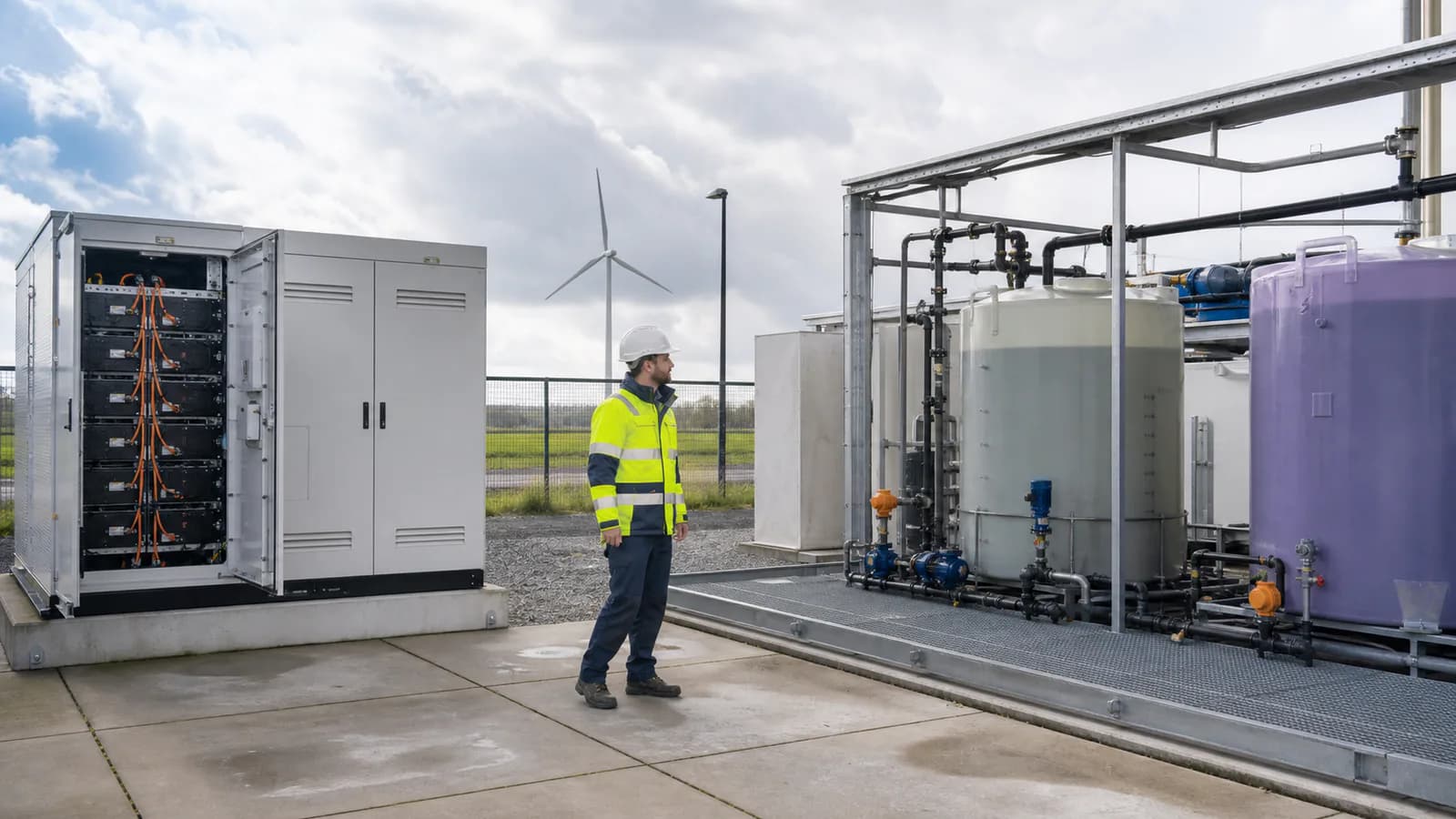
Lithium-ion vs. flow batteries: scattered information versus Energy Intelligence
Anyone wanting to store solar or wind power, or to cover peaks in consumption, soon arrives at batteries. Not every battery suits every situation. A business smoothing a short afternoon power peak has different needs than a site that stores solar energy during the day to use it for hours in the evening. Lithium-ion and flow batteries are the two types you encounter most often, and they differ fundamentally in build, cost and application.
- Lithium-ion stores a lot of energy in little space and delivers power quickly; suited to short, sharp peaks and widely used.
- In a flow battery the stack sets the power and the tanks set the capacity; you can enlarge these separately, which suits long storage duration.
- The choice depends on your profile: short fast peaks point to lithium-ion, hours-long storage points to a flow battery.
Insight
Traditional approach
Information is scattered across portals, documents, invoices or separate spreadsheets.
Modern approach
Data, context and interpretation are brought together into a clear decision picture.
Decision-making
Traditional approach
Choices are made based on averages, assumptions or occasional analyses.
Modern approach
Scenarios, KPIs and current measurement data make the trade-off more concrete and repeatable.
Follow-up
Traditional approach
Actions often stay non-committal or disappear into separate reports.
Modern approach
Follow-up actions, monitoring and reporting are linked to the same energy data.
How do the two technologies differ?
In a lithium-ion battery the energy is stored in solid electrodes inside the cell. That makes the pack compact and gives it a high energy density: a lot of storage in little space and weight. With lithium-ion, power and capacity are linked; you increase both by adding more cells. In a flow battery, such as the vanadium redox type, the energy sits in a liquid electrolyte in separate tanks. That fluid is pumped along a stack where the conversion takes place. You set the power with the stack and the capacity with the size of the tanks. Both scale independently. A flow battery is therefore larger and heavier per stored unit, but flexible in the ratio between power and storage duration.
- Lithium-ion: energy in solid electrodes, compact and high energy density.
- Flow battery: energy in a liquid electrolyte in tanks, pumped along a stack.
- With lithium-ion, power and capacity are linked; with a flow battery they scale independently.
- A flow battery needs more space per stored unit than lithium-ion.
When do you choose which?
Look first at your discharge duration and usage pattern. If the battery must cover short, sharp peaks and respond quickly, lithium-ion is a good fit: it delivers power promptly and is compact to install. If you want to discharge for hours instead, for example using daytime solar energy in the evening, the flow battery comes into view. Because you can enlarge the tanks separately, longer storage duration becomes relatively cheaper. Flow batteries generally have a long cycle and calendar life and tolerate daily deep discharging well, because there are no wearing solid phase transitions in the cell. Lithium-ion wears faster under heavy, intensive cycling. Vanadium redox is currently the most widely applied flow type for stationary storage.
- Short, fast power peaks: lithium-ion is the obvious choice.
- Hours-long, daily discharge: a flow battery becomes more attractive.
- Flow batteries tolerate deep and frequent discharging without rapid wear.
- Vanadium redox is now the most common flow battery type for stationary storage.
What should you watch out for?
Each technology has points to consider. Lithium-ion is sensitive to overheating: if damaged or overcharged it can suffer thermal runaway, which makes fire safety and cooling design points. Raw materials play a role too, because lithium-ion relies on materials whose extraction and recycling require attention. A flow battery usually uses a non-flammable, water-based electrolyte that you can store away from the stack, which limits the fire risk. Against that, the energy density is low, so you need more space, and the cost per kilowatt-hour is currently often higher. Per project, weigh space, safety, discharge duration and management against each other. Have an independent party calculate the profile before you commit to a technology.
- Lithium-ion: risk of thermal runaway if damaged or overcharged; cooling and fire safety are design points.
- Lithium-ion relies on raw materials whose extraction and recycling require attention.
- Flow battery: usually a non-flammable electrolyte, storable separately from the stack.
- Flow battery has lower energy density and currently often higher cost per kilowatt-hour.
Curious what this looks like with your own data?
In a no-obligation call, a specialist looks at your meters, sites and energy questions with you. Response within one business day.
Search the knowledge base
Find the answer to your question.
Search using your own words. Abbreviations and spelling variants are recognised, so EMS also finds the articles on energy management systems.
Topic