
Low-temperature (LT) heating: a guide for businesses
Direct answer
Low temperature heating, often called LT heating, keeps a building comfortably warm with supply water of roughly 30 to 55 degrees, where classic boiler installations often run at around 70 to 80 degrees. It only works with good insulation and a large emitting surface, such as underfloor heating or LT radiators. It is the basis for an efficient heat pump and for a low temperature heat network connection.
- Clear definition
- Data-driven assessment
- Risks and opportunities visible
- Practical next steps
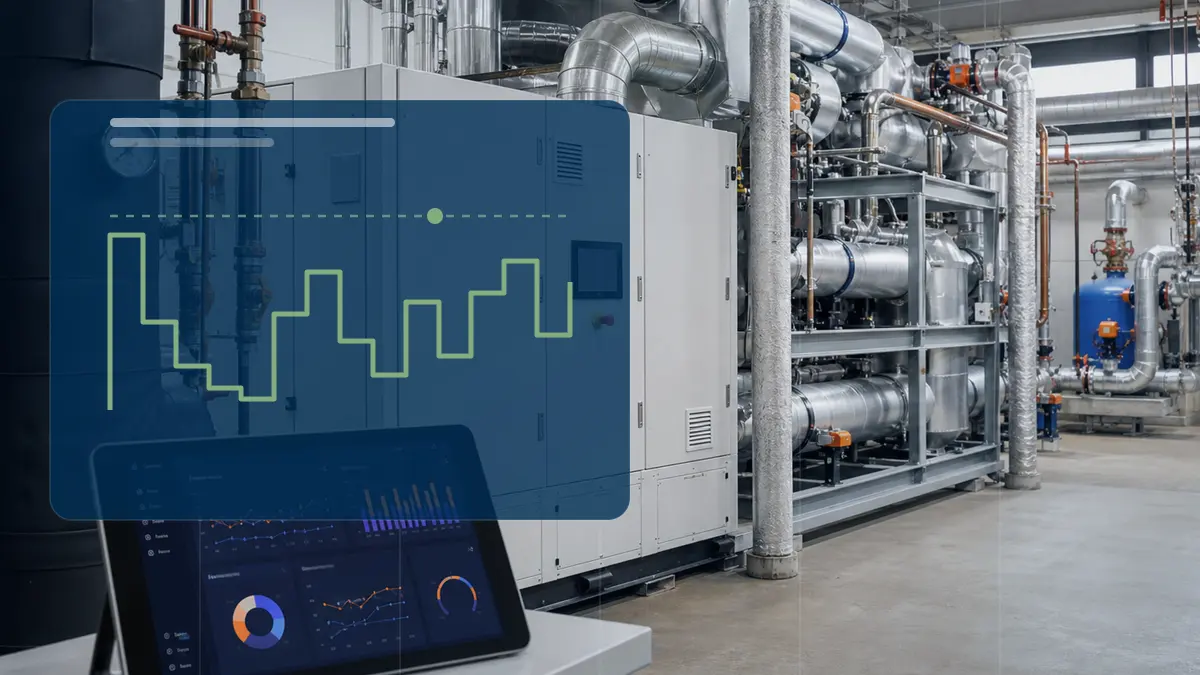
Low-temperature (LT) heating: scattered information versus Energy Intelligence
Anyone taking a building in the Netherlands off natural gas almost always runs into the temperature of the heating water. A heat pump delivers its highest efficiency at low supply temperatures, and many new heat networks supply heat at a lower level than a gas boiler. The picture is familiar: radiators that used to get piping hot on a gas boiler stay lukewarm after the switch. That is not a defect, but a sign that insulation and the emitting system are not yet designed for low temperatures.
- LT heating runs on supply water of roughly 30 to 55 degrees; underfloor heating is designed for water temperatures up to around 40 degrees.
- Cooler water requires a larger emitting surface: underfloor heating, wall heating or LT radiators deliver enough heat at low temperatures, standard radiators often do not.
- Good insulation comes first: the less heat the building loses, the lower the supply temperature can be without losing comfort.
Insight
Traditional approach
Information is scattered across portals, documents, invoices or separate spreadsheets.
Modern approach
Data, context and interpretation are brought together into a clear decision picture.
Decision-making
Traditional approach
Choices are made based on averages, assumptions or occasional analyses.
Modern approach
Scenarios, KPIs and current measurement data make the trade-off more concrete and repeatable.
Follow-up
Traditional approach
Actions often stay non-committal or disappear into separate reports.
Modern approach
Follow-up actions, monitoring and reporting are linked to the same energy data.
How does low temperature heating work?
How much heat an emitter delivers depends on two things: the temperature difference with the room and the surface area emitting that heat. If the water gets cooler, the surface must grow to heat the same space. That is why LT heating comes with a different emitting system: underfloor heating, wall heating, or LT radiators and LT convectors with extra surface area or a quiet fan. Underfloor heating is the best known example. The floor itself must not get too warm to remain comfortable, so the water temperature there stays limited to around 40 degrees. The building warms up more gradually and the heat spreads more evenly through the room.
- A smaller temperature difference means more emitting surface is needed for the same heat.
- Suitable emitting systems are underfloor heating, wall heating and dedicated LT radiators or LT convectors.
- With underfloor heating the water temperature is limited to around 40 degrees.
- LT systems respond slowly: steady heating works better than large temperature swings.
When is your building ready for it?
Insulation always comes first. LT heating delivers less power per square metre of emitting surface, so the building must lose so little heat that this lower power is sufficient. Think of roof, facade, floor and glazing insulation and good draught sealing. A practical first test: on a cold day, set the supply temperature of the current boiler installation to around 50 degrees and check whether the building stays comfortably warm. If so, the building is already largely suitable. For a final design a room by room heat loss calculation is needed: it determines which rooms require a larger emitting surface. Sometimes replacing a few radiators is enough, sometimes underfloor heating or extra insulation is the more logical step.
- Insulate first, then adapt the emitting system: that order prevents an oversized, inefficient system.
- Test on a cold day whether the building stays warm with a supply temperature around 50 degrees.
- Have a room by room heat loss calculation made for the final design.
- Existing radiators can sometimes stay if, after insulation, they are generously sized for the reduced heat demand.
Why is LT heating the basis for gas free buildings?
A heat pump works more efficiently as the difference between the source temperature and the emitting temperature gets smaller. The lower the supply water, the less electricity the heat pump needs for the same heat. New Dutch heat networks also increasingly supply heat at a lower temperature level; a building with LT emitters can connect to them directly. Do note the limits. Domestic hot water falls outside LT heating: showering and storing water safely against legionella require higher temperatures, so hot tap water gets its own provision such as a storage cylinder. And in buildings that are hard to insulate, such as listed monuments, full LT heating is not always feasible. A medium temperature or hybrid setup is then a realistic intermediate step towards gas free heating.
- The lower the supply temperature, the higher the efficiency of a heat pump.
- An LT ready building can connect directly to heat networks with a lower temperature level.
- Domestic hot water requires higher temperatures and therefore a separate provision, such as a storage cylinder.
- For buildings that are hard to insulate, medium temperature or a hybrid solution is a realistic intermediate step.
Curious what this looks like with your own data?
In a no-obligation call, a specialist looks at your meters, sites and energy questions with you. Response within one business day.
Search the knowledge base
Find the answer to your question.
Search using your own words. Abbreviations and spelling variants are recognised, so EMS also finds the articles on energy management systems.
Topic