
Generation
Article 6 of 20 · Generation and storageSmall wind turbines for businesses: a guide for businesses
Direct answer
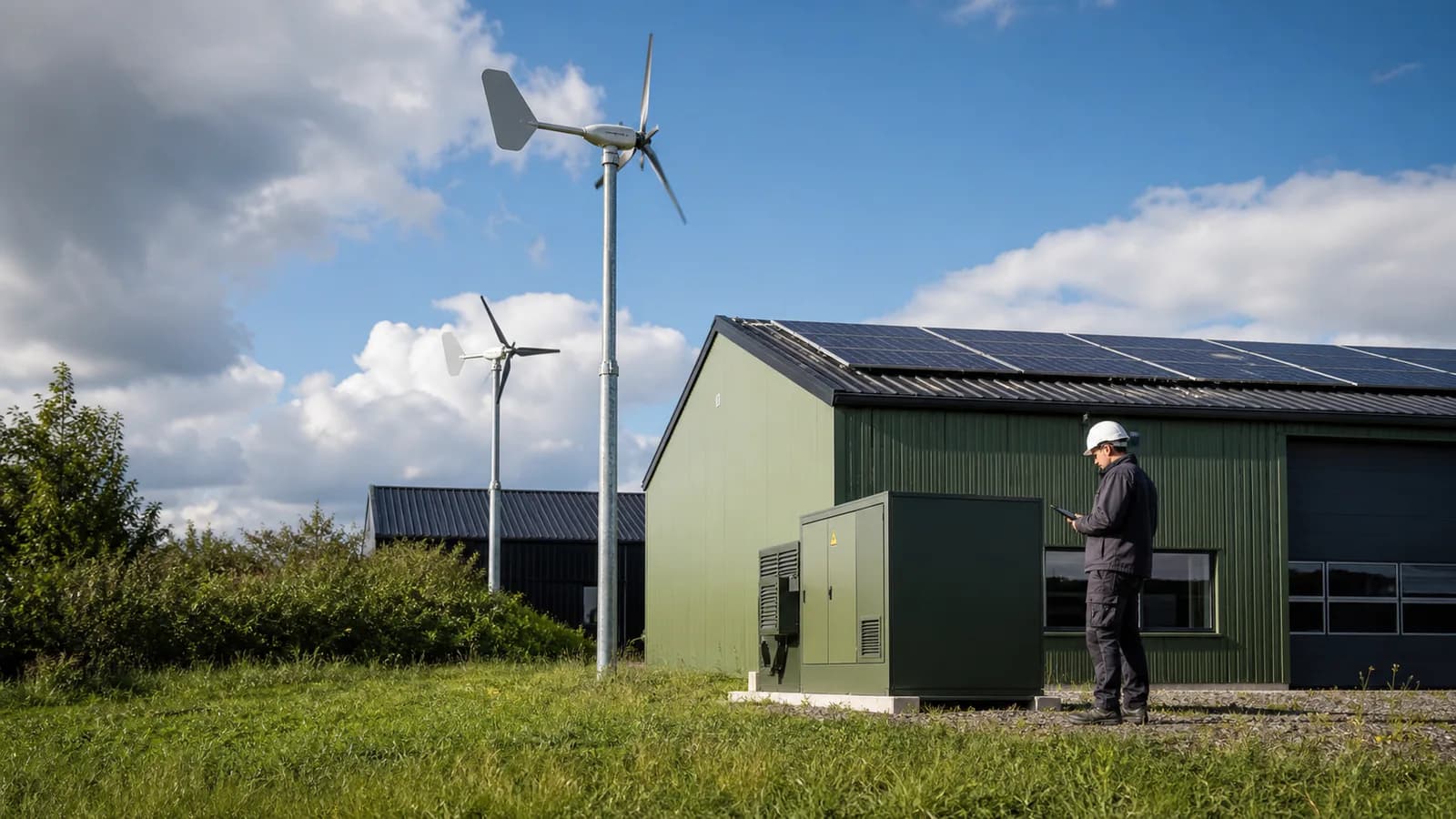
Small wind turbines are compact wind turbines with a limited mast height, intended for a business park or farmyard. They generate electricity for your own use, including in winter and at night when solar panels deliver little. Whether they make sense depends mainly on the wind supply at your own location in the Netherlands.
- Clear definition
- Data-driven assessment
- Risks and opportunities visible
- Practical next steps
Small wind turbines for businesses: scattered information versus Energy Intelligence
More and more Dutch businesses want to generate their own electricity, because the grid is full and expanding a connection takes a long time. Solar panels are often already in place, but they deliver little in winter and at night. A small wind turbine on the company's own yard or site can partly fill that gap. Think of a farm in an open polder or a factory near the coast. Whether it pays off varies strongly per location and per business.
- A small turbine on a business site typically has a mast height of roughly 15 to 30 metres; the even smaller rooftop types deliver far less.
- Placing one always requires an environmental permit from the municipality, with rules for noise, shadow flicker and safety.
- The yield drops off quickly with little wind; a small turbine is usually only worthwhile from an average wind force of 3.
Insight
Traditional approach
Information is scattered across portals, documents, invoices or separate spreadsheets.
Modern approach
Data, context and interpretation are brought together into a clear decision picture.
Decision-making
Traditional approach
Choices are made based on averages, assumptions or occasional analyses.
Modern approach
Scenarios, KPIs and current measurement data make the trade-off more concrete and repeatable.
Follow-up
Traditional approach
Actions often stay non-committal or disappear into separate reports.
Modern approach
Follow-up actions, monitoring and reporting are linked to the same energy data.
What is a small wind turbine?
A small wind turbine is a turbine that is far lower and lighter than the large turbines along the motorway. For a business site or farmyard, this usually means turbines with a mast height of roughly 15 to 30 metres. In addition there are even smaller mini turbines with a hub height of up to about 15 metres, often placed on a roof, which generate clearly less. You can distinguish turbines with a horizontal axis, with blades like a classic windmill, from turbines with a vertical axis, which catch wind from any direction. Vertical types suit a built-up environment where the wind shifts better. The right choice depends on the location.
- Mast height on a business site is typically around 15 to 30 metres.
- Smaller mini turbines, often on a roof, with a hub height up to about 15 metres deliver far less.
- Horizontal axis: blades that turn into the wind, like a classic mill.
- Vertical axis: catches wind from any direction, better in built-up areas.
- The choice of type follows from the location and the wind supply.
When is a small wind turbine worthwhile?
A small wind turbine is mainly worthwhile if you use most of the electricity yourself and directly. What you generate and use immediately, you do not have to buy. Wind complements solar energy well: it often blows precisely when there is little sun, in late autumn and winter, and also at night. This spreads generation more evenly across the year and the day. The turbine sits behind the meter, just like solar panels. What matters is that the wind supply at your location is sufficient. An open position without obstacles, for example in a coastal province, offers the best chance. Also ask your grid operator whether the turbine fits your current connection.
- Most favourable when you consume the generated power directly yourself.
- Wind and solar complement each other: wind often in winter and at night.
- An open location without obstacles catches clearly more wind.
- The turbine sits behind the meter, just like solar panels.
- Check with the grid operator whether your connection can handle it.
What should you watch out for?
The wind supply at your own location is decisive. With little wind the yield drops off quickly, and a small turbine is usually only worthwhile from an average wind force of 3. A local wind measurement or a preliminary study gives a realistic picture of that. To place one, you always need an environmental permit from the municipality. Requirements differ per municipality and province, and rules apply for noise, shadow flicker and safety, set out in the environmental plan and the Quality of the Living Environment Decree. Ask your municipality in advance what is allowed. Also take into account maintenance over the lifespan and whether you may feed any surplus back to the grid.
- The wind supply at your location determines the yield; have it measured first.
- Usually only worthwhile from an average wind force of 3.
- An environmental permit is always required; rules differ per municipality.
- Rules for noise, shadow flicker and safety also apply to small turbines.
- Count on maintenance over the lifespan of the installation.
Curious what this looks like with your own data?
In a no-obligation call, a specialist looks at your meters, sites and energy questions with you. Response within one business day.
Search the knowledge base
Find the answer to your question.
Search using your own words. Abbreviations and spelling variants are recognised, so EMS also finds the articles on energy management systems.
Topic