
Industrial heat pump: a guide for businesses
Direct answer
An industrial heat pump is a large heat pump that upgrades waste heat or ambient heat into usable process heat. The machine moves heat using electricity, instead of creating heat by burning gas. As a result it delivers more heat than the electricity it consumes. This allows an industrial heat pump to replace gas boilers in processes such as drying and pasteurising.
- Clear definition
- Data-driven assessment
- Risks and opportunities visible
- Practical next steps
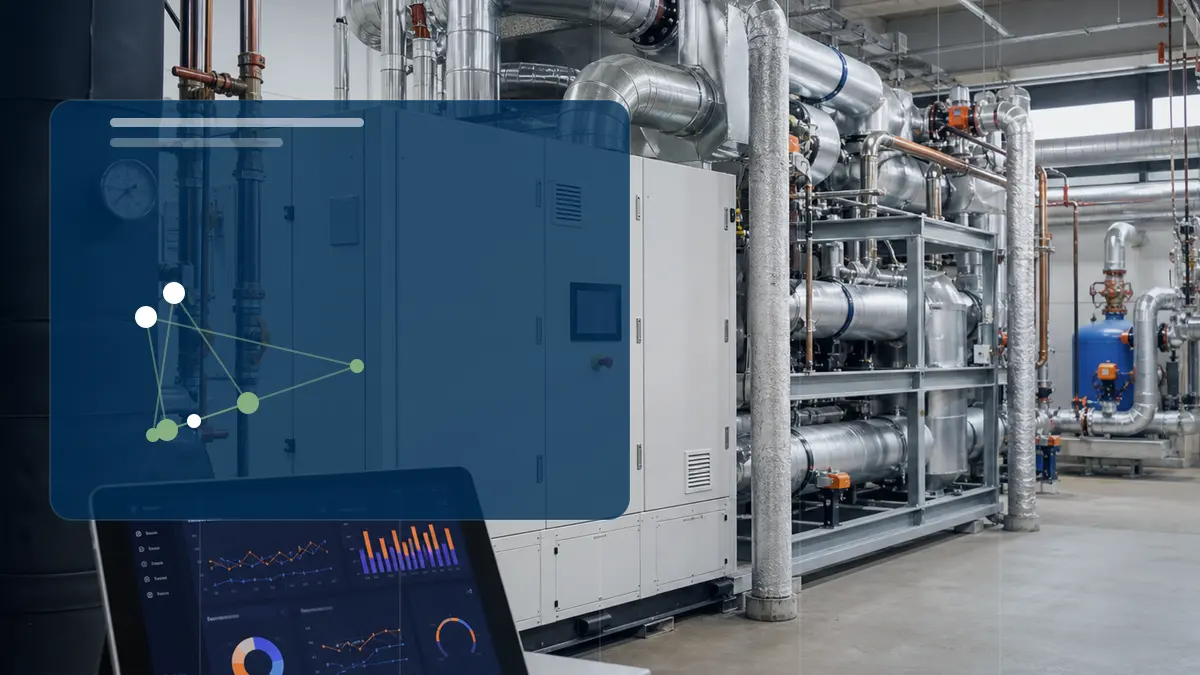
Industrial heat pump: scattered information versus Energy Intelligence
Many Dutch factories still produce their process heat with natural gas boilers. Think of a dairy company pasteurising milk, or a producer drying raw materials. Meanwhile, heat constantly leaves those same factories unused through cooling water, extraction air or the sewer. The industrial heat pump brings those two worlds together: it captures low-grade heat and turns it back into usable process heat. For businesses that want to move away from gas, this is one of the main options for electrifying heat.
- An industrial heat pump uses heat that is already there, such as waste heat from the production process itself, and lifts it to a higher temperature.
- Commercially available systems mainly deliver process heat at lower temperature levels; technology for higher temperatures and steam is being developed and tested in the Netherlands.
- A heat pump runs on electricity: check early with your grid operator whether your connection can handle the additional capacity.
Insight
Traditional approach
Information is scattered across portals, documents, invoices or separate spreadsheets.
Modern approach
Data, context and interpretation are brought together into a clear decision picture.
Decision-making
Traditional approach
Choices are made based on averages, assumptions or occasional analyses.
Modern approach
Scenarios, KPIs and current measurement data make the trade-off more concrete and repeatable.
Follow-up
Traditional approach
Actions often stay non-committal or disappear into separate reports.
Modern approach
Follow-up actions, monitoring and reporting are linked to the same energy data.
How does an industrial heat pump work?
A heat pump does not generate heat, it moves heat from a low to a higher temperature. The machine absorbs heat from a source, for example cooling water, humid drying air or outside air. An electrically driven compressor then compresses a working fluid, which raises the temperature. That lifted heat goes into the production process. Because only the compressor consumes power, more heat comes out than electricity goes in. That is the high efficiency heat pumps are known for. Efficiency is highest when the temperature difference between source and process is small. The principle is the same as a heat pump for homes or offices. The difference is scale: an industrial heat pump delivers far more capacity and higher temperatures, connected to a process instead of a heating installation.
- The heat source is often waste heat from the process itself, such as cooling water or exhausted drying air.
- An electrically driven compressor lifts that heat to the temperature the process requires.
- The smaller the temperature lift between source and process, the higher the efficiency.
- The difference with a building heat pump lies in capacity, temperature level and the link to a production process.
What does industry use heat pumps for?
Industrial heat pumps are best suited to processes with a low to medium temperature level. Think of drying, pasteurising, evaporating, distilling, cleaning and producing hot process water. These processes are common in the food industry, the paper industry and parts of the chemical sector. There the heat pump replaces the gas boiler fully or partly. Preheating is also a common route: the heat pump brings water or air up to temperature and the existing boiler only covers the final degrees or the peaks. Businesses that use waste heat from their own process as the source benefit twice: less gas is needed for heat and less cooling capacity to dispose of the waste heat. For processes that require steam, TNO and partners in the Netherlands are working on heat pumps that can deliver steam.
- Drying, pasteurising, evaporating and distilling are typical applications.
- Preheating is also possible: the heat pump does the base work, the boiler covers peaks.
- Using your own waste heat as the source also saves on cooling.
- Heat pumps for steam production are in development and being tested in the Netherlands.
What should you pay attention to?
Start with the temperature level of your process. The higher the required temperature, the smaller the range of proven heat pumps and the lower the efficiency. Then look at the heat source: is enough waste heat or ambient heat available close to the process, at the right moments? Next comes the electricity connection. A heat pump shifts energy consumption from gas to electricity, and that often requires additional connection capacity. In areas with grid congestion, upgrading a connection can take a long time, so involve your grid operator early. Integration itself requires engineering: piping, controls and usually a planned shutdown. Finally the business case. It depends strongly on the ratio between the electricity price and the gas price, and on the number of operating hours. Calculate with your own profile and check with RVO which support schemes currently apply.
- First map the temperature level and heat profile of your process.
- Check whether a suitable heat source is available close to the process.
- Ask your grid operator early whether the connection can handle the additional electrical capacity.
- Integration requires engineering and usually a planned shutdown.
- The payback period depends strongly on the ratio between electricity and gas prices.
Curious what this looks like with your own data?
In a no-obligation call, a specialist looks at your meters, sites and energy questions with you. Response within one business day.
Search the knowledge base
Find the answer to your question.
Search using your own words. Abbreviations and spelling variants are recognised, so EMS also finds the articles on energy management systems.
Topic