
Hybrid heat pump: a guide for businesses
Direct answer
A hybrid heat pump is an electric heat pump that works together with a gas-fired boiler. The heat pump delivers most of the heat, while the boiler steps in on cold days and usually provides the hot tap water. This sharply reduces gas consumption without a full switch, including in buildings with moderate insulation.
- Clear definition
- Data-driven assessment
- Risks and opportunities visible
- Practical next steps
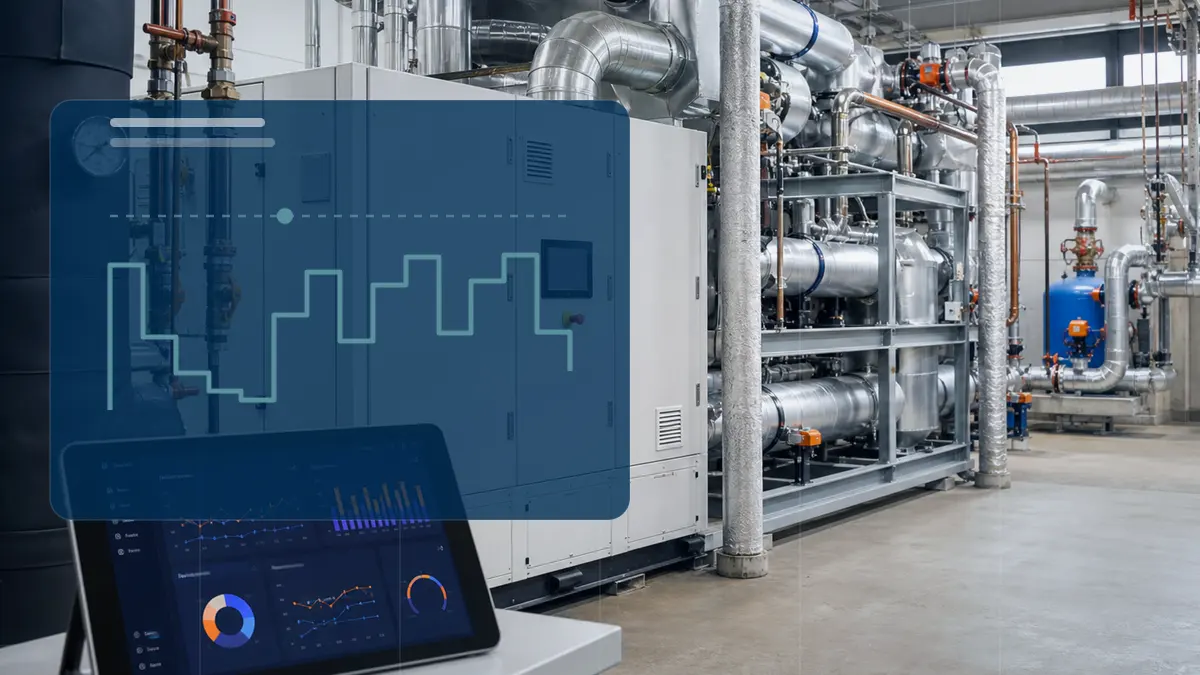
Hybrid heat pump: scattered information versus Energy Intelligence
Many Dutch buildings are still heated with a gas-fired boiler. Heating entirely without natural gas often requires substantial insulation first, and sometimes a different heat emission system. The hybrid route sits in between. Think of an office or house from the nineteen eighties: reasonably, but not perfectly insulated. A hybrid heat pump immediately lowers gas consumption there, while the familiar boiler remains available as backup. For owners who want to decarbonise without major renovation, this is often the first realistic step.
- The heat pump extracts heat from the outdoor air and runs on electricity; the boiler takes over when it is very cold outside or when a lot of heat is needed quickly.
- There is currently no obligation in the Netherlands: the earlier plan to make the hybrid heat pump the standard from 2026 when replacing a boiler was scrapped.
- Existing radiators are usually sufficient, but the heat emission system must deliver enough heat at a lower supply temperature of roughly 30 to 55 degrees Celsius.
Insight
Traditional approach
Information is scattered across portals, documents, invoices or separate spreadsheets.
Modern approach
Data, context and interpretation are brought together into a clear decision picture.
Decision-making
Traditional approach
Choices are made based on averages, assumptions or occasional analyses.
Modern approach
Scenarios, KPIs and current measurement data make the trade-off more concrete and repeatable.
Follow-up
Traditional approach
Actions often stay non-committal or disappear into separate reports.
Modern approach
Follow-up actions, monitoring and reporting are linked to the same energy data.
How does a hybrid heat pump work?
A hybrid heat pump consists of two parts working together: an electric heat pump and a gas-fired boiler. The heat pump extracts heat from the outdoor air and runs on electricity. It covers the heat demand for most of the year. When it gets very cold outside, or a room needs to warm up quickly, the boiler steps in. The boiler usually also provides the hot tap water. The control system automatically decides which appliance runs at which moment. A hybrid heat pump can often be connected to the boiler already installed; it can also be fitted together with a new boiler. For the user, day-to-day operation barely changes.
- The heat pump runs on electricity and extracts heat from the outdoor air.
- The boiler steps in on cold days and when heat is needed quickly.
- Hot tap water usually comes from the boiler.
- Connecting to an existing boiler is often possible.
Why an intermediate step, and for whom?
The hybrid heat pump is intended as an intermediate step. Fully electric heating requires a well-insulated building; a hybrid system also works with moderate insulation, because the boiler covers the peaks. Gas consumption drops sharply without major renovation. If a building is already reasonably to well insulated, a fully electric heat pump may be the better choice straight away. There is no obligation: the earlier Dutch plan to make the hybrid heat pump the standard from 2026 when replacing a boiler was scrapped. The choice is therefore voluntary. The government does encourage adoption, including through the ISDE subsidy scheme administered by RVO.
- Suitable for buildings with moderate insulation where fully electric is not yet feasible.
- Sharply lower gas consumption without a full switch or major renovation.
- No obligation: the previously announced standard from 2026 did not go ahead.
- For a reasonably to well insulated building, fully electric may fit better right away.
What should you pay attention to?
Check the heat emission system first. A heat pump heats the water to roughly 30 to 55 degrees Celsius, lower than a boiler. Radiators or underfloor heating must deliver enough heat at that temperature; otherwise the boiler steps in more often and you use more gas than necessary. Larger radiators or radiator fans often solve this. Also consider the outdoor unit: it needs a location and its fan produces noise, so choose the position carefully. Keep in mind that electricity consumption rises and that you remain partly dependent on natural gas. Anyone aiming to eliminate gas entirely will eventually arrive at insulation and a fully electric solution. Have an installer assess the situation beforehand.
- The heat emission system must deliver enough heat at a lower supply temperature.
- The outdoor unit needs a well-chosen location because of space and noise.
- Gas consumption falls, but electricity consumption rises.
- A hybrid system is not gas-free; fully electric remains the final step.
Curious what this looks like with your own data?
In a no-obligation call, a specialist looks at your meters, sites and energy questions with you. Response within one business day.
Search the knowledge base
Find the answer to your question.
Search using your own words. Abbreviations and spelling variants are recognised, so EMS also finds the articles on energy management systems.
Topic